
It’s not an understatement to say that the ability to give positive, timely and helpful feedback in the right manner at the right time can be a game changer for young athletes and differentiates the good coaches from the best coaches. As a coach with thirty years experience, I can safely say that I am always upping my “feedback game”, constantly assessing how I give feedback to my students, and adding to my “toolbox” so I can be the best I can be and offer them the best instruction and motivation possible.
Feedback in coaching is also called “Knowledge of Performance” or KP and is the term used for communicating technical information about the performance of a skill in order to help the athlete progress and improve in said skill or sport. It’s important to note that feedback works best when you are giving information about the “execution of the skill itself” and NOT the results of the performance, which is termed Knowledge of Results or KR. Knowledge of Results deals with such things as a skaters grade of execution on a jump, their overall placement in a competition, or a swimmer’s time in a race.
Why is it important that we give feedback on an athlete’s performance you ask? Well, because that is the thing that an athlete CAN CONTROL. We can’t change the points we receive from a judge for a particular jump, but we CAN work hard on the take-off of a jump so that we improve the overall jump performance, which would then increase the points we receive by default.
Feedback isn’t a one size fits all, and it’s important to remember that you have to adjust your approach to fit the learning style and personality of each individual student you work with. Over the years, I’ve found that there are a few “tried-and-true” feedback principles that have served me well as I strove to give my athletes the best I had to give.
Below is my list of the most basic principles of feedback that I’ve found to work over my coaching career. Now, I love a good psychological abstract as much as the next gal, (sarcasm intended) but for the purpose of keeping this readable and easily applicable in the field for new coaches, I will endeavor to keep these principles short and to the point.
Disclaimer: Before going any further, you should know that I have made every single mistake possible in terms of when, where and how to give feedback, and I am still a work in process. I use these particular principles because I have made countless mistakes and missteps in the feedback department and those mistakes helped me to learn what works and what doesn’t.
Addendum to disclaimer: All of these principles apply when coaching neurotypical athletes and children. Over the years I have worked closely with athletes with conditions such as ADHD, anxiety, and learning disabilities, not to mention, now I am the parent of a seven year old daughter with all of these challenges. How we give feedback to these athletes needs to be VERY different than how we work with neurotypical athletes, and I will address that in my next blog.
FEEDBACK MUST BE POSITIVE. Well……duh! Most of you experienced coaches reading this are saying this in your head, and I know it’s pretty basic, but it needs to be repeated. I can’t stress enough the importance of keeping feedback as positive as humanly possible. So, how exactly do you keep it positive? Well, I like to think in terms of ratios of positive to negative comments. And this is where it gets tricky and depends on the personality of each athlete. I’ll show you what I mean.
- If an athlete is supremely self-confident and task oriented, they respond best to one piece of positive praise to one piece of technical critique or correction. When I get athletes like this I always like to use what I call the Reverse But….. (no, this isn’t J-Lo walking backwards). It’s a well known fact that when you use the word “but” in a sentence, you are sending the listener the message that everything before the word “but” wasn’t important, but everything after is what you really think or feel. (Thanks to Dr. Phil for clarifying that in his many episodes…..he’s a font of great information…don’t get me started on his two-sides to a flapjack analogy.) So, when I have an athlete or child that responds best to the 1:1 positive/negative ratio of feedback I ALWAYS put the negative first, and I use the word “but” before the positive. So it might sound like this:
“I know that the take off of the flying camel got a little out of control because you weren’t balanced over they entry edge, but you recovered very nicely, finished the fly AND got your revs in, so good for you!”
This works like a charm, I acknowledge the mistake, therefore being honest about what we need to work on and maintaining my credibility with the athlete, but in using the word but, (see what I did there) I am subconsciously cuing them to focus on the final, positive part of my feedback.

- If an athlete needs a little more self-esteem building, but is still fairly self-confident, then I use the 2:1 positive to negative feedback ratio. I like to use the “sandwich” or “hamburger” strategy, where you sandwich a patty of correction between two yummy buns of positivity. (As I write this I’m thinking it sounds a little too suggestive for a blog about young athletes, but at least it will stick with you). An example of this would be to say something like, “wow Sally, you gave such a wonderful effort out there, I was really impressed! I think you got a little confused on the transition steps into your double flip, which slowed you down on the entry, but that’s an easy fix, and once we work on it a little more, your flip will be fantastic. Good for you! (Notice my use of the Reverse But there too…..you’re never going to look at J-Lo the same way again….sorry, not sorry;)
- If you have an athlete that needs a lot of building up, than you must increase the number of positives to every negative until you find the magic number that works for them. How do you know it’s working? Well, watch their face as you give them corrections for one, and see if they take the feedback to heart and apply it for the other. I used to have a skater that was the shyest, most sensitive little girl I have ever worked with. I LITERALLY had to give her 10 nuggets of praise for every one technical critique, and then had to follow up with at least 3 other positives. I kid you not, if I didn’t she would cry, and it got worse as she approached her teen years and closer to puberty…(damn hormones).
So to summarize the point I am making about positivity, if you want to get the most out of your athletes, and make their (and your) experience the best it can possibly be, then take the time to figure out that their magic ratio when giving feedback.
FEEDBACK MUST BE HONEST. Seriously. Kids are the best bullshit lie detectors. EVER. Look, as much as you hurt for them when they have a less than stellar performance, and you want to pump them up, your feedback MUST be sincere. If you just try to blow smoke to make them feel better, your athlete will figure it out, and you will lose credibility in their eyes.

I’ll say it again. If you are less than honest with your athletes they will know, and they will trust you less.
That doesn’t mean you have to be mean. Just be honest. If they had a bad day, acknowledge that it was a bad day. But remind them that tomorrow is another day, and make them revisit all of the technical things they CAN do well so they feel confident enough to rebound and re-group to fight again.
PRAISE IN PUBLIC, PUNISH IN PRIVATE. (clarification: I’m using the term punishment to talk about giving corrections and feedback about performance, not actual physical punishment) I’ve seen it too many times to count, and done it more than I wish to remember. How many times have you watched a group of athletes performing a routine, or a skill, or a drill, and shouted out corrections to individuals as they are performing, in front of everyone who could hear you, their peers, their parents, and anyone watching the practice.
How do you think it makes an athlete feel to get called out like that in front of everyone? How would you feel? Centering out athletes for criticism in front of their peers is humiliating for the athlete, no matter how you deliver the critique. Instead, shout out praise to individual members of the group for the skills they ARE DOING WELL. Then, AFTER the skill, drill or performance, pull each team member aside and give them some constructive feedback individually. This becomes especially important when dealing with neuroatypical athletes. More on that in my next blog.
THE WHEN IS JUST AS IMPORTANT AS THE HOW. How many times have you seen a coach yell out corrections or feedback AS their athletes are performing a skill. I do it. We all do it. Years ago, when Madonna was still socially relevant, coaches of a certain age (cough, cough) were taught that feedback should be immediate….in fact, if my aging memory is correct, I remember more than one coaching course in the 80’s touting the benefits of providing feedback within 3-4 seconds of skill acquisition. You know who instantaneous feedback benefits? You….the coach. That’s who. It makes us feel better, it makes us feel in control, and it makes us feel like we are doing something to help.
In reality, our athletes are busy processing all of the information and signals necessary to form the motor neurons necessary for that skill. Nine times out of ten, they DON’T EVEN HEAR our cues or corrections.
Think of it this way. Our bodies are supercomputers. When we want to perform a skill, we have to build the circuitry and the program required to execute that skill. If your computer has frozen, repeatedly yelling “Download now! Download now!” at it is NOT. GOING. TO. HELP. Why? Because it is still processing.
Let your athletes process in peace.
Look, I’d like to believe that when I yell out cues to my students as they are practicing a skill that it helps, and it may help in the short term, but let’s be honest……most of the time it just makes me feel more in control of the situation, and helps me channel my thoughts and nerves, especially when they are performing at a competition and it is now totally out of my control and in their hands.
I have found it is best to wait until a skill has been performed and the skater has had time to process their internal feelings and reactions to the attempt. I will ask them “how did that feel?” and I will even go so far as asking them if they had to rate that performance out of ten where they would rate it. Next, I ask my athletes if they felt there was anything they would like to fix or adjust to make it better. Only after that “de-brief” do I weigh in with my feedback, which I keep short and to the point.
WATCH YOUR BODY LANGUAGE AND FACIAL EXPRESSIONS. There’s a line in a movie called the “Upside of Anger” that sometimes reminds me of myself and my coaching style. It goes something like this: “You would try the patience of a saint, and I’m not a patient mother@#$%er.” I am one of those coaches that expects their students to be mindful. I expect them to give me 150% in our lessons, AND I also expect them to incorporate the feedback and training plans I give them into their everyday practice.
Combine that with a VERY expressive face and a very cartoon like teaching style……weeeeelllll….let’s just say when I’ve told a student for the 10,000th time to try a specific correction and they still don’t incorporate it….I feel FRUSTRATED. And my face and body can show it! It’s my coaching Achilles Heel.
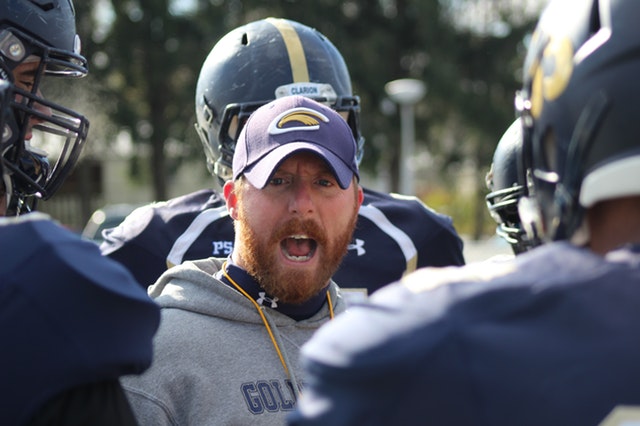
You know what. It’s okay to feel frustrated. It means that, as a coach, you care. I’ll take a coach that cares too much over one that is apathetic ANY DAY, BUT I have to be careful to not show that frustration on my face, or in my body stance or posture. Kids pick up on our facial expressions, and they can tell when we are frustrated or angry with them. No matter WHAT you are feeling on the inside, present a calm exterior. No athlete wants to feel like they have angered or disappointed their coach, it affects their self-esteem, and their motivation to take risks in the future.
FOLLOW UP. Too often, coaches give feedback or corrections to skaters, then they leave it there, expecting their skaters to incorporate it as if by magic. Remember, the younger your athlete is, the more they will need your help incorporating that feedback into their training. Give your athlete suggestions about how to apply your advice, and then FOLLOW UP with them as many times as necessary to see if they are adhering to the plan. So, it might look something like this:
“Susan! Wow, I was really impressed with the height of that salchow, AND you fully rotated it, so great job! There was a little loss of flow on the landing because you weren’t in a strong air position, and I think it is because you let your free side get out of control on the take off. What do you think about tweaking your practice plan this week to add some one foot salchow/salchow exercises to help control that? Do you think you could do that, then show me your practice plan with what days and how many times you can work on that? I know that when you spend a little time tweaking it, you’ll be more balanced on take off, and have a better air position, which will allow for more flow on the landing.”
Once I have made the skater accountable for their progress, I then make a plan to check on how they want to incorporate it. I will also CHECK through-out the week to see if they have been following their plan.
As you can see, there are many things to consider when you give feedback to your athletes, and I hope that some of my tips can help you in your coaching practice. There are so many great articles out there that can help you brush up on your feedback game, check out this one from the Coaching Association of Canada.
In my next blog, I’ll talk about how important it is to adjust your “feedback game” when working with neuroatypical athletes. From my personal experience and observations, too many coaches are unaware of how conditions such as ADHD, Learning Disabilities and Anxiety affect athletes, and how they as coaches need to change their coaching style to make modifications and accommodations for them. What’s even worse, as a parent, I’ve seen too many coaches who are unwilling to even educate themselves about what these differences are and how they can best help.
What about you? What are your best tips on giving feedback from your own experience?





 BellaZinga.Blog