Category: figure skating

  • Here’s to the Coaches

    Here’s to the Coaches

    I recently made the decision to step away from coaching. It wasn’t an easy decision to make. I have loved skating, and loved coaching for as long as I can remember. I love everything about being on the ice with my athletes, interacting with them, guiding them, planning their training, reassuring them when needed, and laughing with them.

    The simple fact is, I got TIRED. I will write more on WHY I stepped away and how I felt after I made the decision in another blog. In this one, I want to pay my respects to the many amazing coaches I have had the opportunity to work with.

    I have been incredibly lucky to practice my craft alongside some of the best coaches in the world; coaches who care, and go the extra mile for their students, time and time again. Coaches who have inspired me, challenged me, and taught me so very much. So as I step away from the world of coaching, I wanted to say a thank-you to all my fellow coaches.

    So, here’s to the coaches who give everything so that their skaters can succeed.

    Here’s to that first coach that carried us onto the ice on our first day of skating; drying our tears, wiping our noses, and picking us up over and over and over until we could, finally, get up by ourselves and stand on our own.

    Here’s to the coach that helped us develop our abilities from the very beginning, often for years, giving us the foundation we needed to excel later in our career, until we decided it was time to move on and had to say good-bye.

    Here’s to the coach who gave us that last bit of finesse, polish, and competitive push we needed to succeed at the highest levels of competition.

    Here’s to the coaches who found us a dress for our first competition when our mom forgot.

    Here’s to the coaches who lectured us on taking responsibility for packing our own skate bag, tying our own skates and bringing our own water bottle, even while re-tying our skates EVERY session for us until our fingers could FINALLY tie them on their own.

    Here’s to the coaches who spent countless hours finding program music, cutting said music, (12 hours or more for one cut, amiright?) finding or designing the perfect costume, and then, as if that wasn’t ENOUGH…. choreographing those programs.

    Here’s to the coaches who pick up students and take them to and from the rink, even though they know they shouldn’t, and are making themselves legally liable if anything happens during that drive, but if they don’t, their skater won’t be able to participate in the sport they love.

    Here’s to the coaches who find a second job, so they can afford to coach when the hours they get at their small club just won’t cut it.

    Here’s to the coaches who find a second job so they can afford to coach when the small club they work for refuses to pay them what they are worth. (You ALL know it happens.)

    Here’s to the coaches who place their skaters over their own children and family, re-scheduling family vacations, weekend get-a-ways (Ha! WHAT weekend get-a-ways?) and after-school activities to accommodate their athletes’ skating schedule.

    Here’s to the coaches who risk their marriages because their spouses don’t understand the stress of coaching and are tired of hearing us complain about work.

    Here’s to the coaches who teach in small clubs, yet somehow manage to find the off-ice programs, extra-ice, and equipment needed to help their skaters succeed even when the skaters themselves can’t afford it.

    Here’s to the coaches at large clubs who deal with competitive pressures every day and manage to navigate political waters like champs.

    Here’s to the coaches who feel like if they EVER see another hotel room again it will be too soon.

    Here’s to the coaches who desperately need that glass of wine to take the edge off after standing for 14 hours on the cold concrete at a competition and taking an emotional ride with EVERY student.

    SKATING PARENTS. Enough said.

    Here’s to the coaches who spend more than they can afford on books, seminars and courses to give their very best to their clients.

    Here’s to the coaches who stay awake at nights worrying and wondering why they just can’t get their skater to LAND. THAT. DOUBLE AXEL!

    Here’s to the coaches who don’t let the politics get them down; who stick to the plan and trust their instincts and their athletes.

    Here’s to the coaches who know when it’s time to move on and provide support and encouragement through-out all phases of a skater’s career.

    Here’s to coaches that know that while their time with an athlete may be small, their impact is great, and strive to be the best influence they can be.

    Here’s to the coaches who spend hours and hours pouring over technical announcements and strategizing program content to make sure they give their skaters the best chance they can during a competition.

    Here’s to the coaches who lessen the sting of defeat by bolstering confidence and emphasizing the lessons learned from failure.
    Here’s to the coaches who teach winning with grace and dignity, and set THAT example EVERY. SINGLE. DAY. for their skaters.

    Here’s to you coach, WE SEE YOU.

    Got any stories you want to share about how your coaches inspired you? Any funny coaching stories? Share with the class in the comments below. While you’re at it, do me a favor, and share this with your friends!


  • Sports Parents Get a Bad Rap

    Sports Parents Get a Bad Rap

    Several years ago, I signed my daughter up for the summer soccer league in town.  The price was right, and I thought it would be a good summer activity for her to try to get rid of her boundless energy. I showed up enthusiastically on the designated meet-the-coach day only to wait 30 minutes for anyone to show up at her table.  When he finally did show up, I asked him the usual questions I would normally ask any coach who is working with my daughter like:

    1.  So I assume you have played soccer before ?  (he hadn’t)
    2. How long have you been coaching (not long)
    3. What certifications do you have (minimal)
    4. Do you have a police clearance (he actually WAS a police officer, so at least there was THAT)

    The biggest observation I took away from that day was the disbelief in his voice when I actually asked him these questions.  It was obvious that no other parent had asked him these before. 

    When I got home, I spoke to my brother, who is a high school physical education teacher and who coaches (and plays) multiple sports.  He looked at me like I was crazy for asking the questions I had asked.

    I shouldn’t have been surprised. 

    I have been a figure skating coach for well over 25 years.  I am nationally certified and continue to this day to update my certifications and my coaching toolkit. I have easily worked with thousands of kids in the sport of skating, both recreationally and competitively.  I have run intense training programs and worked within our system my entire life.

    Do you know how many parents have asked me if I have a police clearance?

    Take a guess.

    None.

    What do you think about the number of parents of new students who ask me about my coaching philosophy?

    Yup, you guessed it.

    None.

    This exchange with my daughter’s former soccer coach has been foremost in my mind these past few days because I read a Facebook post from a friend entitled “Why Coaches Hate Over-Involved Parents” by Amy Carney.

    This is a well written article, carefully stating the things that parents should never debate or contact their child’s hockey coach about. Things like playing time, issues with teammates and team strategy are mentioned as basically off limits. The overall theme of the article is to let the coaches coach, the kids play, and the parents stay out of it.  It speaks to the athlete taking accountability for their actions, stepping up to be their own advocates, and proving themselves before expecting to gain playing time or their desired position.

    While I HEARTILY agree we need to make our athletes responsible, accountable and capable of communicating effectively with their coaches, I think that, ESPECIALLY IN THESE TIMES, we have to be more careful than ever with our children. 

    Look:  I have had some humdingers as sports parents.

     I mean, irrational, never-happy, always-criticizing-or-second-guessing-your methods-no-matter-HOW-much-information-you-give-them kind of parents.

    But those parents are the exception, not the rule.  And as I grew into my coaching career, I realized that the more I informed my figure skating parents of my philosophies, the more they were inclined to give me their trust.

    The more I explained the strategies, time tables and reasons behind my tactical decisions for their children, the more they left me alone to coach their children.

    So, as I read this article about how parents shouldn’t email, complain or talk to their players coach about issues, I must respectfully disagree.

    You see, coaches are people too. This means that coaches are subject to the same character flaws, foibles and behaviours that we all have, including bias, prejudice, ego, disorganization and many more not-so-great behaviours.

    Add to this that many coaches in the amateur sports systems are volunteers, and this takes away all accountability.  Don’t get me wrong.  Volunteers are a mainstay for youth sport, and I have the utmost admiration for those that give selflessly of their time for our children.  But there are good and bad volunteers. 

    And just because you volunteer to coach DOES NOT MEAN YOU GET A PASS TO DO A POOR JOB.

    I’m sorry, if my 10 year old child feels that their coach is biased against them, and has done everything in their power to work hard, advocate for themselves, speak up and earn their spot, and I see there is a discrepancy between either their skills and their playing time, or perhaps an unfair allotment of playing time,  why shouldn’t I ask the coach in a polite email to explain their strategy and why they aren’t playing my child?

    If my child feels they aren’t being heard or worse, are being ignored or disrespected, it’s our job as caring adults to help them navigate those tricky waters.

    And as a coach that spends hours sending out information, newsletters, and videos, as well as organizing and sitting in countless meetings with parents and coaching colleagues, shouldn’t that coach have gone the extra distance to share his/her strategy of who she/he is selecting and why?  Shouldn’t that coach have called for a parent meeting with regard to his/her coaching philosophies at the beginning of the year, so all members of the team are on the same page and know what is expected of them? 

    I have an eight-year-old daughter who is in her fourth year of competitive dance at her dance studio.  Dance is her happy place, and she excels at it.  But she has been bullied continuously at school and has developed low self-esteem and continuous anxiety because of the exclusion and ostracism.  She also has ADHD, anxiety, possible sensory processing issues and poor executive functioning, not to mention giftedness, so social cues are difficult for her to read.

    So, you had better believe that if I see behaviour from her dance teachers that runs contrary to creating a positive learning environment, and it happens continuously, I am going to speak up. 

    Because that’s my job as her parent.  To make sure she is safe both physically and mentally at the one place she feels strong and powerful and confident, so she can continue to have a positive learning experience with this one area of her life.

    I can assure you that verbal abuse, emotional abuse and yes, physical and sexual abuse are rampant in our sport system.  As I write this, I can think off-hand of at least two rumors of high level coaches who have slept with their athletes, albeit, when these athletes were of age of consent, but still, the imbalance of power is the issue.

    Coaches are in a complete and absolute position of power over our children, whether on the field, the court or on the ice. So much happens that we as parents don’t see, or can’t hear, or can’t feel because we aren’t on the field of play with our children. 

    But too often, we don’t support our children if they “feel” something is off.

    As a young athlete who experienced emotional abuse and transactional coaching (find out how transactional and transformational coaching differ by reading my book report on InsideOut Coaching) when I was younger, I can assure you, we (young athletes) don’t share everything our coaches say and do because of the power they have over us. 

    Shame and fear convince young athletes that they deserve to be pushed aside, or told they aren’t worthy. And this can and DOES create trauma as they grow older.

    Blindly thinking that we can trust coaches in any sport system without following up and asking questions about strategy, tactics, philosophies, or just asking why they were hard on our child today can lead to this:

    Larry Nassar

    And this (Graham James)

    And this (Bertrand Charest)

    And this (Richard Callaghan)

    Look, no coach likes to be second guessed.  But for the most part, all a parent wants is information and communication.  As a former elite athlete, an experienced competitive coach and a mother of a competitive dancer, I think it is dangerous to suggest that we muzzle communication between coaches and parents.

    Parents can be our biggest allies as coaches.  It is OUR job as coaches to figure out how to communicate effectively with them, set the parameters for expectations for them and what they can expect from us, and create a positive learning environment.

    If a coach has done all these things, then I find the incidence of problematic parent behaviour tends to decrease dramatically.

    So how about we stop giving parents a bad rap?  And maybe do a better job as coaches educating, informing and looking at our own behaviours before we start pointing fingers outward.

    If we work together and make parents feel part of the team, then everyone benefits.

    If you enjoyed this post, do me a favor, share it and follow me!

    Feel free to share your parent or coaching stories in the comments below!

  • Coaching Advice to My Younger Self

    Coaching Advice to My Younger Self

    I have a couple of little skaters competing in a competition this weekend in the Star 1 category.  This is the first time competing for one of them, and the other has only competed once previously.  I always look forward to these competitions with my littlest skaters because they are such a great opportunity to have fun and learn so much about themselves as people and athletes.

    My skaters are ready.  They have been fully prepped on the elements they need to perform.  We have worked extensively on knowing what they need to do to get the highest marks, and we have emphasized the small details like presentation and finesse.

    I’ve sent out emails double checking and verifying schedules with their parents, as well as our competition check list so they have a concrete list they can use to help them organize themselves.

    In short, we are fully prepared to handle just about anything that may or may not happen on the day, and it’s a good feeling to know that all the HARD work is done and now they get to simply go and enjoy their skate.

    As the weekend draws closer, I can’t help but think back to all the other competitions at the many different levels I have attended.  It’s been a rewarding and exciting coaching journey so far, and I hope it continues forever.  As I look back this week, I am realizing how much I have changed as a coach from the mistakes I have made and the experiences I have been lucky enough to share with my students.

    If I could go back in time and give advice to my younger coaching self as she was starting out, here are the things I would tell her.

     The Longer You Coach, the More You Will Realize You Know NOTHING About Coaching

    Our sport is ever evolving and always changing, a statement fully illustrated by the infuriating number of updates we must read and study each year as the never-ending list of amendments filter down to us from the powers that be. Just when you think you have the rules memorized for spin, jump or program requirements for a level, they will change. 

    Get used to it and stop stressing about it.

    Also, there will ALWAYS be new techniques to learn for each skill you teach.  Someone, somewhere will come up with a new exercise, or a new way of packaging an old technique that will be ALL the rage for a few years.  Embrace it, learn it, add it to your coaching tool kit, but do NOT forsake all the old techniques, they are useful too. The more you can pull out of your toolbox when you are in the field, the better you will be able to get results from your athletes.

    There is NO Right Way or Wrong Way to Teach a Skill

    Of course, the basic bio-mechanical principles and the laws of physics will hold true for everything you teach.  What I’m talking about are the coaches that steadfastly teach their jumps (or spins, or field moves, or any other skill) one way, and will not attempt to modify their approach if it isn’t working.  If you have tried for 4-6 weeks (which coincidentally is about the length of time of a small to average macrocycle when you start to periodize your training)  to make progress with a student in a jump, spin or any other element, and it’s not happening, then you had better find another way to teach it, describe it, or show it to that student. 

    I am going to tell an athlete whatever it takes to get results in that skill, no matter how wacky it may sound.  Why?  Well…this is where the next point is important.

     Every Student is Different, and You Must Adapt Your Instruction and Teaching Style Accordingly

    Well, DUH, you are probably thinking.  But this point is SO important it bears repeating often and adamantly.

    No two students are alike and will differ in every possible way: from size, to shape, to muscle fibre type, to learning styles, to aggressiveness, to their stage of development, to how quickly they process information, to how sensitive they may be, to confidence, to anxiety levels, to kinesthetic awareness, to strength to flexibility…..and on…..and on…..and on….

    So why on earth would you teach the same thing in the same way to each student. The answer is, you can, but it won’t get you results from each student. 

    Some students I am loud, vivacious, gregarious and jokey with and they respond to this teaching style. I may teach an axel with an “h” position on the take off simply because when I teach the karate kick or get-on-the-horse method they aren’t bringing the free knee through at all.

    Some students I am serious, firm but kind with and this is the teaching style that works best with them.  And I may teach the axel to these students by telling them not to move their free leg at all because they can’t control the swing or the trajectory of it and that’s the technique that works best for them.

    Others are extremely sensitive, and I must treat ever-so-softly so they are nurtured and supported every step of the way.  And you know what?  I may teach the axel in a completely different way to these students if that is what they require to attain proficiency in the skill.

    It’s your job to adapt to them, not their job to adapt to you.

     Some Students and Parents (and even other coaches) Will Love you, Some Will Hate You, and That’s OK

    You be you.  Keep growing, learning and striving to be the best coach you can be and the best person you can be.  Learn from your mistakes, but don’t beat yourself up about them, just own them and do better next time. Identify and work with the people who you respect and who respect you. 

    As for the rest?  Don’t sweat it, there are enough students out there to keep every coach busy, and frankly, if someone doesn’t like you and see all you have to offer, it’s their loss.

     Change is Part of The Game

    If you are lucky, you will have the honor of guiding some of your skaters for a long period of time. Some  for a decade or more.  But, this is not the norm.  As our sport evolves, skaters change coaches more and more.  This is simply how the learning process works.  Spend the time you have with each of your charges wisely.  Do your best, teach them to the best of your abilities, support them and help them grow as people and wish them well when they move on.  The best feeling in the world is to look back on your time with an athlete and KNOW that you gave them the best you had to give. 

     Set Your Boundaries Early and Be Firm

    From finances, to free time, to discipline on the ice.  It is EASY to be EASY and HARD to be HARD.  Always start out being FIRM.  Set rules for payment, fees, discipline, and expectations early and CLEARLY in your relationships.  Follow these rules and do not allow your parents or your students to take advantage of them.

    Too often you will want to overlook money owed to you, or bad behaviour on the ice because you want to help others, even at your own expense.

    DON’T.

    It is human nature to push boundaries.  Students will act out as much as they can to test their boundaries.  Parents will allow an invoice to go unpaid as often as they can until you impose restrictions on your time or late fees because of it.  An executive will pay you as little as they can get away with because it will help the bottom line for their club IF YOU ALLOW IT. Speak up, set the rules and stick with them.  Trust me, this will save you untold amounts of grief and financial hardship.

     Skating Ain’t Life, Find Other Interests

    You can love skating, you can love coaching, but you had better work hard to find other interests in your life outside of skating.  It is too easy to be caught up in the drama that seems to always go hand in hand with our sport and our profession. 

    But there is so much in this world that is so much more important. 

    Spend time with your friends.  Cherish your family time and guard it zealously. Find your tribe of coaches you trust and when you get together, make sure you talk about things OTHER than skating. Find a balance in your life and work hard to maintain it.  This will keep you a more grounded and happier person and a better coach in the long run.

    These are a few of the things I WISH I had known when I first started coaching all those many years ago.  As my journey continues, I look forward to the new lessons I will learn and the students I will get to meet.

    What advice would you give your younger self about coaching? Share below in the comments!

  • SUPERS.T.A.R GOAL SETTING:                                         A step by step primer on how to set your goals for figure skating or dance.

    SUPERS.T.A.R GOAL SETTING: A step by step primer on how to set your goals for figure skating or dance.

    Part One: Setting your Goals

    “Plan the work, and work the plan.”

    The first step on any journey is to know where you are going. 
    Goal setting is the first step on your journey in skating!

    Learn How to Goal Set Like a SuperS.T.A.R.

    S.T.A.R. stands for:

    Specific: You can’t achieve it if you can’t describe it in detail! Break your goal down into manageable chunks, and attack it one chunk at a time.

    Trackable: If you can’t measure it so you can keep track of it you won’t know when you’ve achieved it. Make sure each goal has a quantity attached, or a quality, as well as a time element. These things will  help you track your progress.

    Attainable:  I’d like to play in the NBA.  I’m 5’4” and can’t jump high. I’m also 50 years old. Even if I could quit my job and train 5 days a week to get a great jump shot, I will never grow any taller. 


    My goal of playing in the NBA is NEVER going to happen.  Enough said.

    Realistic: It may be attainable, but are you willing to put in the work and make the sacrifices to make it happen?  THIS is when it gets real.

    As we work through our goal setting process together, I am going to ask you to always come back to these principles. 

    Ask your self constantly, is this goal specific, is it trackable, is it attainable, and is it realistic. If not, adjust your goal to make it so.

    GOAL SETTING IS A SKILL, THE MORE YOU PRACTICE IT, THE BETTER YOU GET!

    SuperS.T.A.R. Goal Setting Strategy

    The first step in any goal setting process is sometimes the scariest.  You have to DARE to dream. Don’t worry about anyone making fun of you.  These are your dreams, and you’re allowed to have them!

    So, when you dream about skating, where do your dreams take you?

    Use the space below to write out some of your dreams when it comes to your skating:

    Now that you’ve dared to dream, you have to do something even harder.  You have to ask yourself some hard questions about your dream.

    ACTIVITY #1: Try using these questions to help you assess if your dream is realistic.
    (Using a blank piece of paper, spend some time thinking of the answers to the questions
    , and write them down.

    1. How realistic is this goal?  Check out the internet, google how many people have achieved it. Read about their journey, find out how long it took them and the obstacles they encountered.

    2. Am I really ready to make the changes necessary in my life to achieve this goal?

    3. Am I ready to make sacrifices along the way to achieve this goal?

    4. Am I ready mentally to handle the ups and downs/successes and failures I will encounter along the way as I work toward this goal?

    5. Will I have a good support system around me to help me achieve this goal? This includes, family, friends, coaches and teachers.

    6. Are the necessary facilities and coaching readily available in my area to achieve this goal, or do I have to look elsewhere for them?

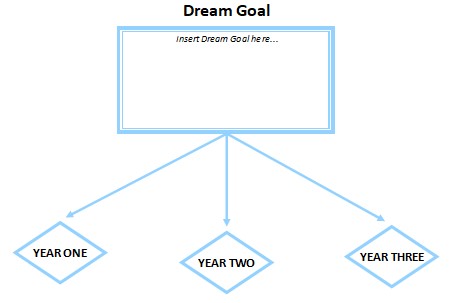
    For our next step, take a look at the picture below and insert your DREAM GOAL.

    Now divide your dream goal up into do-able chunks by years to start.  We will use a three year plan here, but anything goes! Take some time and list the things you need to accomplish along the way to get there.

    Year One:  Steps Necessary to Achieve Your Dream Goal

    Year Two:  Steps Necessary to Achieve Your Dream Goal

    Year Three:  Steps Necessary to Achieve Your Dream Goal

    Note:  If you need more years to break your dream goal down, use a blank piece of paper or a journal to write down your thoughts.

    We’ve spent all this time thinking about our goals, and breaking them down into yearly steps, or increments.  So far so good!

    Here’s the next step:

    Now that we’ve painted in the larger strokes of our goal setting, it is time to follow our SuperS.T.A.R. guidelines once again and get even more specific.  For this phase, you now need to do your research, chat with your coaches and parents, and find out a whole lot of information.

    ACTIVITY #2: Using the Yearly Planning chart found after these questions, we are going to plan the dates and major events for each season. 

    Things you will need to know, or at least have a rough idea of are:

    · Start and end dates for each season. Make sure to start with the month that your year starts in, if you are competitive and skate/dance year round, this would be May/June  If not, this might be September/October.

    · Major life events, such as holidays, school trips, exams, or anything else that may require some of your time and focus away from skating (these are called INTERVENING VARIABLES) and you need to plan for them whenever possible and adjust your training schedule accordingly.

    · Test Days/Exam Days

    · Competitions—these can be divided into two groups:

    1. TRAINING competitions: where the whole idea is to go and get some feedback.  This means you will not be varying your training overly much to produce what we call a “peak”

    2. QUALIFYING competitions: These competitions are the priority, where you will be adjusting your training leading up to the event in order to help you feel ready and rested so you have every chance to turn in your absolute best performance. Put a star beside these on your Yearly Planning Chart!

    · Choreography, when is the best time for you to start working on new programs?

    · Dates you set aside in order to check your equipment, such as if you need your skates sharpened, or if you need new skates or dance shoes, or a new costume.

    · Dates you set aside to monitor your progress. (More on this a little later)

    These dates will help you as you plan your training for each season, so circle the important ones on the Yearly Planning Chart so you know when they are coming and where they sit in your year.

    Yearly Planning – Important Dates

    Year:   

                            The Importance of Assessment Days    


    Before we move on, we need to remember a crucial part of goal setting and planning:  ASSESSMENT DAYS!

    These are the days that you SPECIFICALLY SET ASIDE so you can go back through your week, month, season, or year, and take stock of how you did.

    This is part of what we call SELF-MONITORING – which is the ability for you to look at your strategy, and “tweak it as you go” so you can be more successful.

    Those people who are able to look at their strategies, analyse them, and tweak them are the people who end up seeing the most success and happiness in their careers.

    So, how do we know if we’ve achieved our goals?

    Ask yourself these questions:

    · Did you pass the tests/exams you had wanted to?

    · Did you achieve the performances you wanted to?

    · What about the specific elements in your skating or dancing, did you achieve those in the time frame you wanted to?

    IF YES, CONSIDER THESE THINGS:

    Did you achieve these things right on time, or WAY ahead of the time frame you allowed yourself? Did you feel a sense of accomplishment with your goals? If you achieved your goals too easily, you might want to make your next set of goals a little more difficult.   

    If you don’t challenge yourself, you limit your ability to grow and really see what you can do!

    IF NO, CONSIDER THESE THINGS:

    WHY didn’t you achieve the goals you wanted to accomplish? What do you need to change in terms of time, effort or strategies in order to complete these goals?

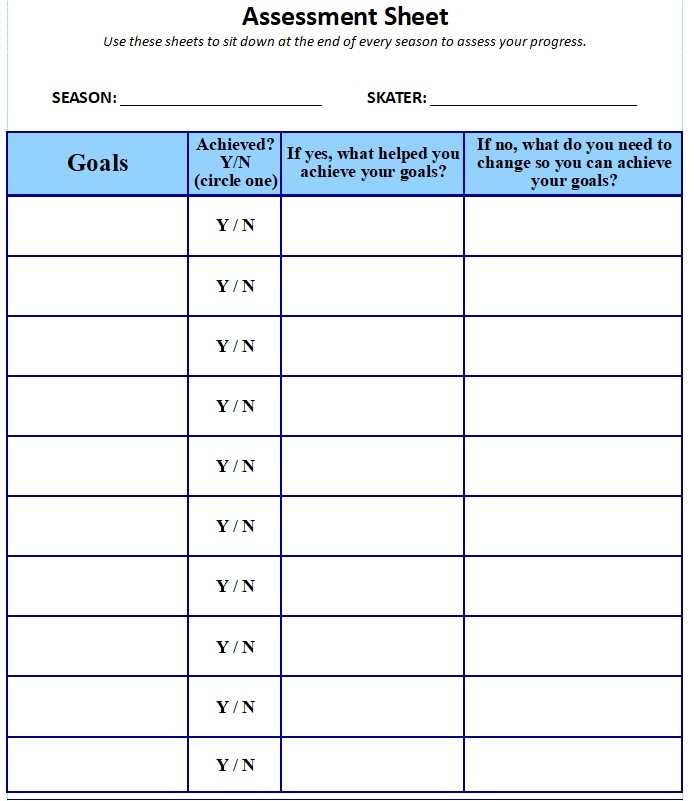
    Use failure to achieve goals as FUEL for the next round, and be more realistic in your next round of goal setting! There are assessment sheets at the back of this module, use them after every season!

    Now that we have our list of important dates, we can move forward with breaking down our first year!

    AGAIN: It’s important to  pick the season where your year starts.  Example, for a competitive skater, the year starts in the spring.  For a recreational skater, your year may start in the summer if you summer skate, or in the fall if you do not.  This is where it’s important to know what you can give and commit  in order to make your dreams come true. We are going to pick YEAR ONE.

    ACTIVITY #3: Using the following template, break into groups, or pairs and help each other fill out ONE TEMPLATE PER SEASON.

    Use this template to write out your goals for each season.  Take your time and really break things down.

    Hint:  It helps to work backwards, if you know you want to be able to land an axel 3/3 attempts by your third skating season, (if you only skate three seasons a year) then by the end of your second season you should be able to land 2/3 axels clean and by the end of the first, you should aim for 1/3 landed.

    SEASON ONE:                    

    Date Begins:                                        # of Weeks:                          

    TEST GOALS:                                                                                                                                                                        

    COMPETITIVE GOALS:

    PROCESS GOALS: (goals you want to achieve as you work every day toward your larger goals)

    JUMP ELEMENTS:

    SPIN ELEMENTS:

    PROGRAMS:

    OTHER:

    EQUIPMENT/COSTUME NEEDS:

    INTERVENING VARIABLES:

    (these are things that may disrupt your training, like exams, vacations, etc, so adjust your goals accordingly)


    As you set out your goals for each season, make sure to revisit your SuperS.T.A.R. goal setting guidelines!

    Now that you have all of your goals for every season planned out, the next step is to use these goals to break down each season into monthly and weekly sections so you can more easily keep track of your progress and you can adjust your training as you go.

    Keep your eyes peeled for the “SuperS.T.A.R. Goal Setting Part Two” blog when it comes out for more information about how to organize your skating or dancing year so you can be the best skater you can be!

    Note:  make sure that at the end of every season you sit down either by yourself, in a group or with your coach and use the assessment sheet template provided below to really see how you’re doing, what’s going really well, and what you can do better. 

    Assessment days are a real opportunity to gain valuable feedback about your training and how you can tweak it to progress faster!

    I hope this blog and the goal setting ideas and exercises help you to better plan your skating or dancing journey, and help you enjoy the ride! Remember, these principles apply to any sport, and can easily be applicable for competitive cheerleading and gymnastics too!

    Do you have any helpful goal setting tips you’ve used for your athletes? If you’re an athlete, what works best for you in terms of goal setting?

  • Feedback: The Highs, the Lows and the In-Betweens

    Feedback: The Highs, the Lows and the In-Betweens

    It’s not an understatement to say that the ability to give positive, timely and helpful feedback in the right manner at the right time can be a game changer for young athletes and differentiates the good coaches from the best coaches. As a coach with thirty years experience, I can safely say that I am always upping my “feedback game”, constantly assessing how I give feedback to my students, and adding to my “toolbox” so I can be the best I can be and offer them the best instruction and motivation possible.

    Feedback in coaching is also called “Knowledge of Performance” or KP and is the term used for communicating technical information about the performance of a skill in order to help the athlete progress and improve in said skill or sport. It’s important to note that feedback works best when you are giving information about the “execution of the skill itself” and NOT the results of the performance, which is termed Knowledge of Results or KR. Knowledge of Results deals with such things as a skaters grade of execution on a jump, their overall placement in a competition, or a swimmer’s time in a race.

    Why is it important that we give feedback on an athlete’s performance you ask? Well, because that is the thing that an athlete CAN CONTROL. We can’t change the points we receive from a judge for a particular jump, but we CAN work hard on the take-off of a jump so that we improve the overall jump performance, which would then increase the points we receive by default.

    Feedback isn’t a one size fits all, and it’s important to remember that you have to adjust your approach to fit the learning style and personality of each individual student you work with. Over the years, I’ve found that there are a few “tried-and-true” feedback principles that have served me well as I strove to give my athletes the best I had to give.

    Below is my list of the most basic principles of feedback that I’ve found to work over my coaching career. Now, I love a good psychological abstract as much as the next gal, (sarcasm intended) but for the purpose of keeping this readable and easily applicable in the field for new coaches, I will endeavor to keep these principles short and to the point.

    Disclaimer: Before going any further, you should know that I have made every single mistake possible in terms of when, where and how to give feedback, and I am still a work in process. I use these particular principles because I have made countless mistakes and missteps in the feedback department and those mistakes helped me to learn what works and what doesn’t.

    Addendum to disclaimer: All of these principles apply when coaching neurotypical athletes and children. Over the years I have worked closely with athletes with conditions such as ADHD, anxiety, and learning disabilities, not to mention, now I am the parent of a seven year old daughter with all of these challenges. How we give feedback to these athletes needs to be VERY different than how we work with neurotypical athletes, and I will address that in my next blog.

    FEEDBACK MUST BE POSITIVE. Well……duh! Most of you experienced coaches reading this are saying this in your head, and I know it’s pretty basic, but it needs to be repeated. I can’t stress enough the importance of keeping feedback as positive as humanly possible. So, how exactly do you keep it positive? Well, I like to think in terms of ratios of positive to negative comments. And this is where it gets tricky and depends on the personality of each athlete. I’ll show you what I mean.

    • If an athlete is supremely self-confident and task oriented, they respond best to one piece of positive praise to one piece of technical critique or correction. When I get athletes like this I always like to use what I call the Reverse But….. (no, this isn’t J-Lo walking backwards). It’s a well known fact that when you use the word “but” in a sentence, you are sending the listener the message that everything before the word “but” wasn’t important, but everything after is what you really think or feel. (Thanks to Dr. Phil for clarifying that in his many episodes…..he’s a font of great information…don’t get me started on his two-sides to a flapjack analogy.) So, when I have an athlete or child that responds best to the 1:1 positive/negative ratio of feedback I ALWAYS put the negative first, and I use the word “but” before the positive. So it might sound like this:

    “I know that the take off of the flying camel got a little out of control because you weren’t balanced over they entry edge, but you recovered very nicely, finished the fly AND got your revs in, so good for you!”

    This works like a charm, I acknowledge the mistake, therefore being honest about what we need to work on and maintaining my credibility with the athlete, but in using the word but, (see what I did there) I am subconsciously cuing them to focus on the final, positive part of my feedback.

    • If an athlete needs a little more self-esteem building, but is still fairly self-confident, then I use the 2:1 positive to negative feedback ratio. I like to use the “sandwich” or “hamburger” strategy, where you sandwich a patty of correction between two yummy buns of positivity. (As I write this I’m thinking it sounds a little too suggestive for a blog about young athletes, but at least it will stick with you). An example of this would be to say something like, “wow Sally, you gave such a wonderful effort out there, I was really impressed! I think you got a little confused on the transition steps into your double flip, which slowed you down on the entry, but that’s an easy fix, and once we work on it a little more, your flip will be fantastic. Good for you! (Notice my use of the Reverse But there too…..you’re never going to look at J-Lo the same way again….sorry, not sorry;)
    • If you have an athlete that needs a lot of building up, than you must increase the number of positives to every negative until you find the magic number that works for them. How do you know it’s working? Well, watch their face as you give them corrections for one, and see if they take the feedback to heart and apply it for the other. I used to have a skater that was the shyest, most sensitive little girl I have ever worked with. I LITERALLY had to give her 10 nuggets of praise for every one technical critique, and then had to follow up with at least 3 other positives. I kid you not, if I didn’t she would cry, and it got worse as she approached her teen years and closer to puberty…(damn hormones).

    So to summarize the point I am making about positivity, if you want to get the most out of your athletes, and make their (and your) experience the best it can possibly be, then take the time to figure out that their magic ratio when giving feedback.

    FEEDBACK MUST BE HONEST. Seriously. Kids are the best bullshit lie detectors. EVER. Look, as much as you hurt for them when they have a less than stellar performance, and you want to pump them up, your feedback MUST be sincere. If you just try to blow smoke to make them feel better, your athlete will figure it out, and you will lose credibility in their eyes.

    I’ll say it again. If you are less than honest with your athletes they will know, and they will trust you less.

    That doesn’t mean you have to be mean. Just be honest. If they had a bad day, acknowledge that it was a bad day. But remind them that tomorrow is another day, and make them revisit all of the technical things they CAN do well so they feel confident enough to rebound and re-group to fight again.

    PRAISE IN PUBLIC, PUNISH IN PRIVATE. (clarification: I’m using the term punishment to talk about giving corrections and feedback about performance, not actual physical punishment) I’ve seen it too many times to count, and done it more than I wish to remember. How many times have you watched a group of athletes performing a routine, or a skill, or a drill, and shouted out corrections to individuals as they are performing, in front of everyone who could hear you, their peers, their parents, and anyone watching the practice.

    How do you think it makes an athlete feel to get called out like that in front of everyone? How would you feel? Centering out athletes for criticism in front of their peers is humiliating for the athlete, no matter how you deliver the critique. Instead, shout out praise to individual members of the group for the skills they ARE DOING WELL. Then, AFTER the skill, drill or performance, pull each team member aside and give them some constructive feedback individually. This becomes especially important when dealing with neuroatypical athletes. More on that in my next blog.

    THE WHEN IS JUST AS IMPORTANT AS THE HOW. How many times have you seen a coach yell out corrections or feedback AS their athletes are performing a skill. I do it. We all do it. Years ago, when Madonna was still socially relevant, coaches of a certain age (cough, cough) were taught that feedback should be immediate….in fact, if my aging memory is correct, I remember more than one coaching course in the 80’s touting the benefits of providing feedback within 3-4 seconds of skill acquisition. You know who instantaneous feedback benefits? You….the coach. That’s who. It makes us feel better, it makes us feel in control, and it makes us feel like we are doing something to help.

    In reality, our athletes are busy processing all of the information and signals necessary to form the motor neurons necessary for that skill. Nine times out of ten, they DON’T EVEN HEAR our cues or corrections.

    Think of it this way. Our bodies are supercomputers. When we want to perform a skill, we have to build the circuitry and the program required to execute that skill. If your computer has frozen, repeatedly yelling “Download now! Download now!” at it is NOT. GOING. TO. HELP. Why? Because it is still processing.

    Let your athletes process in peace.

    Look, I’d like to believe that when I yell out cues to my students as they are practicing a skill that it helps, and it may help in the short term, but let’s be honest……most of the time it just makes me feel more in control of the situation, and helps me channel my thoughts and nerves, especially when they are performing at a competition and it is now totally out of my control and in their hands.

    I have found it is best to wait until a skill has been performed and the skater has had time to process their internal feelings and reactions to the attempt. I will ask them “how did that feel?” and I will even go so far as asking them if they had to rate that performance out of ten where they would rate it. Next, I ask my athletes if they felt there was anything they would like to fix or adjust to make it better. Only after that “de-brief” do I weigh in with my feedback, which I keep short and to the point.

    WATCH YOUR BODY LANGUAGE AND FACIAL EXPRESSIONS. There’s a line in a movie called the “Upside of Anger” that sometimes reminds me of myself and my coaching style. It goes something like this: “You would try the patience of a saint, and I’m not a patient mother@#$%er.” I am one of those coaches that expects their students to be mindful. I expect them to give me 150% in our lessons, AND I also expect them to incorporate the feedback and training plans I give them into their everyday practice.

    Combine that with a VERY expressive face and a very cartoon like teaching style……weeeeelllll….let’s just say when I’ve told a student for the 10,000th time to try a specific correction and they still don’t incorporate it….I feel FRUSTRATED. And my face and body can show it! It’s my coaching Achilles Heel.

    You know what. It’s okay to feel frustrated. It means that, as a coach, you care. I’ll take a coach that cares too much over one that is apathetic ANY DAY, BUT I have to be careful to not show that frustration on my face, or in my body stance or posture. Kids pick up on our facial expressions, and they can tell when we are frustrated or angry with them. No matter WHAT you are feeling on the inside, present a calm exterior. No athlete wants to feel like they have angered or disappointed their coach, it affects their self-esteem, and their motivation to take risks in the future.

    FOLLOW UP. Too often, coaches give feedback or corrections to skaters, then they leave it there, expecting their skaters to incorporate it as if by magic. Remember, the younger your athlete is, the more they will need your help incorporating that feedback into their training. Give your athlete suggestions about how to apply your advice, and then FOLLOW UP with them as many times as necessary to see if they are adhering to the plan. So, it might look something like this:

    Susan! Wow, I was really impressed with the height of that salchow, AND you fully rotated it, so great job! There was a little loss of flow on the landing because you weren’t in a strong air position, and I think it is because you let your free side get out of control on the take off. What do you think about tweaking your practice plan this week to add some one foot salchow/salchow exercises to help control that? Do you think you could do that, then show me your practice plan with what days and how many times you can work on that? I know that when you spend a little time tweaking it, you’ll be more balanced on take off, and have a better air position, which will allow for more flow on the landing.”

    Once I have made the skater accountable for their progress, I then make a plan to check on how they want to incorporate it. I will also CHECK through-out the week to see if they have been following their plan.

    As you can see, there are many things to consider when you give feedback to your athletes, and I hope that some of my tips can help you in your coaching practice. There are so many great articles out there that can help you brush up on your feedback game, check out this one from the Coaching Association of Canada.

    In my next blog, I’ll talk about how important it is to adjust your “feedback game” when working with neuroatypical athletes. From my personal experience and observations, too many coaches are unaware of how conditions such as ADHD, Learning Disabilities and Anxiety affect athletes, and how they as coaches need to change their coaching style to make modifications and accommodations for them. What’s even worse, as a parent, I’ve seen too many coaches who are unwilling to even educate themselves about what these differences are and how they can best help.

    What about you? What are your best tips on giving feedback from your own experience?

  • Skating Clubs: What Makes a Good Executive?

    Skating Clubs: What Makes a Good Executive?

    A skating club executive sets the tone for the rest of its membership; how the people on the executive treat each other, the skaters, the coaches and the parents who participate in their club determines the climate and culture for the entire organization.

    I have noticed over my years teaching in many different clubs there are certain things that successful club executives have in common. 

    After compiling a list, I’ve whittled it down to ten important traits for any skating club executive to create, grow a and nurture a positive and successful culture.

    •  They Listen

    Successful club executives listen to their membership.  Even if they don’t agree with everything they hear, they are always ready to listen, understand and empathize.  To know that your opinion is respected and valued by those at the highest level of any organization is a powerful thing.  It fosters good will from all members and encourages them to have more ownership in the direction and success of that organization.

    • They Know They Don’t Know Everything

    Successful club executives realize they don’t know everything about figure skating, and that’s okay. A healthy Board of Directors is always willing to learn new things and grow in new directions, and they aren’t afraid to ask for help and advice, particularly utilizing the extensive knowledge found within their coaching staff.  If the people at the top levels of the organization have a growth mindset, this will filter down to all levels of membership. Check out more about Mindset by reading my book review here

    •  They Don’t Lose Sight of the Forest for the Trees

    A successful club executive realizes that sometimes the spirit of the law is more important than the letter of the law.  Sometimes, blind adherence to rules and regulations that restrict an athletes’ ability to gain the ice time they need or participate in the programs necessary to progress can be detrimental to skaters, coaches and the health and longevity of the club in general.  The bigger picture must always be taken into consideration.

    •  They Defer to the Coaches in All Things Skating

    Would you go to your child’s school and sit in on the teacher’s class, critiquing the curriculum and their teaching methods?  A strong executive doesn’t micromanage their coaching staff.  They allow them to develop and implement the programs as they see fit, and they support them along the way.  When coaches feel valued and appreciated, their loyalty, commitment, and job appreciation grows exponentially.

    •  They Do their Jobs Well

    If a skating club is to be run well, those at the executive level must know the roles and responsibilities of their positions and execute those duties efficiently.  This means attending meetings regularly, and educating themselves in the role they have been elected for. When everyone knows what they are supposed to do, a club runs at maximum efficiency.

    •  They Communicate Regularly and Effectively

    A strong youth organization will spare no expense to communicate to its members in a timely, organized and knowledgeable fashion.  When people have the information they need, before they even realize they need it, they trust that their needs are being met and are more likely to stick with that organization.  Knowledge of procedures, registration dates, session regulations, etc. creates a feeling of security and control and makes for a club that runs like a well-oiled machine.

    •  They Acknowledge and Reward Good Work

    There’s nothing worse than feeing like you are not seen, heard or valued for your efforts and contributions.  Those clubs that recognize initiative, creativity, dedication, hard work and loyalty create a workplace for coaches and a training environment for athletes that is dynamic, supportive and positive. This positivity and support encourages people to continue stepping outside of the box, creating new programs and initiatives that further the sport.  In short, positivity breeds positivity, creating a self-fulfilling prophecy in any organization.

    • They Always Look at the “Big Picture”

    Call it vision, call it a mission statement, but whatever you call it, it matters.  A successful board of directors of any skating club will spend some time on creating a shared vision for it’s members, and they revisit this vision on a regular basis, making sure to communicate this mandate to their membership often and consistently.  Every decision must then be compared with the goals and philosophy of the club’s vision, and every decision must benefit as many people as possible.  It sounds like a simple thing, but having a shared vision is vital to the longevity, growth and success of every single skating club or youth organization.

    • They Lead by Example

    There are two types of people in this world; those who talk the talk, and those who walk the walk.  If you want to create a club where everyone treats people with honour, integrity and respect, then you had better lead by example and treat your membership this way.  As coaches, we are always aware that we must model the behaviour we would like to see from our students; club executives need to do the same.  If you lead with kindness, integrity and inclusiveness, these values will trickle down to every part of the club structure.

    • They are Transparent

    Nothing good ever grows in the dark.  (except maybe, mushrooms, I LOVE mushrooms, especially in a great white wine and garlic sauce…but I digress) The Executive of ANY youth organization needs to be absolutely and utterly transparent in every part of it’s process.  Reasons for decisions made need to be made public, along with milestones achieved, money spent, and any other topic or issue that affects the membership in any way.  It’s simply good business.

    As simple as these ten characteristics sound, it is rare to find a skating club that incorporates them on a regular basis.  Those that do stand out.  Those that don’t fail to thrive, often cycling through coaching staff and losing skaters on a regular basis.  It would be beneficial of every new club executive to thoroughly educate themselves on the sport AND these attributes if they want to provide an optimum climate for athletes to enjoy their skating journeys.

    Do you have any other characteristics you’ve found that make for a supportive and growth minded skating club? Share in the comments below!