Category: personal stories

  • Autistic Overwhelm After a Stressful Day: It’s Not About the Cheeseburger

    Autistic Overwhelm After a Stressful Day: It’s Not About the Cheeseburger

    I wasn’t the best version of myself yesterday, and I’m having trouble letting myself off the hook for it.

    In the span of about 45 minutes, I lost my temper and spoke harshly to two separate service workers, and I’m deeply ashamed of my behaviour. I pride myself on treating people the way I want to be treated, with kindness, grace, empathy. I’ve spent most of my life trying very hard to be a good person.

    Yet in those moments, it was like I was outside myself looking in.

    I could feel my cheeks flushing, everything getting hot, my heart rate ramping up. My breathing changed. My thoughts…well, “racing” doesn’t even begin to cover it. I couldn’t hold onto them long enough to put two together coherently. Speaking in full sentences suddenly became difficult.

    And here’s the kicker: I lost it over such small, innocent things. Things that most people, and honestly even me on a good day, wouldn’t stress over at all.

    But in those moments, all my brain could perceive was:

    “Danger! Danger, Will Robinson!”

    I was ashamed immediately afterward. I apologized. More than once. Because neither person deserved that.

    But I still can’t let it go.

    And what I’m beginning to realize is this wasn’t really about McDonald’s or Walmart. This is part of a pattern that stretches throughout my entire life, one that has profoundly affected my mental health, my relationships, and the way I move through the world.

    Let me explain.

    Already Running on Empty

    Yesterday had already been a lot before the cheeseburger meal incident even happened.

    I was stressed about money because my car has been making a weird noise and I’m trying to figure out how to cover everything until child support and my next paycheck arrives. Kiddo has been dealing with some ongoing health issues that have been scary, complicated, and exhausting to navigate, and the doctor’s appointment we had just come from required me to do most of the heavy lifting and advocating yet again.

    If you’re a parent of a medically complex or neurodivergent kid, you know the drill. You walk in hoping someone will connect the dots, listen carefully, maybe even take some initiative…and instead you leave feeling like you just performed a one-woman TED Talk while simultaneously trying to remember symptoms, timelines, medications, and not sound “too emotional” while doing it.

    At the same time, Dad has been very ill for a long time now, and when he has a few bad days in a row, it can feel catastrophic. Mom is exhausted and emotional. I still had work waiting for me at home. The grass needed cutting. My brain already felt like a browser with 47 tabs open and one of them blasting music I couldn’t find.

    I’m also starting to realize just how much chronic stress and possible autistic burnout lower my ability to cope with even minor disruptions.

    The Cheeseburger Meal

    So we stopped at McDonald’s.

    Now, for context, kiddo is autistic and likes sameness. Predictability matters. We’ve been ordering the exact same meal for probably a decade. Literally.

    Extra Value Double Cheeseburger Meal.
    No onions.
    No pickles.
    Coke.
    Substitute poutine.

    Same order. Same McDonald’s half the time. Often the same employee.

    So when the employee suddenly asked, “Did you mean the McDouble?” my brain completely short-circuited.

    I said no, the Extra Value Meal, and she said she just wanted to make sure I got the right thing. Which was kind and reasonable. But suddenly I felt confused and flustered and overwhelmed all at once.

    Because a few years ago, at another McDonald’s, I had gotten into a weird argument where an employee insisted they didn’t have Extra Value Meals anymore even though I had literally ordered one there the week before. Another voice came over the speaker. They argued with me. I ended up ordering something different, then parked and went inside only to discover the Extra Value Meal still sitting there on the self-order screen like a tiny greasy monument to my growing insanity.

    So yesterday, that memory came flooding back instantly.

    And suddenly this wasn’t just:
    “Which burger did you want?”

    It was:
    “You’re confused.”
    “You’re wrong.”
    “The script changed.”
    “You’re not being understood.”

    I know how ridiculous that sounds written out. Trust me. But my nervous system did not interpret it as a minor inconvenience. It interpreted it as a threat.

    So I clarified I wanted the Extra Value Meal, and when I was answered with, “They’re all Extra Value Meals” I snapped back, “I’ve been ordering this same thing every day for five years, I know you have it.” 

    Side note: it was probably closer to ten years, but remember…confusion? Racing thoughts? Check and check.

    I’m learning that this kind of distress around sudden change and disrupted expectations is actually pretty common in routine disruptions in autism.

    By the time I got to the window, I had calmed down enough to apologize. I explained that kiddo is autistic and needs consistency, and the employee was actually lovely about it.

    But I drove away thinking:
    What the hell was that?
    Primed

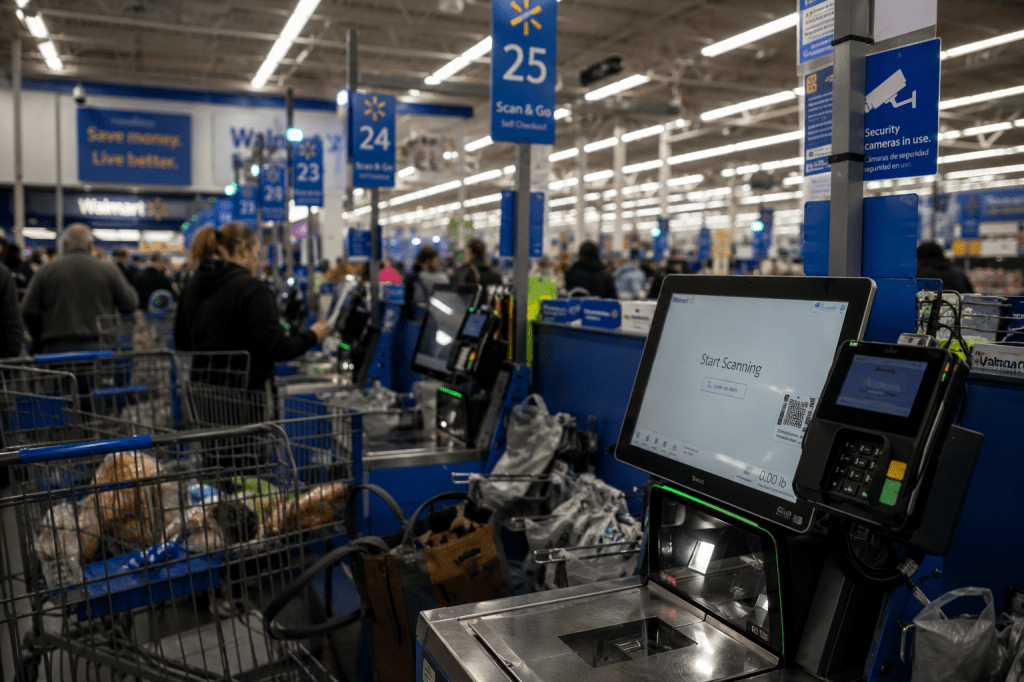
    Then came Walmart.

    Now let me tell you something about Walmart self-checkout.

    I hate it.

    Every time I go, my anxiety increases exponentially.

    The bustle of people. The carts. The noise. The constant blips from every self-scanner going off at once. I can never tell which sounds belong to my machine and which belong to someone else’s. My brain doesn’t filter them out.

    And the heat.

    Oh my god, the heat.

    I struggle badly with overheating, especially when I’m stressed. It’s not uncommon for me to take off my coat and sweater while scanning groceries because I suddenly feel like I’m boiling alive under fluorescent lighting.

    And naturally, I have a system.

    Of course I do.

    I position the cart just so. Purse on the floor instead of in the cart because someone might take it. Coat off. Sweater off. Scan carefully. Check the screen after every item because with my luck, one won’t scan and I’ll somehow get accused of shoplifting, another weirdly intense fear of mine.

    I make little piles after scanning so I know what goes into which bag. Then I bag. Then I reload the cart. Then I double-check the screen. Then I pay.

    When I finally walk through those sliding doors into the parking lot and feel the breeze hit my skin, I have NEVER. BEEN. SO. GRATEFUL. to breathe outside air.

    Even if it’s a Walmart parking lot.

    I’m starting to realize how much of this was probably sensory overload mixed with hypervigilance and an already overloaded nervous system.

    So before the interaction even happened, I was already primed. My nervous system was already overloaded, and I still hadn’t recovered from our McDonald’s kerfluffle.

    Under Surveillance

    Then the scanner glitched.

    The first item scanned twice. No problem, I thought. Honest mistake. The employee came over, removed it, and then had to review the video footage to confirm what had happened.

    Which, rationally, I understand.

    But emotionally? My nervous system immediately clocked it as:
    You’re under surveillance.

    Then later, while scanning cat food, another item accidentally scanned twice. Again.

    Only this time, the machine froze and flagged an error. Before I even had time to explain, another employee was there reviewing footage again while I stood there trying to explain that I was literally holding four cans while the screen showed five.

    And I could feel the threat response escalating in real time.

    Not because anyone was actually accusing me outright, but because my brain had already shifted into hypervigilance mode.

    The first video review primed me.
    The second one confirmed the fear.

    By the time the employee kept insisting the scan was correct while I stood there counting cans in my hand like a sweaty, overstimulated Sesame Street character, something in me snapped.

    Not in a dramatic screaming way.

    But sharply.
    Harshly.

    “What are you not getting? I have four in my hand.”

    Even writing that makes me cringe.

    Then, because the universe apparently enjoys irony, the machine flagged me again while I was bagging my groceries. Another employee came over and explained the system had become confused by the placement of my reusable bag.

    At this point I was internally one blinking fluorescent light away from a full system shutdown.

    Later, as I was leaving, I found the first employee again and apologized.

    Because she didn’t deserve that either.
    The Shame Spiral

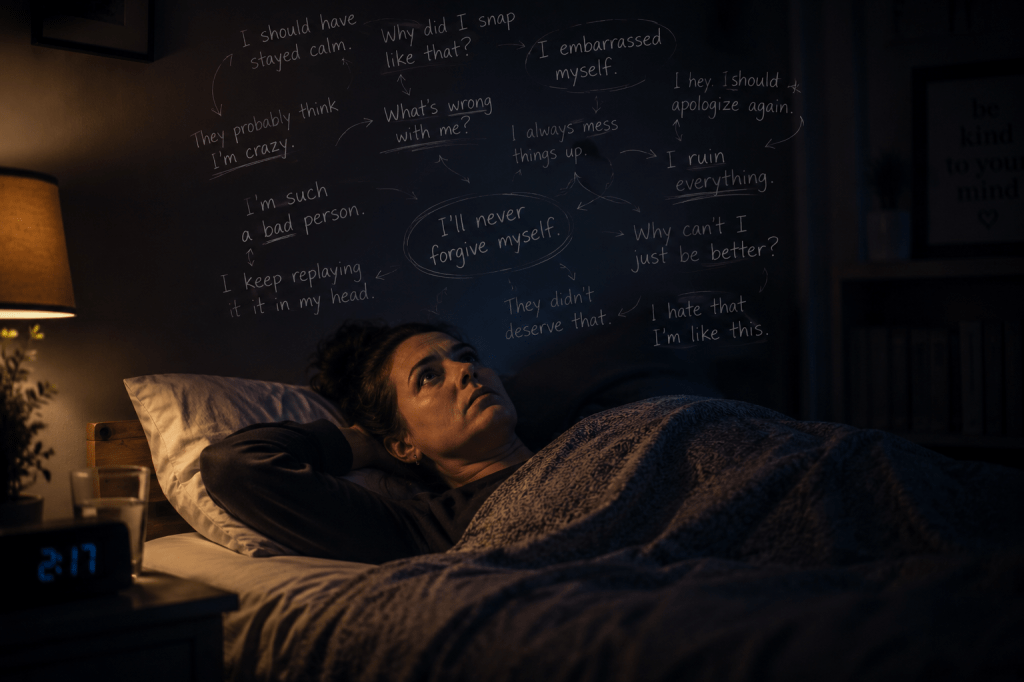
    But then came the shame spiral.

    And honestly? The shame spiral is the part I know best.

    Because this is what I do.

    I replay interactions endlessly in my head. I remember coaching moments from years ago where maybe I was too hard on a student. Not abusive. Not cruel. But maybe too intense. Too impatient. Too much.

    And I can’t let myself off the hook for it.

    Ever.

    My brain immediately jumps to:

    What’s wrong with me?
    Why can’t I control myself?
    Why didn’t I just say this differently?
    Why am I like this?

    And underneath all of it is this terrifying belief I’ve apparently carried my entire life:

    If I’m not perfect, I’m bad.

    Not imperfect.
    Not stressed.
    Not dysregulated.

    Bad.

    Monster-level bad.

    I’m beginning to realize how much rumination and black-and-white thinking have shaped my inner world.

    My Map Is Gone

    At the same time, I’m also beginning to realize that some of the things I thought were personal failings may actually be connected to being neurodivergent.

    Like how deeply routine disruptions affect me.

    For example, my mother sometimes tidies or reorganizes my things without asking. She means well. Truly. But it drives me absolutely insane.

    Why?

    Because I have a system.

    I know where things are. It may not look organized to anyone else, but it works for me. So when I go to grab medication or keys or paperwork and it’s suddenly been moved, it doesn’t just mildly annoy me.

    It disrupts the entire flow of my day.

    It feels like my map is gone.

    And if I’m already overwhelmed, that unexpected obstacle can feel enormous.

    The same goes for interruptions.

    If I’m hyperfocused on something and someone suddenly pulls me away from it, my reaction is almost physical. It feels jarring. Like my brain is being yanked out of one mode and shoved violently into another before I’m prepared.

    Apparently distress around interrupted hyperfocus is also pretty common in neurodivergent adults, which honestly made me feel both validated and mildly attacked.

    I used to think this just meant I was difficult. Anal. OCD. Controlling.

    Now I’m wondering if it’s something else.

    Maybe I’ve spent my entire life trying to manage an overloaded nervous system without understanding that’s what I was doing.

    Understanding vs Excusing

    And maybe that understanding matters.

    Not because it excuses hurting people.

    It doesn’t.

    I am still responsible for how I speak to people. Full stop.

    But maybe understanding the wiring underneath it all helps explain why some things feel so disproportionately overwhelming to me. Maybe it explains why I have to work harder than the average person to regulate myself when I’m overloaded.

    And maybe, just maybe, understanding that isn’t “playing the victim.”

    Maybe it’s finally learning to stop treating myself like a monster every time I struggle.

    I don’t have neat answers yet.

    I don’t know how to completely let myself off the hook while still holding myself accountable.

    I don’t know how much of this is autism. Or ADHD. Or stress. Or perimenopause. Or burnout. Or just being human.

    Probably all of the above.

    What I do know is this:

    I don’t think I was ever really angry about the cheeseburger meal.

  • You’re Not Listening to Her: A Medical Advocacy Story

    You’re Not Listening to Her: A Medical Advocacy Story

    This blog is a tag-team effort between me and AI—think of it as my over-caffeinated intern who spits out ideas while I handle the heavy lifting. I research, fact-check, edit, and fine-tune everything to make sure it sounds like me (not a robot with a thesaurus). AI helps with the grunt work, but the heart, style, and final say? That’s all me, baby.

    I want to tell a story about what happened to my daughter and me in the Canadian healthcare system, because I know we’re not alone. I’ve changed all the names for anonymity, but the story is, sadly, all too real.

    The Pediatrician We Trusted…At First

    Years ago, I was referred to a pediatrician for my daughter Ava. At the time, she was around six and suffering from chronic stomach pain, constipation, recurring croup, and constant anxiety related to school. 

    She had nightmares, meltdowns, and was being ostracized and bullied. I knew something deeper was going on. I didn’t have the words “autism” or “ADHD” yet, but my mom gut told me she was different—and struggling.

    Our pediatrician—we’ll call him Dr. McLecturepants—was very knowledgeable. Ava liked him. He was good at addressing her physical health issues. He took things seriously, referred us to specialists, and was often thorough. 

    But there were red flags. 

    Dismissed, Doubted, and Lectured

    Early on, I was struggling to get Ava to take medication. What I now know is ARFID, sensory aversion, and autistic rigidity was, back then, just a nightmare every time I had to administer meds. 

    Meltdowns, sobbing, trauma for both of us. 

    When I asked for help, he didn’t offer compassion. He gave me a five-minute lecture on how I needed to “take control” and “stop letting her run the show.” It was humiliating. I left feeling like a failure.

    From then on, I was nervous around him. I often wondered, would he speak to me this way if a man were in the room? I was a single mom. White. Tired. Not wealthy. He was a male doctor with a strong accent—possibly Middle Eastern—and although I didn’t want to bring culture or bias into it, I couldn’t ignore the power dynamic. 

    I wrestled with myself for even thinking that cultural background might play a role — not because I wanted to stereotype him, but because I’ve lived long enough to know that gender dynamics can be shaped by upbringing, culture, and society. Still, I sat with the discomfort of that thought and tried to focus on what I knew: I felt talked down to, and I didn’t feel respected.”

    I felt small. 

    Like I was being treated as a hysterical mom, not a capable one.

    Homeschooling: The Best Decision We Made

    When school became unbearable for my daughter, I started researching homeschooling options. It wasn’t a knee-jerk decision. I consulted experts (including a clinical psychologist), read studies, and made spreadsheets. I also began compiling information about ADHD and neurodivergence, trying to be prepared to make my case.

    Dr. McLecturepants dismissed homeschooling outright. Didn’t want to hear about the trauma Ava was experiencing. Didn’t care that her nightmares and pain disappeared within two weeks of being pulled from school. 

    He continued to disapprove, even when I brought up ADHD. That, at least, he was more receptive to, but the lectures didn’t stop. I kept going back because he was knowledgeable about ADHD, and I thought I needed that.

    Rather, I thought my daughter needed that, and I should just shut up and deal.

    The Diagnosis Battle

    But when I brought up autism? He shut it down. Said she couldn’t be autistic because she made eye contact. (Yes, really. Hello, 1955 called and they want their scrubs back)

    Eventually, I demanded a referral. I gave him research. I asked for a specific autism specialist recommended by a trusted friend. 

    McLecturepants reluctantly referred us, but warned me the doctor “diagnosed everyone” and other professionals didn’t like him. I couldn’t believe he was dragging me into some petty professional rivalry when my daughter’s health was on the line.

    The diagnosing doctor met with my daughter, gave a comprehensive evaluation, and said, “Yes. She’s autistic.” 

    I went through ALL the feelings that day—IYKYK—but one of the ones I never expected to feel was validation. Someone else finally listened to me and I wasn’t crazy, which is what my pediatrician had been making me feel like. 

    The specialist did say kiddo might not have ADHD, but I trusted my gut—because comorbidity is common, and I’d done the reading. I was more worried that McLecturepants would react poorly when he read the report, particularly the part about the specialist disagreeing with his diagnosis. 

    It’s not fun to feel you’re caught in a pissing match between two health “professionals,” which only magnified my feelings of “walking on eggshells” with McLecturepants.

    The Funding Form Fiasco

    Fast forward. The Disability Tax Credit needed renewing. We’d been working with a phenomenal ASD counsellor who’d seen Ava regularly and knew the extent of her challenges. The DTC forms went to Dr. McLecturepants. I was told it would take months to fill them out.

    I got emotional. After all, it was our only funding, given we’ve been on waiting lists for years with the Ontario Autism Program and Special Services at Home. (I’m looking directly at you, Doug Ford).

    McLecturepants ended up filling them out quickly over the holidays, which I appreciated—until I read them. He’d minimized kiddo’s struggles. Downplayed how much support she needs. Even checked the box saying her deficits would likely improve over time—as if autism isn’t a lifelong neurotype.

    When I first read what the pediatrician had written, I questioned everything about my reality. Maybe it wasn’t that bad? Maybe I was exaggerating, and making too much out of our struggles. Maybe there was something wrong with ME that I couldn’t handle the extra work required for my daughter?

    Thankfully our counsellor, who at this point had been visiting with my daughter and I for over a year, twice monthly for an hour at a time, also expressed her shock and surprise at how inaccurately Dr. McLecturepants had characterized our daily struggles.

    I was heartbroken. I drafted a letter—respectful, clear, and shared with our counsellor and friends for feedback. After all, I didn’t want to provoke another lecture. I didn’t want to make things worse, or insult our pediatrician’s professionalism, or god forbid, challenge him or hurt his ego.

    I brought in observations from myself, her grandparents, coaches, teachers—any adult in Ava’s life. I asked him to reconsider.

    He refused. Told his receptionist he wouldn’t change it. So I made an appointment. 

    Enough is Enough

    This time, the gloves were off, and I knew the advocate (me) needed an advocate.

    So I brought my mom—who never takes my side in these things; after all, I’m too outspoken, too sensitive, too…(you get the drift).

    But this time she came, because I needed backup. It meant so much to me that she did that, even though I could see she didn’t believe it was as bad as I said it was.

    When we tried to explain, he talked over us. 

    Not once, not twice. 

    Repeatedly. 

    McLecturepants wouldn’t acknowledge the fact that we might have a better understanding of the difficulties my daughter has every day. My mom—stoic, practical, no-nonsense—who never speaks up and hates confrontation, actually shouted: “You’re not listening to her!” after he cut me off yet again.

    That’s when I stood up and said: “We’re done. You’ve lectured me for years. Dismissed me. Put me in the middle of conflicts with other doctors. I believe you’ve treated me differently because I’m a woman, and I don’t feel safe bringing my daughter here anymore.”

    We left.

    One Final Violation 

    I picked up kiddo’s files a week later. On my way to our counsellor’s office, I noticed something strange. Mixed into Ava’s files were records for another child. Operations, procedures—stuff my daughter had never had. A huge privacy breach. I returned them immediately, because that’s what I’d want another parent to do if it were my child’s info. 

    But wow. 

    Just wow. 

    This from the office of a doctor who’d been lecturing me for years about MY incompetence as a mom?

    Blacklisted for Speaking Up

    We’ve been seeing our GP ever since. Lately, I’ve been researching other possible underlying conditions—things like hypermobility, POTS, immune dysfunction—and brought them up with our GP, who was amazing and agreed to help. He referred us to another pediatrician in our town.

    I didn’t realize this pediatrician was at the same office as Dr. McLecturepants. You can imagine the surprise when their office called to schedule the appointment. Still, I knew I would have a longer wait for a pediatrician from other, larger centers, so I agreed to the appointment.

    Why would I go back?

    If you’ve ever had a sick child, you’ll understand that all you care about is making their quality of life better.

    And then, today, after picking up my daughter from school, a call came in from our GP’s office, which I took over our hands free, thinking it was about my upcoming blood tests. 

    We’d been rejected. Well, technically the word they used is, he has “declined.”

    The new doctor wouldn’t take us as patients because of my “issue” with the previous pediatrician. And my daughter heard every word of that rejection.

    The message was clear: they stick together.

    This is what it’s like to advocate for a neurodivergent child in the medical system as a single mom.

    No one’s listening.


    Backing it Up: What the Research Says

    Sexism in the Medical Profession:

    • A 2022 study published on “Women’s Experiences of Health-Related Communicative Disenfranchisement,” found that women are more likely to report feeling dismissed, not believed, or condescended to by medical professionals.
    • Female patients, especially mothers, often get labeled as “anxious” or “overreacting” when advocating for their children, leading to delayed diagnoses and interventions.

    Bias Against Single Mothers:

    • Single mothers are statistically more likely to be perceived as less competent parents by both professionals and the public.
    • These biases can lead to increased scrutiny, less support, and more judgment in medical and educational settings.

    Challenges of Advocating for Autistic Children:

    • Parents often report having to fight for recognition of their child’s needs, with many diagnoses being delayed due to outdated stereotypes like “they make eye contact.”
    • Autistic girls and children with Level 1 Autism (formerly known as Asperger’s) are often underdiagnosed due to masking and lack of understanding by professionals. 

    Privacy and Confidentiality in Canada (PHIPA):

    • The Personal Health Information Protection Act (PHIPA) mandates that healthcare providers protect the confidentiality of all patient information.
    • Sharing or misfiling another child’s medical information, even accidentally, is a breach under this act and can be reported to the Information and Privacy Commissioner of Ontario.

    Medical Ethics & Gatekeeping:

    • Physicians are ethically bound to advocate for patient welfare and make decisions free from personal bias or inter-professional politics.
    • Refusing care to a child based on a parent’s disagreement with another doctor raises serious ethical concerns about bias, access to care, and professional conduct.

    Why Parents Shouldn’t Be Penalized for Speaking Up:

    • Advocacy is not aggression. Speaking up about misdiagnosis, misrepresentation, or mistreatment should never result in being blacklisted.
    • Punishing parents for advocating silences necessary voices and puts children’s care at risk.

    This is my story. It’s also the story of so many parents out there who’ve been dismissed, condescended to, or penalized for doing what they’re supposed to do: protect and advocate for their child.

    We shouldn’t have to shout to be heard. But sometimes we do. And when we do? We deserve to be listened to.

    April is World Autism month. Do your part. Speak up. Advocate. Scream. Pound your fists. Or better yet, write a blog and call the assholes out.