Tag: autistic

  • The Night I Realized My Autism Mask Was Slipping

    The Night I Realized My Autism Mask Was Slipping

    This blog is a tag-team effort between me and AI. Think of it as my over-caffeinated intern who spits out ideas and/or helps me organize my thoughts and experiences, while I handle the heavy lifting. I research, fact-check, edit, and fine-tune everything to make sure it sounds like me (not a robot with a thesaurus). AI helps with the grunt work, but the heart, style, and final say? That’s all me.

    Last night I went out with a bunch of friends.
    And it was awesome.I had a few drinks, had a few gummies (my new way to combat anxiety and panic attacks), and danced my face off. Yes, I think that’s a thing.

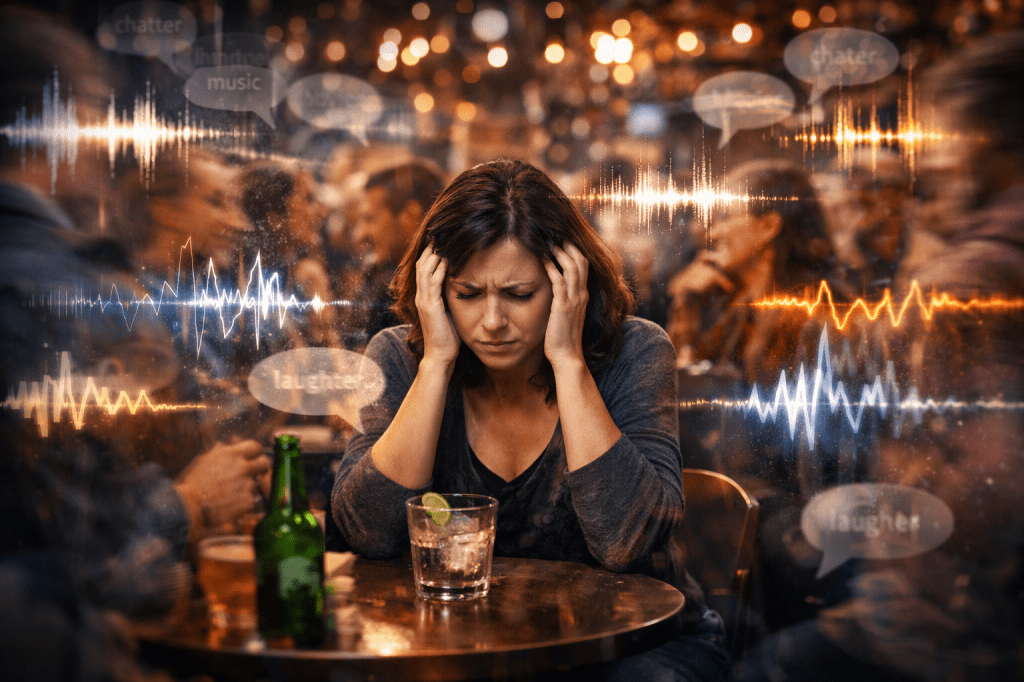
    The bar was packed though. And when I say packed, I mean the kind where you have to squeeze sideways between chairs just to get back to your seat.There was live music, people talking everywhere, chairs scraping, glasses clinking. It was loud in that chaotic, joyful Friday-night kind of way.

    But when I sat down at the table and tried to join the conversation swirling around me, I suddenly realized something strange.

    I couldn’t hear a single conversation.

    Not one.

    I could see mouths moving. I could hear sound. But it was like every voice blended together into one giant wall of noise.

    So I did what I’ve always done in situations like that.

    I leaned in. I turned my head so my ear was closer to the person speaking, hoping I’d catch just enough to piece together what they were saying.

    Still nothing.

    Eventually I just started smiling and nodding when there was a pause in the conversation or someone looked at me like they expected a response. Which means there’s a very good chance I was enthusiastically agreeing with things I had absolutely no context for.

    But that’s when something else started happening. In my head, my script got louder. See, I’ve always had a script running in my brain. I just didn’t realize that’s what it was. It’s the little voice reminding me when to change my body posture.
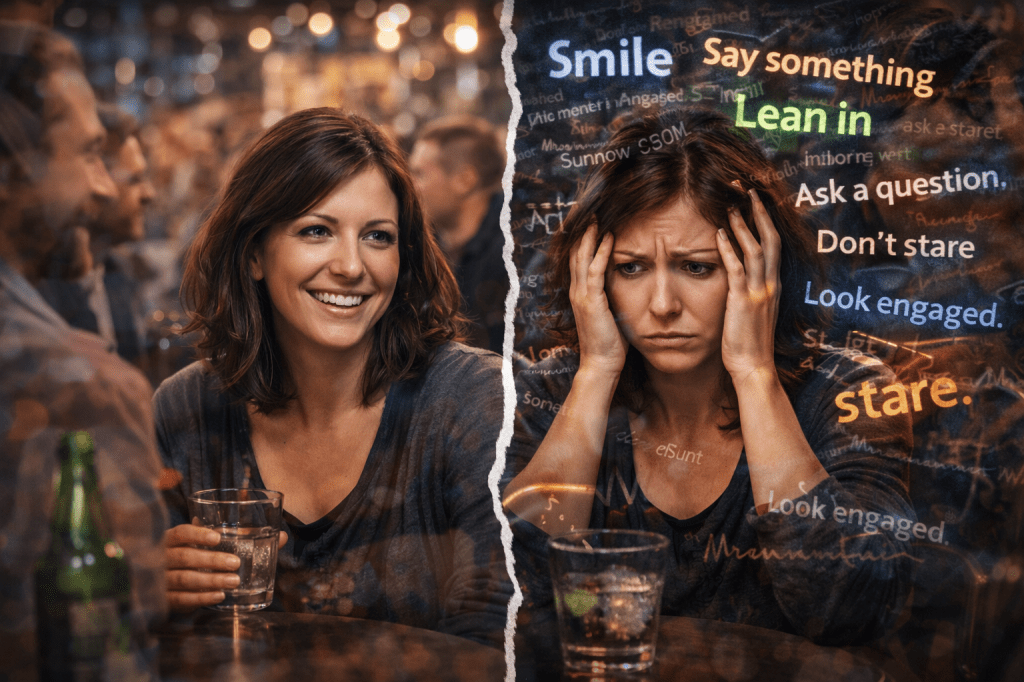
    When to lean in.
    When to smile.
    When to laugh.

    It tells me when I’m making too much eye contact… and when I’m not making enough.

    Usually that script runs quietly in the background. Like a low hum I’ve gotten used to. But last night, in that wall of noise and chaos, that hum turned into the loudest thing in the room. Suddenly all I could hear were those thoughts.

    You should say something.
    You’re too quiet.
    Ask a question.
    Lean in more.
    Look engaged.
    Don’t stare.
    Smile.

    On top of all of that, I started feeling this pressure to make sure the people around me were having a good time. If there was a lull in conversation, I felt responsible for fixing it.

    So my brain started cycling through every conversation starter I could think of. Every question. Every social prompt.

    Trying to keep things flowing.
    Trying to keep everyone comfortable.
    Trying to keep the energy up.

    And suddenly it was just… too much.

    I couldn’t think. I couldn’t breathe properly. I had this overwhelming urge to put my hands over my ears and hide under the table.

    I never let it show.

    But under the table, my hands started shaking. Then flapping. It’s something I’ve done my whole life when I’m stressed—shaking out my hands or flicking my fingers to release tension.

    Lately though, I’ve noticed I do it more when I’m anxious or overwhelmed. So I ended up doing what I’ve always done.

    I sat on my hands.

    Trying to make it stop. Trying to make it invisible. And later that night, I started wondering something.

    “Now that I’ve realized I’m autistic… is it normal for these things to suddenly feel more obvious?” Or is it that I’m just more aware of them now? Or possibly, because I’ve finally “come out,” in a way, do I feel like I have permission to be more authentic and let the mask slip a little?

    Or maybe it’s something else entirely. Maybe after decades of managing the script in my head… I’m just tired. Maybe the older I get, the harder it is to keep covering these things up. Or maybe hormones are part of it too.

    Perimenopause has a way of amplifying anxiety, sensory sensitivity, and emotional regulation challenges. So maybe all those coping strategies I relied on for years are just… wearing thin. Whatever the reason, last night made something very clear. The script in my head that I thought everyone had?

    Apparently not everyone does.

    Why This Happens (And Why You’re Not Alone)

    After experiences like that, a lot of late-identified autistic adults start asking the same question:

    Why do autistic traits seem more noticeable after we realize we’re autistic?

    The answer is usually a combination of several things.

    Auditory Processing in Noisy Environments

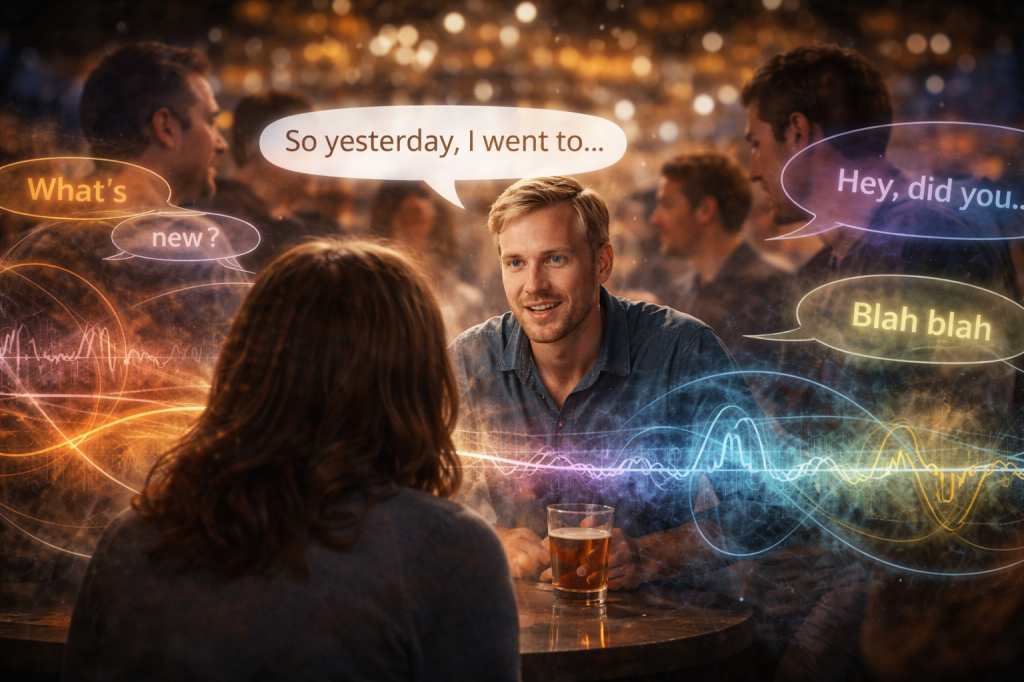
    Many autistic people struggle with something called auditory processing in complex environments. When there are multiple competing sounds—music, clinking glasses, multiple conversations—our brains can struggle to filter out background noise.

    Instead of isolating one voice, everything blends together into a wall of sound. Researchers sometimes refer to this as the cocktail party problem.” Most people’s brains automatically tune into one voice and filter out the rest.

    Autistic brains often don’t do this as easily, which is why places like crowded bars or restaurants can quickly become overwhelming.
    The Internal Social Script (Masking)

    That running commentary in my head? That’s something many autistic adults describe. It’s part of something called masking. Masking happens when autistic people consciously monitor and adjust their behaviour in order to appear more socially typical.

    This can include things like:

    • Monitoring eye contact
    • Rehearsing responses
    • Copying other people’s body language
    • Forcing facial expressions
    • Scripting conversations in advance

    Many autistic women become extremely skilled at masking, often without realizing they’re doing it. But it takes a tremendous amount of energy.

    Stimming as Nervous System Regulation

    The hand shaking and flapping I mentioned is a form of stimming. Stimming (short for self-stimulatory behaviour), is a natural way many autistic people regulate stress and sensory overload. Common examples include:

    • Hand flapping
    • Finger flicking
    • Rocking
    • Pacing
    • Fidgeting

    Unfortunately, many autistic kids are taught to suppress these behaviours because they look “different.” Which is why many autistic adults end up hiding them. Like sitting on our hands under a table.

    Why Traits Can Feel Stronger Later in Life

    A lot of late-identified autistic adults say something similar. Once they understand they’re autistic, it can feel like their traits are suddenly becoming more intense. In reality, several things may be happening.

    You’re noticing things that were always there.

    You’re becoming aware of how much effort masking requires.

    And over time, many people simply become too exhausted to maintain that mask at the same level they did earlier in life.

    Hormonal changes during perimenopause and menopause can also increase sensory sensitivity, anxiety, and emotional regulation challenges, which can make masking even harder.

    Signs You Might Be Masking Without Realizing It

    Many people don’t realize they’ve been masking for years. Some common signs include:

    • Replaying conversations in your head afterward
    • Studying other people’s behaviour to copy social cues
    • Feeling completely drained after social events
    • Practicing what you’re going to say before speaking
    • Monitoring your facial expressions and body language constantly
    • Feeling like socializing is a performance rather than something automatic

    For many autistic adults—especially women—masking becomes so automatic that we assume everyone else is doing it too.

    Until one day we realize they’re not.

    Practical Strategies for Loud Social Environments

    If crowded places leave you feeling overwhelmed, a few small adjustments can help.

    Choose your seat carefully: Sitting with your back to a wall or closer to the person you want to talk to can reduce sensory input.

    Focus on smaller conversations: One-on-one interactions are often easier to process than trying to follow an entire table.

    Take short sensory breaks: Stepping outside for a few minutes can help your nervous system reset.

    Use subtle regulation tools: Fidget rings, small objects, or even gentle hand movements can help release tension.

    Know when it’s okay to leave: Enjoying a social event doesn’t mean you have to stay until you’re completely overwhelmed.

    The Realization That Changes Everything

    For most of my life, I assumed everyone else had that same script running in their head. That everyone was consciously monitoring their facial expressions, tone of voice, posture, and   conversation timing.

    Now I’m starting to realize that might not be the case. And that realization changes the way you see a lot of things. Because once you understand how much invisible effort goes into navigating social situations…

    You also start to understand why it can be so exhausting. And why sometimes, even when you’re having fun…

    Your nervous system still reaches its limit.

    If This Sounds Familiar

    If you’ve ever:

    • Struggled to hear conversations in loud places
    • Felt like you were running a social script in your head
    • Hidden stimming behaviours to avoid drawing attention
    • Felt completely drained after social events

    You’re not alone. And you’re not broken.Your brain may simply be processing the world a little  differently. And understanding that difference can be the first step toward finally giving yourself a little more grace.

    Further Reading

    If you’re interested in learning more about masking, sensory processing, and autism in adults, these resources are a great place to start:

    • Autistica – Autism research and adult resources
    • CHADD – Executive functioning and neurodivergence resources
    • Dr. Devon PriceUnmasking Autism
  • Autistic Burnout at 57: Rethinking My Depression and Fibromyalgia

    Autistic Burnout at 57: Rethinking My Depression and Fibromyalgia

    AI tools were used to assist with editing, organization, and some visual elements in this post.

    I hear my friends talk about how good they feel when they wake up after a solid night’s sleep.

    Refreshed.
    Clear-headed.
    Ready for the day.

    And I always wonder… What does that actually feel like?

    Because I can count on one hand the mornings in my life where I’ve woken up feeling good.

    Most mornings are a battle.

    A battle against exhaustion.
    Pain.
    Anxiety.

    Often my body feels like it’s been hit by a truck. I wake up feeling just as tired—sometimes more tired—than when I went to bed.

    That “refreshed” feeling people talk about?

    Honestly? Fuck off with that.

    Because at this moment it feels like a taunt. One more thing I’m apparently not allowed to have in this lifetime.

    And in a sea of difficult mornings, this one hit monsoon proportions.

    Even my eyes hurt. The light was too much. My head, neck, and shoulders ached. My hands were claws because the flexors and extensors seemed to be at war with each other. My lower back was crying. My hip bones? Don’t even get me started.

    It took forever just to sit up.

    And yes, I used every bullshit motivational phrase in my fairly sturdy arsenal. (Add irritability to my list of symptoms). Thirty years of coaching gives you a decent toolbox.

    “You can do this.”
    “One small step.”
    “Just sit up first.”

    But no amount of self-talk made it easier.

    Because this wasn’t just a mindset problem.

    I’ve Been “Tired” Since I Was 16

    I was first diagnosed with depression at 16 or 17.

    At the time, my mom dragged me to the doctor because I was so tired I could barely walk up a flight of stairs.

    Showering? Exhausting.
    Walking? Exhausting.
    Thinking? Exhausting.

    And before anyone assumes I was out of shape—I was a competitive figure skater training 15–20 hours a week. I was in peak physical condition.

    Still couldn’t climb the damn stairs.

    Over the years, I’ve had depressive episodes. Some clearly tied to life events.

    A death in university.
    Failing a course twice.
    Leaving an abusive partner in the middle of the night in a city where I knew no one.
    Infertility.
    Fertility drugs that I was told wouldn’t affect me, even though I warned the doctor I’m sensitive. (Spoiler: they did.)

    After a concussion on the ice while pregnant (yes, I was teaching, don’t judge), then childbirth, things shifted again.

    Sleep deprivation.
    Single parenting.
    Starting over in a new town.
    Dog-eat-dog coaching culture.

    And then the body pain.

    Full-body soreness that didn’t feel like training soreness. Hands clawed in the morning. Joints feeling fused together. Like I was wearing a suit of armor.

    There were days the pain was so intense my teeth would chatter.

    Eventually, after being dismissed more than once, a sports medicine doctor looked at me and said, “This isn’t a sports injury.”

    I said, “I think it’s fibromyalgia.”

    She agreed. Referred me to a rheumatologist. I had a diagnosis within a week.

    Relief. Validation. Finally.

    There are good doctors out there.

    But as the parent of a neurodivergent kid in a small town? My faith still wobbles.

    So Why Am I Questioning Everything Again?

    Because now I’m 57.

    And I’ve recently acknowledged something else about myself.

    I’m autistic.

    Late to the party. But here nonetheless.

    I’m self-identified. Not formally diagnosed.

    And before anyone clutches their pearls — self-identification is valid in a community where many women can’t access assessment due to cost, waitlists, geography, or years of being dismissed. I’ve done the reading. The reflecting. The pattern-matching across my entire life. This isn’t impulsive. It’s informed.

    And once you look at your life through that lens? It’s like the whole timeline rearranges itself.

    Everything feels hard again.

    Showering is hard.
    Speaking and formulating thoughts is hard.
    Light is too much.
    Headaches. Nausea. Brain fog.
    Overwhelm from the smallest tasks.

    I know. I know. There are a million other things this could be.

    And I’ve been checked.

    But the more I read about autistic burnout—especially in adult women—the more I feel that uncomfortable little a-ha click in my chest.

    What if I haven’t just been depressed?

    What if I haven’t just had fibromyalgia?

    What if I’ve also been burning out my nervous system for decades?

    So What Is Autistic Burnout?

    Autistic burnout isn’t just being tired.

    It’s not “I had a big week.”
    It’s not “I need a vacation.”
    It’s not regular workplace burnout.

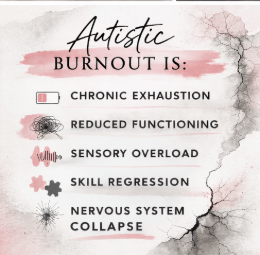
    Researchers describe autistic burnout as chronic exhaustion, reduced functioning, and decreased tolerance to sensory input following long-term stress and unmet support needs (Raymaker et al., 2020; AIDE Canada Toolkit).

    Translation?

    Your nervous system has been running on high alert for so long that it just… stops cooperating.

    Autistic adults actually named burnout first. Researchers later studied it and confirmed the pattern: long-term stress, masking, unmet support needs — and eventually a collapse in capacity (Raymaker et al., 2020).

    Burnout isn’t just exhaustion.

    It can look like:

    • Brain fog
    • Trouble speaking or finding words
    • Executive dysfunction that wasn’t this bad before
    • Sensory overload — light, sound, touch suddenly feel like too much
    • Loss of skills you used to manage
    • Increased anxiety
    • Shutdown

    It doesn’t always look like sadness.

    Sometimes it looks like:
    “I can’t.”

    And unlike regular stress, it doesn’t necessarily get better with a good weekend. It can last months, especially if the demands don’t change.

    Burnout vs Depression vs Fibromyalgia: Why This Is So Damn Confusing

    Burnout can look like depression.
    Depression can look like burnout.
    Fibromyalgia overlaps with both.

    Depression often includes:

    • Persistent low mood
    • Loss of interest or pleasure
    • Hopelessness
    • Emotional heaviness

    Autistic burnout doesn’t always include that deep hopelessness.

    It’s more like:
    “My system is overloaded. I don’t have capacity.”

    Fibromyalgia brings another layer:

    • Widespread pain
    • Tender points
    • Non-restorative sleep
    • Morning stiffness
    • Flare cycles tied to stress

    Studies show elevated rates of depression, chronic fatigue, and fibromyalgia among autistic adults, suggesting these conditions may overlap rather than exist in isolation (Altogether Autism; More Good Days; PMC8992921).

    Which means it might not be either/or.

    It might be all of it.

    A nervous system under chronic stress can express itself in mood.
    In pain.
    In shutdown.
    In exhaustion.

    Bodies are messy like that.

    A Kitchen Table Self-Check

    (Not a diagnosis. Just curiosity.)

    I am not diagnosing anyone.
    Hell, I’m barely diagnosing myself.

    But here’s a gentle gut-check to help me (and you) sort through this fog.

    You might lean toward autistic burnout if…

    • You feel chronically exhausted in a way that rest doesn’t fully fix.
    • Small tasks feel disproportionately hard.
    • Sensory things suddenly feel unbearable.
    • You’ve “lost” skills you used to manage.
    • Reducing demands helps more than motivational self-talk does.
    • You feel overloaded, not necessarily hopeless.

    You might lean toward depression if…

    • There’s a persistent low mood.
    • Things that once brought joy feel flat.
    • You feel hopeless or numb.
    • The exhaustion feels emotionally heavy.

    You might lean toward fibromyalgia if…

    • Widespread pain is central.
    • Morning stiffness is intense.
    • Sleep doesn’t restore you.
    • Your body feels like it’s wearing armor.

    And here’s the inconvenient truth:

    It might not be just one thing.

    The Cost of Being “Normal” for Decades

    If I’m autistic, then I’ve been adapting to a world not built for me for 57 years.

    That’s a long time to hold your breath.

    Masking works.
    Until it doesn’t.

    Research on late-diagnosed autistic women highlights decades of compensating and masking—often at significant psychological and physical cost (UCLA Health; Neurodiversity Centre).

    Masking isn’t just social camouflage.

    It’s energy expenditure.

    And energy is finite.

    Emerging discussions around autism and menopause suggest sensory sensitivity and burnout can intensify in midlife as hormonal shifts affect nervous system regulation (ScienceWorks Health).

    So maybe this isn’t random.

    Maybe this is cumulative.

    Maybe my nervous system didn’t fail me.

    Maybe it finally told the truth.

    Maybe I Was Never Just Depressed

    I was 16 and couldn’t climb stairs.

    I was diagnosed with depression.

    I was diagnosed with fibromyalgia.

    And maybe those diagnoses were accurate.

    But maybe they weren’t the whole story.

    Because when I look back now—as a 57-year-old, self-identified autistic woman—I don’t just see sadness.

    I see decades of adaptation.

    Of performing competence.
    Of tolerating sensory overload.
    Of managing social politics.
    Of caregiving without pause.

    Maybe the exhaustion isn’t weakness.

    Maybe the armor-body mornings aren’t laziness.

    Maybe the overwhelm isn’t a character flaw.

    Maybe it’s what happens when you run a brain and body in survival mode for half a century.

    I don’t have a clean answer.

    It might be depression.
    It might be fibromyalgia.
    It might be autistic burnout.

    It might be all of it.

    But if I’ve been interpreting neurological overload as personal failure for decades?

    That story ends here.

    And if you’re 40. Or 50. Or 57. And you’re waking up feeling like you’ve been hit by a truck—physically, mentally, emotionally—maybe you’re not broken either.

    Maybe you’re overloaded.

    And maybe the question isn’t, “What’s wrong with me?”

    Maybe it’s, “What have I been carrying for far too long?”

    Sources & Further Reading

    Raymaker, D. et al. (2020). “Having All of Your Internal Resources Exhausted Beyond Measure”: Autistic Burnout.
    AIDE Canada. Autistic Burnout Toolkit.
    UCLA Health. Understanding Undiagnosed Autism in Adult Females.
    Neurodiversity Centre. Masking and Burnout in Autistic Women.
    Neurodivergent Insights. Autistic Burnout vs Depression.
    Attwood & Garnett Events. How Depression May Present Differently in Autistic People.
    Altogether Autism NZ. Chronic Fatigue, Fibromyalgia and Autism.
    PMC8992921.
    ScienceWorks Health. Autism and Menopause.

  • Tamra Judge’s Autism Announcement: A Mother’s Perspective

    Tamra Judge’s Autism Announcement: A Mother’s Perspective

    When Tamra Judge, star of “The Real Housewives of Orange County,” recently announced her autism diagnosis, it sparked a whirlwind of reactions. As an autism mom of 13 years, my initial feelings were intense—ranging from disbelief to anger. Raising a child on the spectrum has been a journey marked by profound challenges, daily heartbreaks, and constant advocacy. 

    Hearing Tamra reveal her diagnosis so casually, without the depth of understanding or experience, felt like a slap in the face to families like mine who live this reality every day.

    But then I took a step back. Autism isn’t the same for everyone—it presents differently in every individual, especially for women who often go undiagnosed until later in life. Still, I found myself conflicted, questioning whether her announcement was genuine or if it was simply an excuse for her bad behaviour on the show. 

    In this blog, I want to explore these mixed feelings and offer a glimpse into the realities of autism, both as a condition and a diagnosis that impacts not just individuals, but entire families.

    A World Not Built for Kids on the Spectrum

    For kids like my daughter, the world can feel overwhelming—a place that’s too bright, too loud, too chaotic. It often feels like the world wasn’t built for them. My daughter struggles with sensory sensitivities, which makes it hard for her to be in busy, noisy places like school. The overhead lights, the constant hum of conversation, kids acting out—these things, which many children might find mildly distracting, are huge obstacles for her. 

    Autism Parenting Magazine explains that sensory processing issues are common in autistic children and can cause them to feel overwhelmed by sounds, lights, and touch. For my daughter, these sensitivities often trigger meltdowns and anxiety attacks that make a typical school day feel impossible to get through. She’s forced to endure an environment that’s almost tailor-made to overstimulate her senses.

    And then there’s the bullying. My daughter struggles with reading social signals, understanding concepts like personal space, regulating her voice volume, and following the flow of conversation. She often gets too close, speaks too loudly, or doesn’t know when to enter or end a conversation. 

    Despite her kind heart and good intentions, she’s been ostracized and bullied so severely that we’ve had to change schools. The pain of watching her struggle to fit in, of seeing her beautiful spirit crushed under the weight of her peers’ rejection, is almost unbearable. 

    And don’t get me started about the lack of acknowledgment, understanding or support from school officials, the staggering amount of time I had to spend advocating for her and the number of meetings I had to initiate to try and make school a safe space. (That’s another blog entirely).

    The Emotional and Physical Impact of Autism

    Anxiety is a constant companion for my daughter. The fear of being bullied, the pressure to conform, and the overwhelming sensory input create an emotional cocktail that often results in meltdowns

    These aren’t the minor tantrums that some people might imagine—they are full-blown panic attacks that can last for hours, leaving both of us completely drained for the rest of the day. And these aren’t just emotional responses—they manifest physically, too.

    Autistic children often experience physical symptoms tied to their anxiety, like gastrointestinal issues, frequent headaches, or even asthma. My daughter frequently complains of stomach aches and other physical discomforts on the days when her anxiety is at its peak. Anxiety and gastrointestinal problems are closely linked in autistic children, and it’s a struggle I see play out daily in my own household.

    Executive Function and Daily Struggles

    Even the simplest tasks, like getting ready for school in the morning, can feel insurmountable for my daughter. She struggles with executive function, which means organizing tasks and managing time can be incredibly difficult. While a neurotypical child might be able to get dressed, pack their backpack, and leave the house in 10 minutes, my daughter takes significantly longer because she can’t easily break down the steps in her head. 

    Executive function challenges manifest in autistic children in countless ways, making it hard to manage even routine tasks. For my daughter, things like tying her shoes, packing her lunch, or remembering what order to do things in are daily battles that take ten times as long as a neurotypical child would take. And when the world expects her to keep up with her peers, it adds even more anxiety to her already overwhelming load.

    Tying It Back to Tamra’s Autism Announcement

    This is why Tamra Judge’s announcement initially felt like a punch to the gut. As an autism mom, I know firsthand the profound challenges and daily struggles that come with raising a child on the spectrum. So when Tamra casually mentioned her diagnosis on her podcast, claiming she was diagnosed in one therapy session, it raised a lot of red flags. 

    Diagnosing autism typically takes multiple assessments with specialists, and the process is often lengthy and thorough. Could someone really be diagnosed in one session?

    Reality Blurb’s article on the backlash Tamra received highlights how Tamra’s announcement was met with skepticism, especially given her reputation for dishonesty on “Real Housewives.” To some, it seemed like she might be using autism as an excuse for her bad behaviour on the show—a harmful narrative that could reinforce negative stereotypes about people on the spectrum.

    Understanding Late Autism Diagnosis in Women

    But on the other hand, it’s also important to acknowledge that autism often goes undiagnosed in women, who tend to mask their symptoms more effectively than men. Tamra could very well be one of the many women who were overlooked in childhood and only diagnosed later in life. Autism is frequently underdiagnosed in adult women, who often learn to hide their struggles and adapt to neurotypical expectations.

    While my initial reaction was skepticism, I now see that Tamra’s diagnosis could still be valid. If she is truly on the spectrum, it’s important to have compassion for her and recognize that her journey may be different from others. However, it’s also crucial that we don’t allow this announcement to perpetuate harmful stereotypes about autism.

    Conclusion: Balancing Compassion and Critical Thinking

    At the end of the day, Tamra Judge’s announcement brings to light the complexities of autism, particularly in how it’s perceived and diagnosed in adults. While we should approach her situation with compassion, it’s equally important to demand a responsible conversation around autism—one that doesn’t reduce it to a convenient label or excuse.

    Autism is not an excuse for bad behaviour, and it certainly isn’t a tool for garnering sympathy or avoiding accountability. It’s a condition that profoundly impacts individuals and families and deserves to be discussed with the respect and seriousness it warrants.

    For those reading this, I urge you to educate yourselves further about autism and how it affects not only individuals but their families, friends, and communities. Let’s foster a conversation rooted in understanding, not judgment, and continue supporting and advocating for those on the spectrum in every way possible.