Tag: family

  • I Got My Miracle. So Why Am I Grieving Infertility Again at Menopause

    I Got My Miracle. So Why Am I Grieving Infertility Again at Menopause

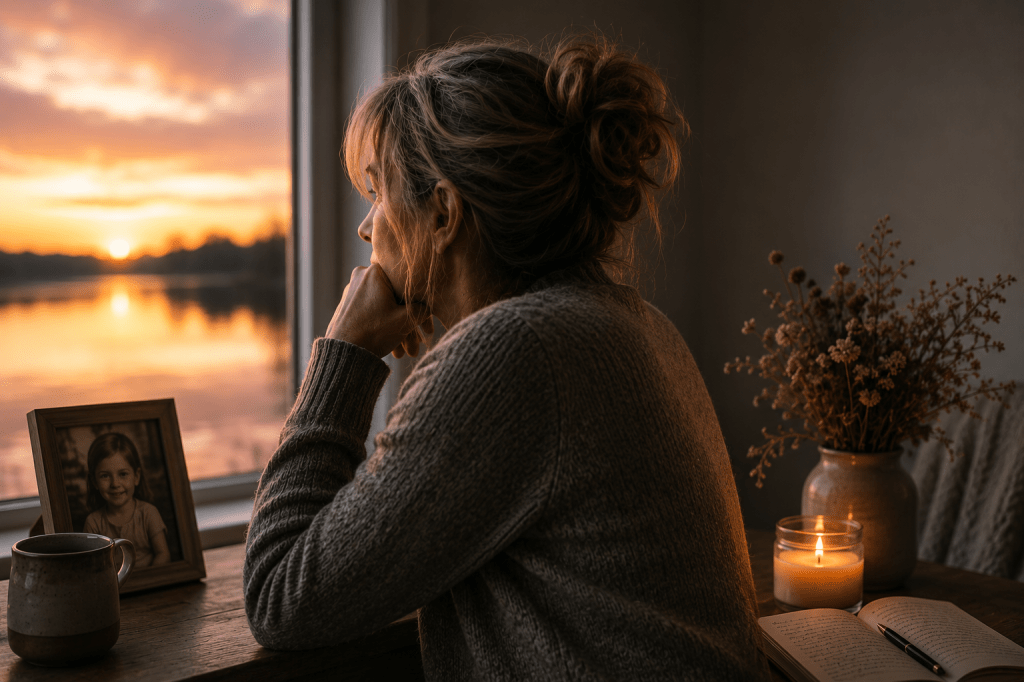
    Images created by AI

    I’ve been thinking a lot about babies lately.

    Wait. That’s not right.

    Rather, whenever I see anything, anywhere, having to do with babies, it’s hitting me a lot harder than it should. Baby clothes on Facebook, a storyline about giving birth on TikTok, Maggie losing her baby on Sullivan’s Crossing. Actually, now that I think about it, Maggie even getting pregnant in the first place hit even harder.

    It took me a while to figure out why this old pain is resurfacing. You see, as many women do, I struggled with infertility.

    But let me start at the beginning.

    I Always Knew I Wanted to Be a Mother

    From the time I was a little girl, I always knew I wanted to be a mother. In fact, I had my life all planned out. I’d teach skating in the early mornings, after school, and on weekends. My husband would have a regular 9–5 and he’d watch the kids while I went out and worked. It would be perfect for staying home with them until school started, and then someone would always be there to run them to their sports and after-school activities when they were done school.

    You see, I grew up in a family of five, me and my two younger brothers. And there was always noise, movement, family dinners, and endless travel to sports, our cottage, and family vacations. We were busy, it was bustling, and yes, it was soooo annoying in my younger years. Even though I’m not particularly close with my brothers now, I still know they’re there to talk to if I need them. When push comes to shove, they’d always be there for me.

    I wanted that for my kids. I didn’t just want children. I wanted a family. A drive-each-other-crazy, beat-each-other-up, but-don’t-you-dare-talk-smack-about-my-sister kind of family.

    I was thinking maybe three, or four, depending on time, and of course money. I wanted to see myself in my children, watch them grow and become little humans, help them on their journey, and be there for them in every way I could to help them have a happy, fulfilling life. To impart lessons, maybe spare them some of the pain I felt growing up (I know, fat chance there), and then eventually see marriages or long-term relationships, grandchildren, and a legacy of family after me.

    I wanted that so badly.

    And of course, there were babies. Just the act of carrying a child, of being able to give birth, create life. And yes, I know it takes a sperm and an egg. But to me, it was always the woman who did the majority of the work, the carrying, the parenting in the early years, simply because that’s how nature worked out the deal.

    The smell of babies. The feel of them. I would literally have sold my soul to hold my baby in my arms.

    So when I met my potential husband back in 1999, I didn’t mince words. I was a woman on a mission. On our first date I made it clear that I wasn’t getting any younger (I was 32ish) and I wanted children, so if he wasn’t down with that, then don’t waste my time.

    I know, right? Cart? Horse?

    Yet, he stuck around. Kudos to him.

    Within a few months we were living together, and knowing we were committed, and knowing my thoughts on children, not much care was given to pregnancy prevention.

    And a year passed. Still nothing.

    That little voice in my head, the one that had always been worrisome, started whispering to me that maybe there might be something wrong with me. Over the course of my life I’d had my fair share of sexual partners and, while safe sex and birth control were always a priority, mistakes HAD happened. And yet, no pregnancies.

    (Don’t judge. I’m a sex-positive girl.)

    Suddenly that whisper became more strident. I wasn’t able to turn down the volume. So, I got an ovulation kit and started charting.

    And another year passed. Still nothing.

    And the charts weren’t looking good.

    Of course, I told myself I wasn’t a fertility doctor, so I was likely reading them wrong. My doctor advised me to cut back on stress, so I stopped waitressing and working my other side hustle and just focused on coaching. I kept in the best shape I could. I kept charting. And of course, we got engaged, then married.

    So, I told myself, planning a wedding and getting married would stress ANYONE out. There’s no reason to be worried.

    But that whisper had become a knock on my awareness, insisting it needed to be heard.

    When Infertility Became Real

    So, we went to see a fertility doctor. Both of us. Together. And the usual tests ensued.

    I remember going in for one, sitting in the waiting room in my gown at the hospital, surrounded by other women. All of us fearful. All of us wondering how much this would hurt.

    And it hurt.

    I wondered why we weren’t given more painkillers, or put under for these procedures. But that, my friends, is the topic of another blog on inequality in medicine.

    For the time being, suffice to say it was a painful, isolating experience that women didn’t talk about. See, there’s shame surrounding the fact that you can’t get pregnant.

    For me, being a woman was connected to the divine right of creation. It’s our sacred space, separate from men. To nurture. To guide. I’ve never felt comfortable in the Christian faith, and I felt better learning about religions that recognized the feminine aspect of the divine. The Goddess. Whatever name you want to give that entity in your life.

    So to be unable to conceive life felt like I wasn’t feminine. I wasn’t a woman.

    I was faulty.

    Of course, the world continues to turn, regardless of our struggles. So during this time my sister-in-law was pregnant again with her second. My friends were getting pregnant again with their seconds, or thirds. Everywhere there were baby showers, shopping for baby clothes. It was like the universe was taunting me, holding this dream I would have given anything for just out of my reach.

    And then the results.

    I still remember the specialist at the clinic entering the room, sitting down with my husband and telling us it was me. I remember my husband trying to be funny, looking at me and saying something like, “See, I knew it was your fault.”

    (Side note: I left him a few years later. Surprise, surprise.)

    I won’t share the details, but the prognosis wasn’t good. Even with trying in vitro, my chances were only around 12% at best. We tried fertility drugs that summer, which resulted in a deep depression, crippling anxiety, and a near psychotic break and suicidal ideation for me.

    I’d share more about this, but frankly, I went to such a dark place during that time that it’s difficult to talk about. I was willing to do anything to realize my dream of being a mother and, in the end, it nearly cost me my life. I had to let go of that dream because it was killing me. It was also one of the final blows to an already crumbling marriage.

    I wish I could explain the hollowness you feel. It’s there all the time. Whenever you see families together. Pregnant women. It’s a pain that seldom goes away, although you do your best to focus on other things.

    And I know I’m far from alone. About one in six people experience infertility in their lifetime. That’s an awful lot of people walking around carrying some version of this story.

    I was holding onto motherhood as if I were hanging from a cliff, one-handed, my bloodied fist wrapped around the rope that was keeping me from falling. And so, I let go. Slowly opening my fingers, one at a time.

    And I fell.

    I threw myself into my work and, when my husband and I broke up, into a bunch of meaningless relationships as I tried to sort out my social life.

    Then, My Miracle

    Adult hands gently holding a baby's tiny hand in warm morning light, symbolizing the joy and tenderness of motherhood.

    Then, my miracle.

    I got pregnant. By accident.

    I’ll never, EVER, be able to express or explain the joy, elation, disbelief, or adrenaline you feel when you are FINALLY staring at two dark stripes on a pregnancy test after peeing on literally hundreds of them.

    I will never forget that night as long as I live. Every detail of that night and the days that followed is etched into my memory as one of the most profound experiences of my life.

    I was finally pregnant.

    That little soul I had been waiting for for so long, that I’d been praying for, dreaming of, longing for, crying for…was finally here.

    I will take that memory to my deathbed and beyond.

    And she was my miracle. She is my miracle every day.

    It hasn’t been easy, because I’ve been doing it alone. But I am so grateful to have her in my life, and watching her grow and become this beautiful, funny, kind, smart, insightful, powerful young woman is an honour I never thought I could have.

    You’d think having my miracle would have erased the grief of the children I couldn’t have.

    But it’s back. And it’s strong.

    That sorrow for the family I could have had. The fear that my child will be alone, with no brothers or sisters to turn to when I’m gone, literally guts me.

    The feeling I’ve failed her because I couldn’t give her that perfect family. Family dinners. A present father. Vacations filled with sibling fights and taunting, but in the end, togetherness.

    It’s such a fear. It keeps me up at night. The thought that she might experience the kind of loneliness I’ve felt for so much of my life is devastating to me in ways I’m not sure I can explain.

    I know having brothers or sisters wouldn’t guarantee she’d never be lonely. Hell, I’m living proof of that. But I wanted her to have people who shared her childhood. People who would remember where she came from. People she could turn to someday when I’m no longer here.

    Why Is My Infertility Grief Coming Back at Menopause?

    And I finally realized why, suddenly, I’m feeling all these feelings again. Why that voice is knocking at my soul. It’s because I’m now four months into the year without a period that marks the transition into menopause.

    I’m losing my ability to conceive a child.

    Knowing something and realizing something are two different things. Before menopause, you know that you have the ability to create life. The possibility is there. And with possibility, there is always hope. The door is never completely shut.

    But now, my ovaries are closing up shop. Parts of me that were once fertile, capable of creating and nurturing life, are reaching the end of that purpose. And it feels like a death.

    Oh, I know…dramatic much?

    But it’s like I’m moving from the Mother into the Crone period of my life, and I’m not ready for it.

    And I’m surrounded by people who have bigger families. Every get-together, every event, I see and hear them talking about their many children.

    And it’s just me and my daughter.

    Our little island of two.

    It’s like this cocktail of sadness, failure, guilt, and what could have been if only, maybe, I’d done things differently. I fear for her. And I’m mourning the family that could have been.

    Because now, that door is closed.

    For better or worse, I have to move forward and carve a path for her and me. All those feelings I’d thought I’d dealt with had apparently just been percolating below the surface, waiting for the right moment to well up again.

    What Will I Leave Behind?

    If I’m not able to have babies and be the matriarch of a big family, what am I? Who am I? What will I leave behind? Will it be enough for my child to stand on her own when I’m gone?

    I don’t have any answers. I wish I did.

    And I know that I’m not alone in this grief and this struggle. So, for now, I’m just going to sit with this. Allow myself the tears and the pain and tell myself it’s not forever.

    Just for now.

    Then I’ll focus on ways to create family beyond the one we’re given by blood. Friends who will be around for my child when I’m gone. Aunts and uncles and cousins.

    And maybe legacy doesn’t have to mean a long line of children and grandchildren who carry my DNA.

    I hope that after I go, I will have changed a few lives. That by being in my daughter’s life, I’ve taught her some things about how to weather the storms. How to love herself. How to thrive, despite life always trying to grind us down.

    And maybe a piece of me will live on in my friends or my students. Maybe I gave them some joy, or humour, or happiness at some point in their lives that they’ll carry forward.

    I guess that’s all any of us can ask.

    I keep remembering a quote I used to have hanging in my coaching locker. I thought it was Ralph Waldo Emerson then. Apparently, it wasn’t. I used to read it every day before I stepped onto the ice, and I haven’t thought about it in years.

    Part of it said that success was knowing that even one life had breathed easier because you had lived.

    Maybe I need to hang it up again.

    Maybe that’s enough.
  • My Teenager Politely Dismantled My Gen-X Spiritual Universalism

    My Teenager Politely Dismantled My Gen-X Spiritual Universalism

    Full disclosure: I was emotionally exhausted and wanted to capture this while it was still fresh, so I stream-of-consciousness dumped everything into ChatGPT and had it help organize my thoughts into a readable post. Usually I write the majority of my content myself and use “Chatty” more for editing, structure, brainstorming, and helping my ADHD brain untangle itself. 

    There are moments, as a parent of a struggling neurodivergent teen, where you suddenly realize your child has been growing the entire time…just not always in the ways society measures.

    Kiddo had her first cardiac stress test today. Which sounds adorable if you phrase it like, “baby’s first stress test,” but apparently cardiology frowns upon that kind of humour.

    She came home exhausted. Pale. Achy. Just completely wiped.

    Earlier in the day I’d gently suggested maybe she crack open her math book for a bit. Later, when I went downstairs to check on her, there was still no math happening.

    Instead, she looked at me with this sad little face and said, “Mom…am I a failure? I want to do school and math. I just can’t.”

    And honestly? That sentence punched me directly in the soul.

    Because I think a lot of neurodivergent kids eventually start confusing “I can’t right now” with “I am bad.”

    And the truth is, this kid has been fighting through exhaustion, chronic nausea, dizzy spells, suspected POTS symptoms, executive dysfunction, anxiety, burnout…all while still trying to figure out who she is as a person.

    So I told her there was no pressure. That she was sick. That struggling doesn’t make her a failure.

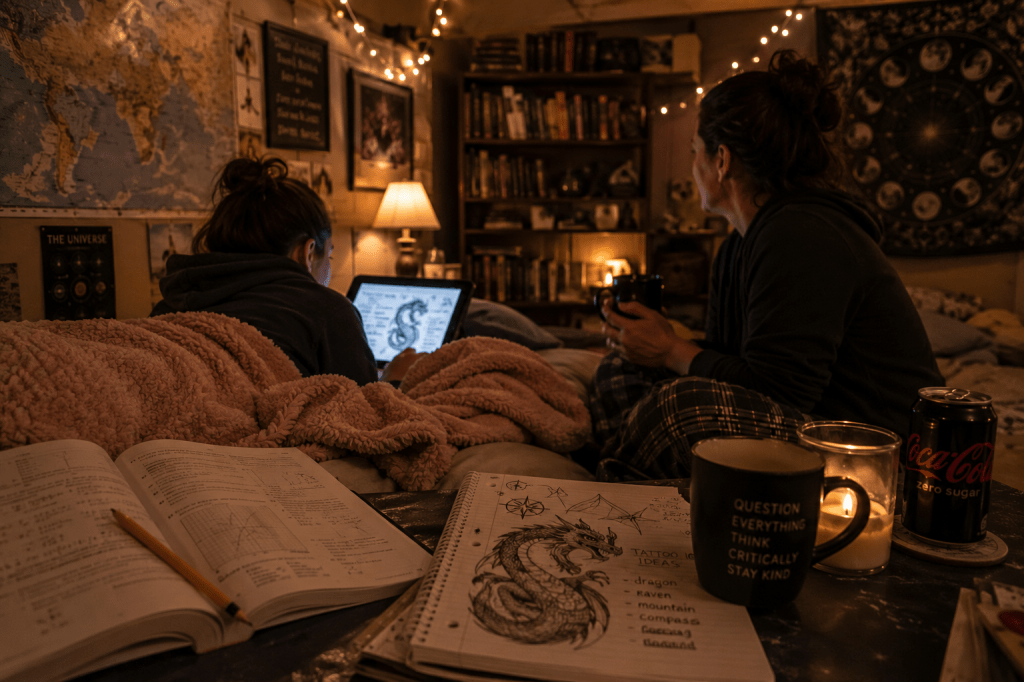
    Then somehow, as conversations with teenagers do, we went from discussing math avoidance to tattoos.

    Naturally.

    She pulled up her tattoo board. We debated what I’d theoretically allow when she turns sixteen. I joked that my bf offered to take her for her first tattoo one day, which honestly feels both sweet and mildly illegal somehow.

    At one point she showed me a dragon tattoo, and I said something about spirit animals.

    Friends.

    When I tell you this child immediately launched into a nuanced discussion about closed Indigenous spiritual practices, colonialism, cultural appropriation, and why my Gen-X “we’re all spiritually connected” worldview maybe wasn’t the progressive masterpiece I thought it was…

    Humbled. Absolutely humbled.

    At one point I found myself defending things I believed twenty years ago while my chronically ill teenager calmly cross-examined me from under a blanket nest.

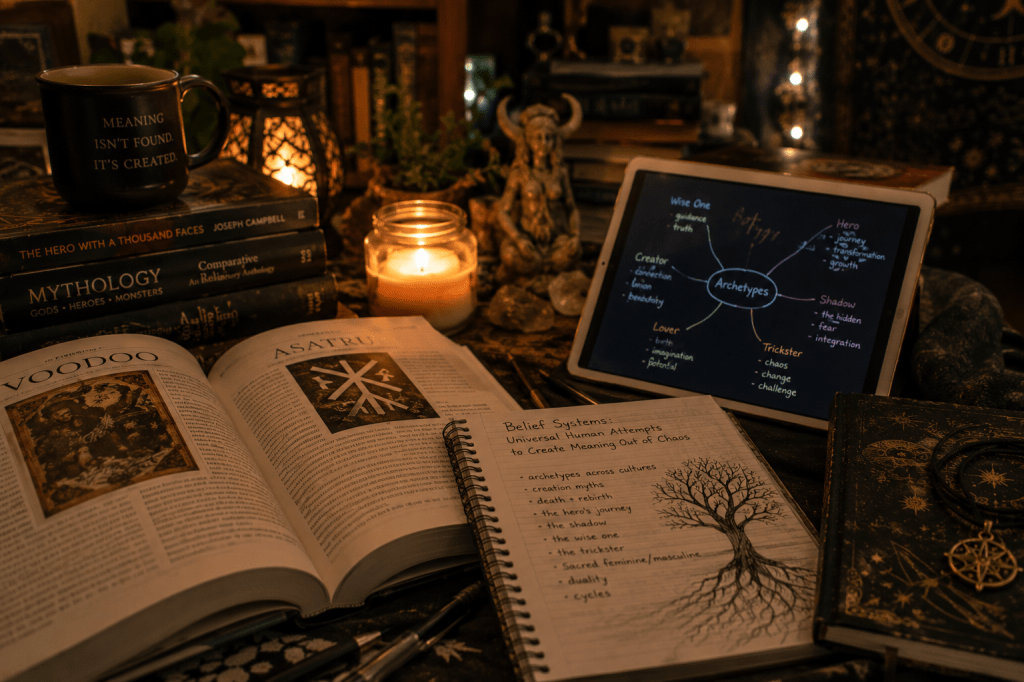
    A warm, candlelit study space filled with books, notebooks, and symbolic objects related to mythology, spirituality, and comparative religion. An open tablet displays a diagram of archetypes while handwritten notes explore belief systems and meaning-making throughout human history. Cozy lighting, celestial details, and scattered texts create a reflective atmosphere of intellectual curiosity and philosophical discussion.

    We somehow ended up discussing Voodoo, Asatru, comparative religion, archetypes throughout human history, and whether belief systems are universal human attempts to create meaning out of chaos.

    You know. Standard post-cardiac-stress-test mother-daughter bonding.

    And here’s the thing: She won the debate. (Who am I kidding, she wins every debate!)

    Not because I suddenly agreed with every point she made, but because she was thoughtful. Informed. Curious. Nuanced. Passionate.

    And because midway through the conversation, when I made a facial expression she didn’t like, she calmly said: “I don’t like when you make that face. It feels condescending.”

    No meltdown.
    No screaming.
    No escalation.

    Just direct communication.

    Then she told me she was proud of herself for setting a boundary calmly.

    And I realized I was proud too.

    Because when your kid is struggling with school, mental health, chronic illness, burnout, executive functioning, or just surviving day to day…it’s very easy to start measuring their worth by productivity.

    Did they do math?
    Did they clean their room?
    Did they attend class?
    Did they hand things in?
    Did they function?

    Meanwhile, your child is quietly becoming.

    Becoming thoughtful.
    Becoming articulate.
    Becoming emotionally aware.
    Becoming someone capable of critical thinking and self-reflection and ethical nuance.

    Those things count too.

    Sometimes I think parents like me get so focused on visible milestones that we miss the invisible ones happening right in front of us.

    Tonight, my daughter didn’t do math.

    But she also politely dismantled her Gen-X mother’s spiritual universalism after a cardiac stress test.

    And honestly?
    That feels like development too.

    I’d love to hear about a moment recently where your child surprised you, connected with you, or reminded you who they’re becoming underneath the struggle.

  • You’re Not Listening to Her: A Medical Advocacy Story

    You’re Not Listening to Her: A Medical Advocacy Story

    This blog is a tag-team effort between me and AI—think of it as my over-caffeinated intern who spits out ideas while I handle the heavy lifting. I research, fact-check, edit, and fine-tune everything to make sure it sounds like me (not a robot with a thesaurus). AI helps with the grunt work, but the heart, style, and final say? That’s all me, baby.

    I want to tell a story about what happened to my daughter and me in the Canadian healthcare system, because I know we’re not alone. I’ve changed all the names for anonymity, but the story is, sadly, all too real.

    The Pediatrician We Trusted…At First

    Years ago, I was referred to a pediatrician for my daughter Ava. At the time, she was around six and suffering from chronic stomach pain, constipation, recurring croup, and constant anxiety related to school. 

    She had nightmares, meltdowns, and was being ostracized and bullied. I knew something deeper was going on. I didn’t have the words “autism” or “ADHD” yet, but my mom gut told me she was different—and struggling.

    Our pediatrician—we’ll call him Dr. McLecturepants—was very knowledgeable. Ava liked him. He was good at addressing her physical health issues. He took things seriously, referred us to specialists, and was often thorough. 

    But there were red flags. 

    Dismissed, Doubted, and Lectured

    Early on, I was struggling to get Ava to take medication. What I now know is ARFID, sensory aversion, and autistic rigidity was, back then, just a nightmare every time I had to administer meds. 

    Meltdowns, sobbing, trauma for both of us. 

    When I asked for help, he didn’t offer compassion. He gave me a five-minute lecture on how I needed to “take control” and “stop letting her run the show.” It was humiliating. I left feeling like a failure.

    From then on, I was nervous around him. I often wondered, would he speak to me this way if a man were in the room? I was a single mom. White. Tired. Not wealthy. He was a male doctor with a strong accent—possibly Middle Eastern—and although I didn’t want to bring culture or bias into it, I couldn’t ignore the power dynamic. 

    I wrestled with myself for even thinking that cultural background might play a role — not because I wanted to stereotype him, but because I’ve lived long enough to know that gender dynamics can be shaped by upbringing, culture, and society. Still, I sat with the discomfort of that thought and tried to focus on what I knew: I felt talked down to, and I didn’t feel respected.”

    I felt small. 

    Like I was being treated as a hysterical mom, not a capable one.

    Homeschooling: The Best Decision We Made

    When school became unbearable for my daughter, I started researching homeschooling options. It wasn’t a knee-jerk decision. I consulted experts (including a clinical psychologist), read studies, and made spreadsheets. I also began compiling information about ADHD and neurodivergence, trying to be prepared to make my case.

    Dr. McLecturepants dismissed homeschooling outright. Didn’t want to hear about the trauma Ava was experiencing. Didn’t care that her nightmares and pain disappeared within two weeks of being pulled from school. 

    He continued to disapprove, even when I brought up ADHD. That, at least, he was more receptive to, but the lectures didn’t stop. I kept going back because he was knowledgeable about ADHD, and I thought I needed that.

    Rather, I thought my daughter needed that, and I should just shut up and deal.

    The Diagnosis Battle

    But when I brought up autism? He shut it down. Said she couldn’t be autistic because she made eye contact. (Yes, really. Hello, 1955 called and they want their scrubs back)

    Eventually, I demanded a referral. I gave him research. I asked for a specific autism specialist recommended by a trusted friend. 

    McLecturepants reluctantly referred us, but warned me the doctor “diagnosed everyone” and other professionals didn’t like him. I couldn’t believe he was dragging me into some petty professional rivalry when my daughter’s health was on the line.

    The diagnosing doctor met with my daughter, gave a comprehensive evaluation, and said, “Yes. She’s autistic.” 

    I went through ALL the feelings that day—IYKYK—but one of the ones I never expected to feel was validation. Someone else finally listened to me and I wasn’t crazy, which is what my pediatrician had been making me feel like. 

    The specialist did say kiddo might not have ADHD, but I trusted my gut—because comorbidity is common, and I’d done the reading. I was more worried that McLecturepants would react poorly when he read the report, particularly the part about the specialist disagreeing with his diagnosis. 

    It’s not fun to feel you’re caught in a pissing match between two health “professionals,” which only magnified my feelings of “walking on eggshells” with McLecturepants.

    The Funding Form Fiasco

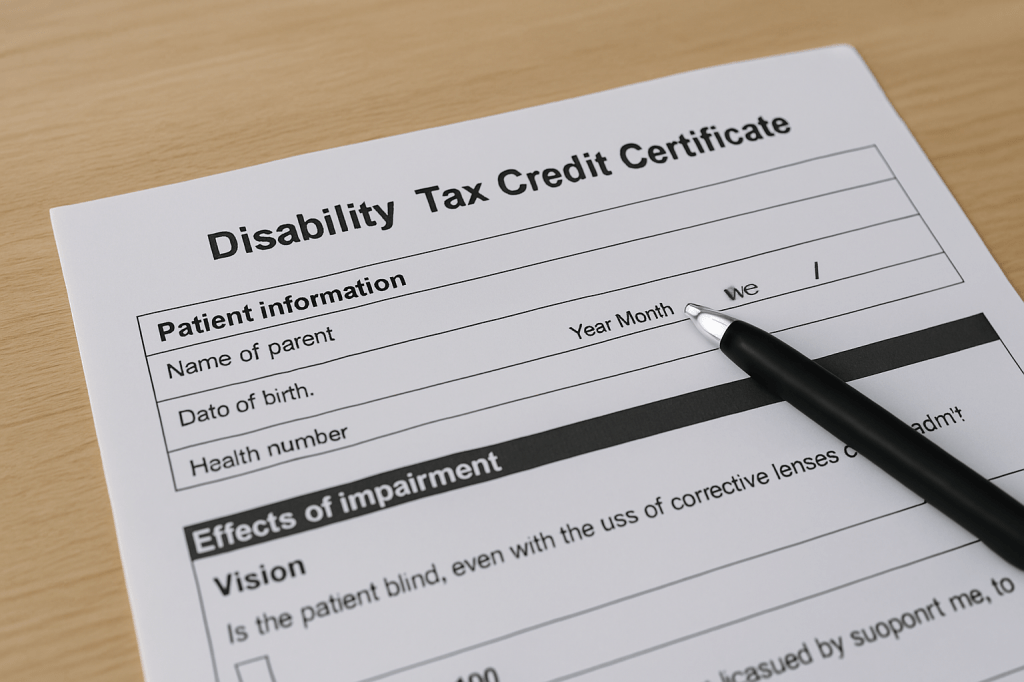
    Fast forward. The Disability Tax Credit needed renewing. We’d been working with a phenomenal ASD counsellor who’d seen Ava regularly and knew the extent of her challenges. The DTC forms went to Dr. McLecturepants. I was told it would take months to fill them out.

    I got emotional. After all, it was our only funding, given we’ve been on waiting lists for years with the Ontario Autism Program and Special Services at Home. (I’m looking directly at you, Doug Ford).

    McLecturepants ended up filling them out quickly over the holidays, which I appreciated—until I read them. He’d minimized kiddo’s struggles. Downplayed how much support she needs. Even checked the box saying her deficits would likely improve over time—as if autism isn’t a lifelong neurotype.

    When I first read what the pediatrician had written, I questioned everything about my reality. Maybe it wasn’t that bad? Maybe I was exaggerating, and making too much out of our struggles. Maybe there was something wrong with ME that I couldn’t handle the extra work required for my daughter?

    Thankfully our counsellor, who at this point had been visiting with my daughter and I for over a year, twice monthly for an hour at a time, also expressed her shock and surprise at how inaccurately Dr. McLecturepants had characterized our daily struggles.

    I was heartbroken. I drafted a letter—respectful, clear, and shared with our counsellor and friends for feedback. After all, I didn’t want to provoke another lecture. I didn’t want to make things worse, or insult our pediatrician’s professionalism, or god forbid, challenge him or hurt his ego.

    I brought in observations from myself, her grandparents, coaches, teachers—any adult in Ava’s life. I asked him to reconsider.

    He refused. Told his receptionist he wouldn’t change it. So I made an appointment. 

    Enough is Enough

    This time, the gloves were off, and I knew the advocate (me) needed an advocate.

    So I brought my mom—who never takes my side in these things; after all, I’m too outspoken, too sensitive, too…(you get the drift).

    But this time she came, because I needed backup. It meant so much to me that she did that, even though I could see she didn’t believe it was as bad as I said it was.

    When we tried to explain, he talked over us. 

    Not once, not twice. 

    Repeatedly. 

    McLecturepants wouldn’t acknowledge the fact that we might have a better understanding of the difficulties my daughter has every day. My mom—stoic, practical, no-nonsense—who never speaks up and hates confrontation, actually shouted: “You’re not listening to her!” after he cut me off yet again.

    That’s when I stood up and said: “We’re done. You’ve lectured me for years. Dismissed me. Put me in the middle of conflicts with other doctors. I believe you’ve treated me differently because I’m a woman, and I don’t feel safe bringing my daughter here anymore.”

    We left.

    One Final Violation 

    I picked up kiddo’s files a week later. On my way to our counsellor’s office, I noticed something strange. Mixed into Ava’s files were records for another child. Operations, procedures—stuff my daughter had never had. A huge privacy breach. I returned them immediately, because that’s what I’d want another parent to do if it were my child’s info. 

    But wow. 

    Just wow. 

    This from the office of a doctor who’d been lecturing me for years about MY incompetence as a mom?

    Blacklisted for Speaking Up

    We’ve been seeing our GP ever since. Lately, I’ve been researching other possible underlying conditions—things like hypermobility, POTS, immune dysfunction—and brought them up with our GP, who was amazing and agreed to help. He referred us to another pediatrician in our town.

    I didn’t realize this pediatrician was at the same office as Dr. McLecturepants. You can imagine the surprise when their office called to schedule the appointment. Still, I knew I would have a longer wait for a pediatrician from other, larger centers, so I agreed to the appointment.

    Why would I go back?

    If you’ve ever had a sick child, you’ll understand that all you care about is making their quality of life better.

    And then, today, after picking up my daughter from school, a call came in from our GP’s office, which I took over our hands free, thinking it was about my upcoming blood tests. 

    We’d been rejected. Well, technically the word they used is, he has “declined.”

    The new doctor wouldn’t take us as patients because of my “issue” with the previous pediatrician. And my daughter heard every word of that rejection.

    The message was clear: they stick together.

    This is what it’s like to advocate for a neurodivergent child in the medical system as a single mom.

    No one’s listening.


    Backing it Up: What the Research Says

    Sexism in the Medical Profession:

    • A 2022 study published on “Women’s Experiences of Health-Related Communicative Disenfranchisement,” found that women are more likely to report feeling dismissed, not believed, or condescended to by medical professionals.
    • Female patients, especially mothers, often get labeled as “anxious” or “overreacting” when advocating for their children, leading to delayed diagnoses and interventions.

    Bias Against Single Mothers:

    • Single mothers are statistically more likely to be perceived as less competent parents by both professionals and the public.
    • These biases can lead to increased scrutiny, less support, and more judgment in medical and educational settings.

    Challenges of Advocating for Autistic Children:

    • Parents often report having to fight for recognition of their child’s needs, with many diagnoses being delayed due to outdated stereotypes like “they make eye contact.”
    • Autistic girls and children with Level 1 Autism (formerly known as Asperger’s) are often underdiagnosed due to masking and lack of understanding by professionals. 

    Privacy and Confidentiality in Canada (PHIPA):

    • The Personal Health Information Protection Act (PHIPA) mandates that healthcare providers protect the confidentiality of all patient information.
    • Sharing or misfiling another child’s medical information, even accidentally, is a breach under this act and can be reported to the Information and Privacy Commissioner of Ontario.

    Medical Ethics & Gatekeeping:

    • Physicians are ethically bound to advocate for patient welfare and make decisions free from personal bias or inter-professional politics.
    • Refusing care to a child based on a parent’s disagreement with another doctor raises serious ethical concerns about bias, access to care, and professional conduct.

    Why Parents Shouldn’t Be Penalized for Speaking Up:

    • Advocacy is not aggression. Speaking up about misdiagnosis, misrepresentation, or mistreatment should never result in being blacklisted.
    • Punishing parents for advocating silences necessary voices and puts children’s care at risk.

    This is my story. It’s also the story of so many parents out there who’ve been dismissed, condescended to, or penalized for doing what they’re supposed to do: protect and advocate for their child.

    We shouldn’t have to shout to be heard. But sometimes we do. And when we do? We deserve to be listened to.

    April is World Autism month. Do your part. Speak up. Advocate. Scream. Pound your fists. Or better yet, write a blog and call the assholes out.