Tag: school avoidance

  • My Teenager Politely Dismantled My Gen-X Spiritual Universalism

    My Teenager Politely Dismantled My Gen-X Spiritual Universalism

    Full disclosure: I was emotionally exhausted and wanted to capture this while it was still fresh, so I stream-of-consciousness dumped everything into ChatGPT and had it help organize my thoughts into a readable post. Usually I write the majority of my content myself and use “Chatty” more for editing, structure, brainstorming, and helping my ADHD brain untangle itself. 

    There are moments, as a parent of a struggling neurodivergent teen, where you suddenly realize your child has been growing the entire time…just not always in the ways society measures.

    Kiddo had her first cardiac stress test today. Which sounds adorable if you phrase it like, “baby’s first stress test,” but apparently cardiology frowns upon that kind of humour.

    She came home exhausted. Pale. Achy. Just completely wiped.

    Earlier in the day I’d gently suggested maybe she crack open her math book for a bit. Later, when I went downstairs to check on her, there was still no math happening.

    Instead, she looked at me with this sad little face and said, “Mom…am I a failure? I want to do school and math. I just can’t.”

    And honestly? That sentence punched me directly in the soul.

    Because I think a lot of neurodivergent kids eventually start confusing “I can’t right now” with “I am bad.”

    And the truth is, this kid has been fighting through exhaustion, chronic nausea, dizzy spells, suspected POTS symptoms, executive dysfunction, anxiety, burnout…all while still trying to figure out who she is as a person.

    So I told her there was no pressure. That she was sick. That struggling doesn’t make her a failure.

    Then somehow, as conversations with teenagers do, we went from discussing math avoidance to tattoos.

    Naturally.

    She pulled up her tattoo board. We debated what I’d theoretically allow when she turns sixteen. I joked that my bf offered to take her for her first tattoo one day, which honestly feels both sweet and mildly illegal somehow.

    At one point she showed me a dragon tattoo, and I said something about spirit animals.

    Friends.

    When I tell you this child immediately launched into a nuanced discussion about closed Indigenous spiritual practices, colonialism, cultural appropriation, and why my Gen-X “we’re all spiritually connected” worldview maybe wasn’t the progressive masterpiece I thought it was…

    Humbled. Absolutely humbled.

    At one point I found myself defending things I believed twenty years ago while my chronically ill teenager calmly cross-examined me from under a blanket nest.

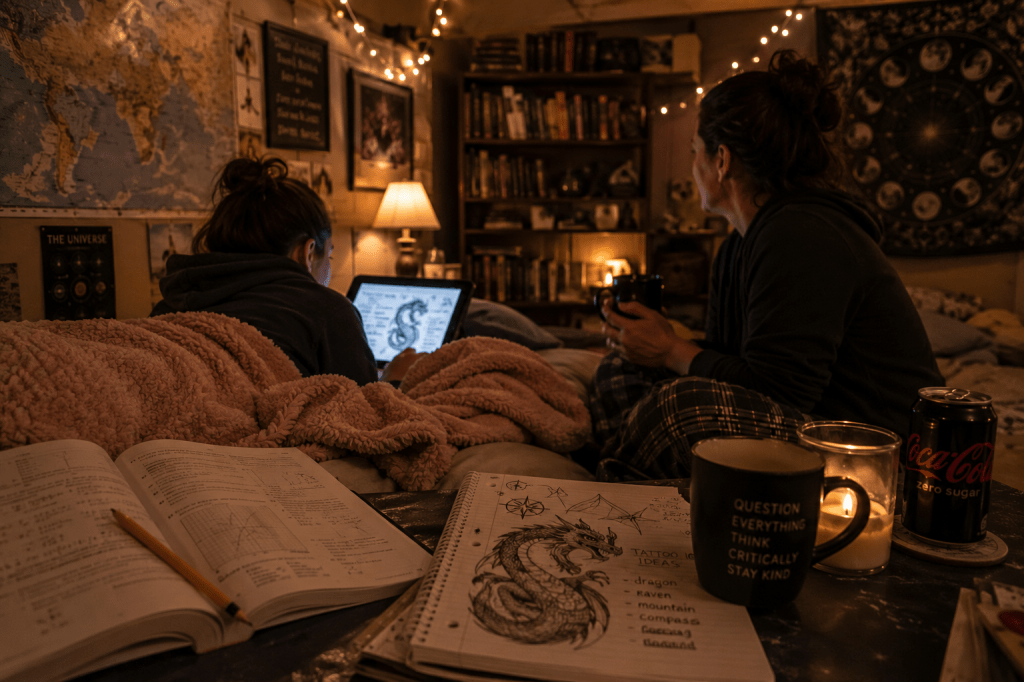
    A warm, candlelit study space filled with books, notebooks, and symbolic objects related to mythology, spirituality, and comparative religion. An open tablet displays a diagram of archetypes while handwritten notes explore belief systems and meaning-making throughout human history. Cozy lighting, celestial details, and scattered texts create a reflective atmosphere of intellectual curiosity and philosophical discussion.

    We somehow ended up discussing Voodoo, Asatru, comparative religion, archetypes throughout human history, and whether belief systems are universal human attempts to create meaning out of chaos.

    You know. Standard post-cardiac-stress-test mother-daughter bonding.

    And here’s the thing: She won the debate. (Who am I kidding, she wins every debate!)

    Not because I suddenly agreed with every point she made, but because she was thoughtful. Informed. Curious. Nuanced. Passionate.

    And because midway through the conversation, when I made a facial expression she didn’t like, she calmly said: “I don’t like when you make that face. It feels condescending.”

    No meltdown.
    No screaming.
    No escalation.

    Just direct communication.

    Then she told me she was proud of herself for setting a boundary calmly.

    And I realized I was proud too.

    Because when your kid is struggling with school, mental health, chronic illness, burnout, executive functioning, or just surviving day to day…it’s very easy to start measuring their worth by productivity.

    Did they do math?
    Did they clean their room?
    Did they attend class?
    Did they hand things in?
    Did they function?

    Meanwhile, your child is quietly becoming.

    Becoming thoughtful.
    Becoming articulate.
    Becoming emotionally aware.
    Becoming someone capable of critical thinking and self-reflection and ethical nuance.

    Those things count too.

    Sometimes I think parents like me get so focused on visible milestones that we miss the invisible ones happening right in front of us.

    Tonight, my daughter didn’t do math.

    But she also politely dismantled her Gen-X mother’s spiritual universalism after a cardiac stress test.

    And honestly?
    That feels like development too.

    I’d love to hear about a moment recently where your child surprised you, connected with you, or reminded you who they’re becoming underneath the struggle.

  • Pathological Demand Avoidance and Autism: A Quick Primer

    Pathological Demand Avoidance and Autism: A Quick Primer

    (Note: Chat GPT Assisted)

    “Autism”, “ASD”, and “PDA”. These aren’t just random abbreviations – they’re essential keys to understanding the vast, colourful world of neurodiversity. Dive into this guide and let’s decode the mystery behind PDA, all while keeping a sense of humour about it.

    Source: Pexels

    What the Heck is PDA (What, You Mean it’s Not a Public Display of Affection)?

    Let’s get our bearings straight:

    • PDA stands for pathological demand avoidance.
    • It’s a subtype of autism spectrum disorder (ASD).
    • PDA involves an extreme avoidance of everyday demands, often driven by high levels of anxiety.
    • A quick history tidbit: PDA was first identified in the 1980s by child psychologist Elizabeth Newson. (Yep, while you were busy rocking those leg warmers and mullets, science was making strides!)

    “Does My Kiddo Have PDA?” – Behaviours to Watch Out For

    Now, no two children are alike, and no, I don’t mean like snowflakes. More like, um, ice cream flavors? But here are some general signs:

    • Resistance to Ordinary Demands: Ever felt like you’re negotiating with a mini-diplomat just to get shoes on for school? This isn’t your typical child stalling. It’s an intrinsic need to resist routine tasks that most of us find mundane.
    • Comfort in Role Play: They might often take on roles or personas and communicate through them. Sherlock today, Spider-Man tomorrow! It’s not just play; it’s a coping mechanism.
    • Social Mimicry: They can often imitate others to mask their difficulties. This isn’t about being the ‘class clown’. It’s a way for them to fit in, making it sometimes hard to pinpoint. Crafty little beings, aren’t they?
    • High Levels of Anxiety: Their anxiety levels are more profound than the dread you feel when you accidentally like a picture from 2012 while stalking someone on social media. This can manifest in various ways:
    • School Avoidance: It goes beyond the occasional “I don’t wanna go!” It’s a deep-rooted fear or reluctance that makes school mornings seem like a scene out of an action movie – and for some chilldren, like mine, a horror movie.
    • Aggression When Anxious: Not just a temper tantrum. When they’re pushed to their limit, their fight-or-flight response might lean heavily on the ‘fight’. This could look like punching walls, throwing things, taking scissors to walls, pushing you, or screaming insults at caregivers.
    • Panic Attacks: Heart-wrenching to watch, these sudden bouts of intense fear can immobilize them. It’s not “attention-seeking” but a genuine overwhelming feeling they can’t control.
    • Self-Harm: Children with PDA often use self-harm, often as a grounding technique to take their mind off their tumultuous feelings of anxiety in their body. This could look like hitting their head with their hands, slapping themselves in the face, or beating their head agains a wall. It’s scary to watch, and can be deeply unsettling for both parent and child.

    Diagnosis: When Should You Seek Professional Insight?

    Your intuition as a parent is uncanny. If you’re feeling something’s up, trust your gut, and:

    1. Consult a Specialist: This usually starts with a pediatrician or a child psychologist.Don’t take “no” for an answer. Unfortunately, there are many medical professionals who don’t believe in PDA, and many who are just not familiar with it. This is where you need to do your own research mama, and go with spreadsheets and data in tow!
    2. Undergo Assessment: This can include observations, interviews, and specific PDA-focused questionnaires.
    3. Receive a Diagnosis: Now that you have a better understanding of your child’s challenges, it’s time to search for supports that fits their needs (and yours.) You’ll also need to arm yourself with information so you can adovcate with schools, coaches, and any other environments your child may need special accommodations in.

    Remember, it’s not about labelling but understanding and supporting your child through this journey.

    Treating PDA: No One-Size-Fits-All Here!

    Treatment is as unique as your child’s fingerprint or your secret cookie stash (oops, did I just spill the beans?):

    • Individual Therapy: Tailored strategies to cope with demands and anxiety.
    • Family Counseling: Because, let’s face it, we all need a bit of group therapy after those family board game nights.
    • Educational Support: Tweaking their learning environment to suit their needs, minus the unnecessary pressure.

    Tips for Navigating the Rollercoaster of PDA at Home

    Welcome to the ‘PDA Theme Park’. Hold onto Your Hats!

    Navigating the zigzaggy roller coaster that is PDA can be, well, quite the wild ride. But fear not! With a sprinkle of patience, a dash of creativity, and the following strategies, you can ensure the ride is smoother for both you and your young adventurer:

    • Pick Your Battles: Does it matter if they wear PJs to the supermarket? Hey, some celebrities have worn meat dresses to award shows, so PJs sound pretty haute couture to me!
    • Use Indirect Requests: Instead of the direct “Brush your teeth,” try a bit of playful challenge like, “Hmm, I wonder who can make their teeth shine the brightest?” Engage their imagination!
    • Establish Safe Spaces: Picture this – a cozy nook with fluffy pillows, their favorite book, and maybe a soft light. Everyone, especially our PDA champions, needs a sanctuary to retreat to when the world gets a tad too overwhelming.
    • Humor is Your Friend: When in doubt, laugh it out! Remember that time you tried to wear two different shoes to work? Yeah, life can be absurd. Sharing a hearty laugh can diffuse tension in a jiffy.
    • Negotiate Like a Pro: It’s not about manipulation; it’s a two-way street. Maybe it’s a compromise, or perhaps it’s letting them feel they have a say. “10 more minutes of play, and then we tackle homework. Deal?”
    • Keep it Low-Key: Sometimes, the fanfare and fuss can be overwhelming. Approaching situations calmly and without a ton of drama can often lead to more successful outcomes.
    • Collaborate with Your Child: Make them part of the solution. “Okay, so we need to do X. How do you think we should get it done?”
    • Find Their Motivation: Is there a toy, a story, or maybe a treat they love? Use it as a carrot (or maybe a cookie?). “Once we’ve tidied up, how about we read that new comic together?”

    These tips may not look like ordinary parenting, but your child is extraordinary, so these special tips will help them (and you) get stuff done with less head-butting and more hugs.

    Wrapping Up: From PDA to BellaZinga!

    Speaking of understanding and celebrating neurodiversity, have you heard of BellaZinga? Inspired by a brilliant girl named Bella who dazzles on the autism spectrum, our online store uses printable merch and educational materials to promote the inclusion, acceptance, and celebration of the true spirit of neurodiversity. Need a touch of inspiration or just a sprinkle of awareness in your life? Swing by BellaZinga and let some neurodivergent light shine on you!

    P.S. While you’re there, maybe grab a little something. Who says advocacy can’t be stylish? 😉🌟