
Tag: sensory overload

  • Autistic Burnout at 57: Rethinking My Depression and Fibromyalgia

    Autistic Burnout at 57: Rethinking My Depression and Fibromyalgia

    AI tools were used to assist with editing, organization, and some visual elements in this post.

    I hear my friends talk about how good they feel when they wake up after a solid night’s sleep.

    Refreshed.
    Clear-headed.
    Ready for the day.

    And I always wonder… What does that actually feel like?

    Because I can count on one hand the mornings in my life where I’ve woken up feeling good.

    Most mornings are a battle.

    A battle against exhaustion.
    Pain.
    Anxiety.

    Often my body feels like it’s been hit by a truck. I wake up feeling just as tired—sometimes more tired—than when I went to bed.

    That “refreshed” feeling people talk about?

    Honestly? Fuck off with that.

    Because at this moment it feels like a taunt. One more thing I’m apparently not allowed to have in this lifetime.

    And in a sea of difficult mornings, this one hit monsoon proportions.

    Even my eyes hurt. The light was too much. My head, neck, and shoulders ached. My hands were claws because the flexors and extensors seemed to be at war with each other. My lower back was crying. My hip bones? Don’t even get me started.

    It took forever just to sit up.

    And yes, I used every bullshit motivational phrase in my fairly sturdy arsenal. (Add irritability to my list of symptoms). Thirty years of coaching gives you a decent toolbox.

    “You can do this.”
    “One small step.”
    “Just sit up first.”

    But no amount of self-talk made it easier.

    Because this wasn’t just a mindset problem.

    I’ve Been “Tired” Since I Was 16

    I was first diagnosed with depression at 16 or 17.

    At the time, my mom dragged me to the doctor because I was so tired I could barely walk up a flight of stairs.

    Showering? Exhausting.
    Walking? Exhausting.
    Thinking? Exhausting.

    And before anyone assumes I was out of shape—I was a competitive figure skater training 15–20 hours a week. I was in peak physical condition.

    Still couldn’t climb the damn stairs.

    Over the years, I’ve had depressive episodes. Some clearly tied to life events.

    A death in university.
    Failing a course twice.
    Leaving an abusive partner in the middle of the night in a city where I knew no one.
    Infertility.
    Fertility drugs that I was told wouldn’t affect me, even though I warned the doctor I’m sensitive. (Spoiler: they did.)

    After a concussion on the ice while pregnant (yes, I was teaching, don’t judge), then childbirth, things shifted again.

    Sleep deprivation.
    Single parenting.
    Starting over in a new town.
    Dog-eat-dog coaching culture.

    And then the body pain.

    Full-body soreness that didn’t feel like training soreness. Hands clawed in the morning. Joints feeling fused together. Like I was wearing a suit of armor.

    There were days the pain was so intense my teeth would chatter.

    Eventually, after being dismissed more than once, a sports medicine doctor looked at me and said, “This isn’t a sports injury.”

    I said, “I think it’s fibromyalgia.”

    She agreed. Referred me to a rheumatologist. I had a diagnosis within a week.

    Relief. Validation. Finally.

    There are good doctors out there.

    But as the parent of a neurodivergent kid in a small town? My faith still wobbles.

    So Why Am I Questioning Everything Again?

    Because now I’m 57.

    And I’ve recently acknowledged something else about myself.

    I’m autistic.

    Late to the party. But here nonetheless.

    I’m self-identified. Not formally diagnosed.

    And before anyone clutches their pearls — self-identification is valid in a community where many women can’t access assessment due to cost, waitlists, geography, or years of being dismissed. I’ve done the reading. The reflecting. The pattern-matching across my entire life. This isn’t impulsive. It’s informed.

    And once you look at your life through that lens? It’s like the whole timeline rearranges itself.

    Everything feels hard again.

    Showering is hard.
    Speaking and formulating thoughts is hard.
    Light is too much.
    Headaches. Nausea. Brain fog.
    Overwhelm from the smallest tasks.

    I know. I know. There are a million other things this could be.

    And I’ve been checked.

    But the more I read about autistic burnout—especially in adult women—the more I feel that uncomfortable little a-ha click in my chest.

    What if I haven’t just been depressed?

    What if I haven’t just had fibromyalgia?

    What if I’ve also been burning out my nervous system for decades?

    So What Is Autistic Burnout?
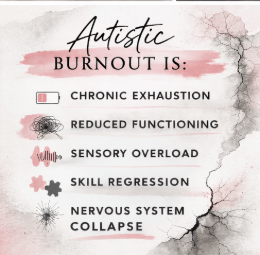
    Autistic burnout isn’t just being tired.

    It’s not “I had a big week.”
    It’s not “I need a vacation.”
    It’s not regular workplace burnout.

    Researchers describe autistic burnout as chronic exhaustion, reduced functioning, and decreased tolerance to sensory input following long-term stress and unmet support needs (Raymaker et al., 2020; AIDE Canada Toolkit).

    Translation?

    Your nervous system has been running on high alert for so long that it just… stops cooperating.

    Autistic adults actually named burnout first. Researchers later studied it and confirmed the pattern: long-term stress, masking, unmet support needs — and eventually a collapse in capacity (Raymaker et al., 2020).

    Burnout isn’t just exhaustion.

    It can look like:

    • Brain fog
    • Trouble speaking or finding words
    • Executive dysfunction that wasn’t this bad before
    • Sensory overload — light, sound, touch suddenly feel like too much
    • Loss of skills you used to manage
    • Increased anxiety
    • Shutdown

    It doesn’t always look like sadness.

    Sometimes it looks like:
    “I can’t.”

    And unlike regular stress, it doesn’t necessarily get better with a good weekend. It can last months, especially if the demands don’t change.

    Burnout vs Depression vs Fibromyalgia: Why This Is So Damn Confusing

    Burnout can look like depression.
    Depression can look like burnout.
    Fibromyalgia overlaps with both.

    Depression often includes:

    • Persistent low mood
    • Loss of interest or pleasure
    • Hopelessness
    • Emotional heaviness

    Autistic burnout doesn’t always include that deep hopelessness.

    It’s more like:
    “My system is overloaded. I don’t have capacity.”

    Fibromyalgia brings another layer:

    • Widespread pain
    • Tender points
    • Non-restorative sleep
    • Morning stiffness
    • Flare cycles tied to stress

    Studies show elevated rates of depression, chronic fatigue, and fibromyalgia among autistic adults, suggesting these conditions may overlap rather than exist in isolation (Altogether Autism; More Good Days; PMC8992921).

    Which means it might not be either/or.

    It might be all of it.

    A nervous system under chronic stress can express itself in mood.
    In pain.
    In shutdown.
    In exhaustion.

    Bodies are messy like that.

    A Kitchen Table Self-Check

    (Not a diagnosis. Just curiosity.)

    I am not diagnosing anyone.
    Hell, I’m barely diagnosing myself.

    But here’s a gentle gut-check to help me (and you) sort through this fog.

    You might lean toward autistic burnout if…

    • You feel chronically exhausted in a way that rest doesn’t fully fix.
    • Small tasks feel disproportionately hard.
    • Sensory things suddenly feel unbearable.
    • You’ve “lost” skills you used to manage.
    • Reducing demands helps more than motivational self-talk does.
    • You feel overloaded, not necessarily hopeless.

    You might lean toward depression if…

    • There’s a persistent low mood.
    • Things that once brought joy feel flat.
    • You feel hopeless or numb.
    • The exhaustion feels emotionally heavy.

    You might lean toward fibromyalgia if…

    • Widespread pain is central.
    • Morning stiffness is intense.
    • Sleep doesn’t restore you.
    • Your body feels like it’s wearing armor.

    And here’s the inconvenient truth:

    It might not be just one thing.

    The Cost of Being “Normal” for Decades

    If I’m autistic, then I’ve been adapting to a world not built for me for 57 years.

    That’s a long time to hold your breath.

    Masking works.
    Until it doesn’t.

    Research on late-diagnosed autistic women highlights decades of compensating and masking—often at significant psychological and physical cost (UCLA Health; Neurodiversity Centre).

    Masking isn’t just social camouflage.

    It’s energy expenditure.

    And energy is finite.

    Emerging discussions around autism and menopause suggest sensory sensitivity and burnout can intensify in midlife as hormonal shifts affect nervous system regulation (ScienceWorks Health).

    So maybe this isn’t random.

    Maybe this is cumulative.

    Maybe my nervous system didn’t fail me.

    Maybe it finally told the truth.

    Maybe I Was Never Just Depressed

    I was 16 and couldn’t climb stairs.

    I was diagnosed with depression.

    I was diagnosed with fibromyalgia.

    And maybe those diagnoses were accurate.

    But maybe they weren’t the whole story.

    Because when I look back now—as a 57-year-old, self-identified autistic woman—I don’t just see sadness.

    I see decades of adaptation.

    Of performing competence.
    Of tolerating sensory overload.
    Of managing social politics.
    Of caregiving without pause.

    Maybe the exhaustion isn’t weakness.

    Maybe the armor-body mornings aren’t laziness.

    Maybe the overwhelm isn’t a character flaw.

    Maybe it’s what happens when you run a brain and body in survival mode for half a century.

    I don’t have a clean answer.

    It might be depression.
    It might be fibromyalgia.
    It might be autistic burnout.

    It might be all of it.

    But if I’ve been interpreting neurological overload as personal failure for decades?

    That story ends here.

    And if you’re 40. Or 50. Or 57. And you’re waking up feeling like you’ve been hit by a truck—physically, mentally, emotionally—maybe you’re not broken either.

    Maybe you’re overloaded.

    And maybe the question isn’t, “What’s wrong with me?”

    Maybe it’s, “What have I been carrying for far too long?”

    Sources & Further Reading

    Raymaker, D. et al. (2020). “Having All of Your Internal Resources Exhausted Beyond Measure”: Autistic Burnout.
    AIDE Canada. Autistic Burnout Toolkit.
    UCLA Health. Understanding Undiagnosed Autism in Adult Females.
    Neurodiversity Centre. Masking and Burnout in Autistic Women.
    Neurodivergent Insights. Autistic Burnout vs Depression.
    Attwood & Garnett Events. How Depression May Present Differently in Autistic People.
    Altogether Autism NZ. Chronic Fatigue, Fibromyalgia and Autism.
    PMC8992921.
    ScienceWorks Health. Autism and Menopause.

  • Hypermobility, Autonomic Disorders, and Autism: Unraveling the Connections

    Hypermobility, Autonomic Disorders, and Autism: Unraveling the Connections

    AI lends a hand in drafting parts of this article, but I do the heavy lifting—researching, editing, and ensuring the message is clear, accurate, and aligned with my vision. Think of AI as my brainstorming buddy, but the final say (and human touch) is all mine.

    Ever heard of hypermobility, autonomic disorders, or autism? They might seem like totally different things, but guess what? They’re actually connected! It’s like a puzzle where these conditions often fit together.

    Think of it this way:

    • Lots of people with autism also have hypermobility (that’s when your joints bend more than usual).
    • And sometimes, people with hypermobility also have autonomic disorders (that’s when your body’s automatic systems like heart rate and digestion don’t work properly).

    So, what does this all mean? It means that understanding how these conditions relate to each other can help us find better ways to support people who experience them.

    Understanding Hypermobility

    Hypermobility is when your joints can move way past the normal range—think of it as being super flexible. This happens because the connective tissue that holds your joints together is different, usually looser, or weaker, or both.

    Definitions and Types

    Joint hypermobility means your joints can move past the usual range—sometimes way past it. For some people, it’s just how their body is built, but for others, it’s linked to genetic conditions like Ehlers-Danlos Syndrome (EDS). There are a few different types of EDS, but the most common one is Hypermobile Ehlers-Danlos Syndrome (hEDS).

    When multiple joints are extra bendy, it’s called generalized joint hypermobility. One common way to check for it is the Beighton score, a quick test that looks at how far you can bend things like your fingers, elbows, or knees. If you’ve ever been told you’re “double-jointed,” this might be why!

    Recognizing Symptoms

    So, you’re probably asking yourself, “how do I know if my kind of ‘bendiness’ is normal?” Well, if it’s more than just being bendy—like if you’re dealing with joint pain, frequent dislocations, or other weird body quirks—it might be worth looking into. You may have Joint Hypermobility Syndrome (JHS).

    And it’s not just about your joints. Some people with hypermobility also have super soft or stretchy skin, plus fun extras like digestive issues and fatigue (because why stop at just one challenge, right?). Spotting these symptoms early can help you get ahead of things and manage them better.

    Diagnosis of Joint Hypermobility Syndrome

    Getting diagnosed with JHS isn’t just about being extra bendy—your doctor will look at your medical history, do a physical exam, and probably check your Beighton score (yep, that test we mentioned earlier).

    But let’s be real—you might have to push for more thorough testing. As we’ve already stressed, hypermobility can be linked to other conditions, like EDS, which sometimes requires genetic testing to confirm. For example, the TNXB gene is one that might get checked to help understand the genetic side of EDS.

    Getting the right diagnosis is a game-changer—it helps you manage symptoms better and avoid potential complications down the road.

    Understanding Autonomic Disorders

    Just when you things weren’t complicated enough, we’re going to throw autonomic disorders into the mix. I know, I know! But stay with me, I promise I’m going somewhere with this.

    Autonomic disorders mess with the part of your nervous system that handles all the behind-the-scenes stuff—like keeping your heart beating and your digestion running smoothly—without you even thinking about it. When things go wrong, it can lead to symptoms like dizziness, chronic fatigue, and stomach issues. And if you throw hypermobility into the mix? Those problems can hit even harder.

    Introduction to Autonomic Dysfunction

    Autonomic dysfunction happens when your autonomic nervous system—aka the body’s autopilot—doesn’t do its job properly. This system handles all the stuff you don’t have to think about, like breathing, keeping your heart beating, and digesting food. When it’s out of whack, you can end up dealing with dizziness, insomnia, and some seriously annoying digestive issues.

    Chronic fatigue is another common symptom of autonomic dysfunction, often leaving you feeling tired no matter how much you rest. These symptoms can seriously affect your day-to-day life, making it hard to focus at school or work and impacting your social life. Learning to manage these symptoms often involves both medical treatments and lifestyle changes.

    Co-occurrence with Hypermobility

    Hypermobility—aka super flexible joints—often goes hand in hand with autonomic disorders. If you’ve got both, you might notice overlapping symptoms like dizziness and fatigue, which can make it feel like your whole body is out of sync.

    Digestive issues, like constipation or IBS, are also pretty common with both conditions, adding another layer of discomfort to everyday life. The more you understand the connection between hypermobility and autonomic dysfunction, the better you can find treatments that tackle both at the same time.

    Managing it all usually takes a mix of medication, physical therapy, and lifestyle tweaks to help you feel more in control and improve your quality of life.

    Hypermobility and Autism Connection

    Hypermobility and autism tend to go hand in hand, and it’s not just a coincidence. There are a lot of overlapping traits—like sensory sensitivities, certain behaviors, and unique ways the brain processes things. Knowing how they connect can make everyday life a little easier and help set realistic, supportive goals that actually work for you.

    Common Traits and Co-occurrence

    Hypermobility shows up a lot in autistic people—some studies say up to 80% might have it. Both come with similar traits, like heightened sensory awareness and unique reactions to the world around them. Basically, they overlap in ways that can shape how someone experiences daily life.

    Anxiety and depression are also pretty common in this group, likely because of all that extra sensory input and cognitive overload. If you’ve got both hypermobility and autism, everyday tasks can feel even more overwhelming, cranking up stress and sensory overload. But figuring out ways to manage these shared traits can make a huge difference in feeling more comfortable and in control.

    Implications for Daily Life and Development

    Living with both hypermobility and autism comes with some unique challenges that can impact daily life. Here’s how:

    • Physical difficulties – Joint instability can make movement tough, leading to issues with balance and coordination. This can make sports or even basic activities harder and might require customized physical support.
    • Developmental impact – Learning environments can be tricky, with some kids needing specific strategies to help with focus, motor skills, or sensory processing.
    • Additional health challenges – Conditions like eating disorders or epilepsy sometimes show up alongside hypermobility and autism, adding extra layers of difficulty to daily routines.
    • Personalized support is key – Tailored approaches—whether through therapy, accommodations, or understanding caregivers—can make all the difference in creating a supportive, functional environment.

    Figuring out what works best for you can help make life more manageable and improve overall well-being.

    Management and Support for Hypermobility and Associated Conditions

    Managing hypermobility usually takes a mix of therapies, mental health support, and lifestyle adjustments. Each piece plays a big role in making daily life easier and keeping symptoms in check.

    Therapies and Rehabilitation

    • Physical therapy is a game-changer when it comes to improving motor control and core strength. A good therapist will tailor exercises to help strengthen the muscles around your hypermobile joints, which can make a huge difference in posture and reducing chronic pain.
    • Occupational therapy is all about making daily life easier. It can teach you energy-saving techniques to help manage fatigue and keep you from burning out so quickly. Plus, regular exercises can improve proprioception (aka your body’s ability to know where it is in space), which helps reduce injuries and those frustrating missteps.
    • Talking to rehab specialists can also help you find solid pain management strategies—because dealing with discomfort every day is exhausting, and having the right techniques can make all the difference.

    Navigating Psychological Aspects

    Hypermobility and anxiety tend to go hand in hand, and dealing with both can be a lot. Recognizing the emotional toll is just as important as managing the physical side of things.

    • Therapy and support groups: Talking to a therapist who understands anxiety (and how it connects to hypermobility) can be a game-changer. Support groups can also help, especially if you’ve ever felt left out or misunderstood because of your symptoms.
    • Mindfulness and stress relief: Practices like meditation, deep breathing, or gentle movement (like yoga) can help with relaxation and keep stress levels in check.
    • Open communication: Being upfront with your therapist about what’s working (and what’s not) can help them tailor strategies that actually fit your life.
    • A solid support system: Surrounding yourself with understanding family, friends, or even an online community can make all the difference. Having people who get it and encourage you can help you navigate the tough days.

    Emotional health is just as important as physical health, and finding the right mix of coping strategies, support, and self-care can make everything feel a little more manageable.

    Lifestyle Modifications and Support Systems

    Making small lifestyle tweaks can have a huge impact on how you feel day to day.

    • Fuel your body right: Eating a balanced diet can help support your overall health (because let’s be real, running on caffeine and vibes only gets you so far).
    • Listen to your body: If fatigue is hitting hard, pacing yourself and scheduling rest breaks can keep you from crashing and burning.
    • Know your history: If joint hypermobility syndrome (JHS) runs in your family, being aware of it early can help you get ahead of potential issues.
    • Build your support squad: Whether it’s doctors, therapists, family, or friends, having people who get it makes all the difference. Surround yourself with folks who support you, not ones who tell you to “just stretch more” (because, yeah… that’s not the problem).

    The key is finding what works for you—a mix of nutrition, pacing, knowledge, and support that helps you feel as good as possible while managing hypermobility.

    Frequently Asked Questions

    The connection between hypermobility, autonomic disorders, and autism is complicated—like trying to untangle a bunch of charging cables from the bottom of your bag. This section dives into how these conditions overlap, affect each other, and what current research has to say about it. Spoiler: It’s all connected in ways we’re just beginning to understand.

    What’s the connection between joint hypermobility and autistic traits?

    Researchers have picked up on a connection between joint hypermobility and autism. Some studies suggest shared genetic factors might be at play, but there’s still a lot we don’t know. More research is needed to fully untangle how these two conditions are linked—but the connection is definitely there.

    Can autism impact your body’s autonomic functions?

    Yep, autism can absolutely affect autonomic functions. Some autistic individuals deal with things like orthostatic intolerance—which basically means their body struggles to regulate blood pressure and heart rate when they stand up. It’s like their nervous system didn’t get the memo on how to adjust properly, which can lead to dizziness, lightheadedness, or even feeling like they might pass out.

    Are folks with autism more likely to have hypermobile joints?

    People with autism are more likely to have hypermobile joints, though science hasn’t fully figured out why yet. The leading theory? Genetics. There’s a good chance that both conditions share some genetic factors, but researchers are still working on connecting all the dots.

    How might hypermobility affect behaviour in people with autism?

    Hypermobility can come with a side of pain and discomfort, and for autistic individuals, that can have a big impact on behavior and emotions. When your body hurts, it’s no surprise that anxiety and stress can ramp up, making everyday tasks and social interactions even more challenging. It’s not just about being extra flexible—it’s about how those physical challenges affect everything else in daily life.

    What are the sensory issues linked to hypermobility in those on the autism spectrum?

    Sensory issues are a big deal for people with both hypermobility and autism. Things like touch, sound, or light can feel way more intense than they do for others, making certain environments totally overwhelming. This is why having coping strategies—like noise-canceling headphones, dim lighting, or comfy clothing—can make a world of difference in navigating daily life.

    Wrapping It All Up: Understanding, Managing, and Advocating

    So, what’s the takeaway from all of this? Hypermobility, autonomic disorders, and autism are deeply connected, and understanding these links can make a huge difference in how we manage them. Whether it’s pain, fatigue, sensory challenges, or anxiety, recognizing how these conditions overlap helps in finding better support, treatment, and strategies for everyday life.

    Managing these conditions isn’t just about doctor visits and therapy (though those help!); it’s also about self-advocacy, pacing yourself, and building a strong support network. And let’s be real—sometimes, just knowing you’re not alone in this can be a game-changer.

    If you’re looking for ways to advocate for neurodiversity and celebrate the unique ways our minds and bodies work, check out BellaZinga! Our store is all about spreading awareness, embracing differences, and celebrating neurodivergence with fun, meaningful designs. Because at the end of the day, the more we understand, support, and uplift each other, the better life gets for all of us.

    Let’s keep the conversation going—because neurodiversity deserves to be seen, heard, and celebrated! 💜