Author: Jill Wismer

  • The Night I Realized My Autism Mask Was Slipping

    The Night I Realized My Autism Mask Was Slipping

    This blog is a tag-team effort between me and AI. Think of it as my over-caffeinated intern who spits out ideas and/or helps me organize my thoughts and experiences, while I handle the heavy lifting. I research, fact-check, edit, and fine-tune everything to make sure it sounds like me (not a robot with a thesaurus). AI helps with the grunt work, but the heart, style, and final say? That’s all me.

    Last night I went out with a bunch of friends.
    And it was awesome.I had a few drinks, had a few gummies (my new way to combat anxiety and panic attacks), and danced my face off. Yes, I think that’s a thing.

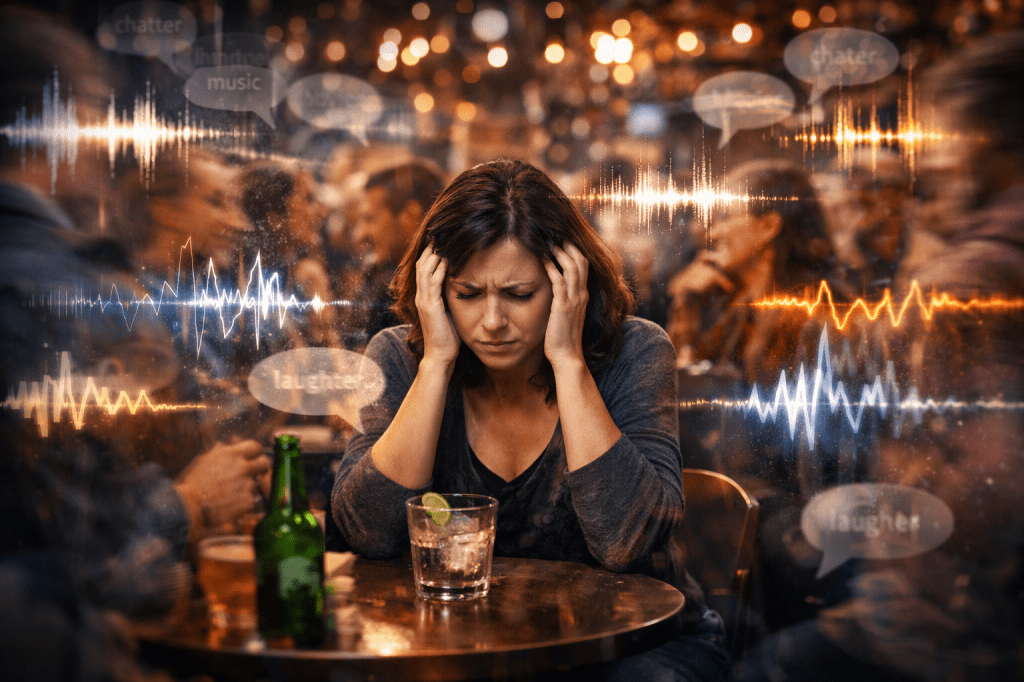
    The bar was packed though. And when I say packed, I mean the kind where you have to squeeze sideways between chairs just to get back to your seat.There was live music, people talking everywhere, chairs scraping, glasses clinking. It was loud in that chaotic, joyful Friday-night kind of way.

    But when I sat down at the table and tried to join the conversation swirling around me, I suddenly realized something strange.

    I couldn’t hear a single conversation.

    Not one.

    I could see mouths moving. I could hear sound. But it was like every voice blended together into one giant wall of noise.

    So I did what I’ve always done in situations like that.

    I leaned in. I turned my head so my ear was closer to the person speaking, hoping I’d catch just enough to piece together what they were saying.

    Still nothing.

    Eventually I just started smiling and nodding when there was a pause in the conversation or someone looked at me like they expected a response. Which means there’s a very good chance I was enthusiastically agreeing with things I had absolutely no context for.

    But that’s when something else started happening. In my head, my script got louder. See, I’ve always had a script running in my brain. I just didn’t realize that’s what it was. It’s the little voice reminding me when to change my body posture.
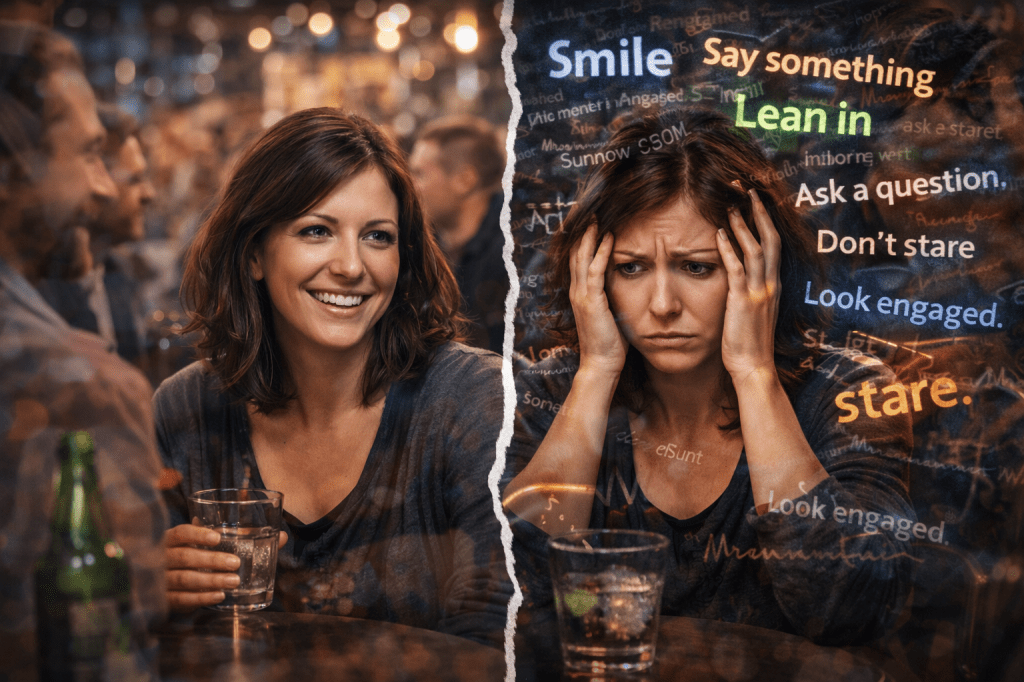
    When to lean in.
    When to smile.
    When to laugh.

    It tells me when I’m making too much eye contact… and when I’m not making enough.

    Usually that script runs quietly in the background. Like a low hum I’ve gotten used to. But last night, in that wall of noise and chaos, that hum turned into the loudest thing in the room. Suddenly all I could hear were those thoughts.

    You should say something.
    You’re too quiet.
    Ask a question.
    Lean in more.
    Look engaged.
    Don’t stare.
    Smile.

    On top of all of that, I started feeling this pressure to make sure the people around me were having a good time. If there was a lull in conversation, I felt responsible for fixing it.

    So my brain started cycling through every conversation starter I could think of. Every question. Every social prompt.

    Trying to keep things flowing.
    Trying to keep everyone comfortable.
    Trying to keep the energy up.

    And suddenly it was just… too much.

    I couldn’t think. I couldn’t breathe properly. I had this overwhelming urge to put my hands over my ears and hide under the table.

    I never let it show.

    But under the table, my hands started shaking. Then flapping. It’s something I’ve done my whole life when I’m stressed—shaking out my hands or flicking my fingers to release tension.

    Lately though, I’ve noticed I do it more when I’m anxious or overwhelmed. So I ended up doing what I’ve always done.

    I sat on my hands.

    Trying to make it stop. Trying to make it invisible. And later that night, I started wondering something.

    “Now that I’ve realized I’m autistic… is it normal for these things to suddenly feel more obvious?” Or is it that I’m just more aware of them now? Or possibly, because I’ve finally “come out,” in a way, do I feel like I have permission to be more authentic and let the mask slip a little?

    Or maybe it’s something else entirely. Maybe after decades of managing the script in my head… I’m just tired. Maybe the older I get, the harder it is to keep covering these things up. Or maybe hormones are part of it too.

    Perimenopause has a way of amplifying anxiety, sensory sensitivity, and emotional regulation challenges. So maybe all those coping strategies I relied on for years are just… wearing thin. Whatever the reason, last night made something very clear. The script in my head that I thought everyone had?

    Apparently not everyone does.

    Why This Happens (And Why You’re Not Alone)

    After experiences like that, a lot of late-identified autistic adults start asking the same question:

    Why do autistic traits seem more noticeable after we realize we’re autistic?

    The answer is usually a combination of several things.

    Auditory Processing in Noisy Environments

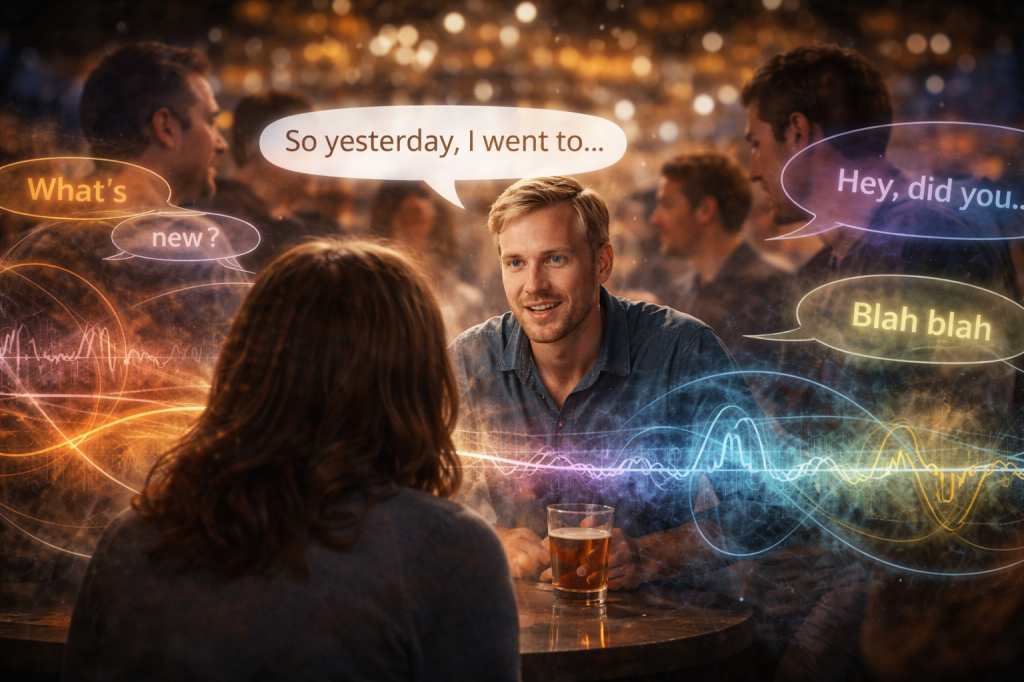
    Many autistic people struggle with something called auditory processing in complex environments. When there are multiple competing sounds—music, clinking glasses, multiple conversations—our brains can struggle to filter out background noise.

    Instead of isolating one voice, everything blends together into a wall of sound. Researchers sometimes refer to this as the cocktail party problem.” Most people’s brains automatically tune into one voice and filter out the rest.

    Autistic brains often don’t do this as easily, which is why places like crowded bars or restaurants can quickly become overwhelming.
    The Internal Social Script (Masking)

    That running commentary in my head? That’s something many autistic adults describe. It’s part of something called masking. Masking happens when autistic people consciously monitor and adjust their behaviour in order to appear more socially typical.

    This can include things like:

    • Monitoring eye contact
    • Rehearsing responses
    • Copying other people’s body language
    • Forcing facial expressions
    • Scripting conversations in advance

    Many autistic women become extremely skilled at masking, often without realizing they’re doing it. But it takes a tremendous amount of energy.

    Stimming as Nervous System Regulation

    The hand shaking and flapping I mentioned is a form of stimming. Stimming (short for self-stimulatory behaviour), is a natural way many autistic people regulate stress and sensory overload. Common examples include:

    • Hand flapping
    • Finger flicking
    • Rocking
    • Pacing
    • Fidgeting

    Unfortunately, many autistic kids are taught to suppress these behaviours because they look “different.” Which is why many autistic adults end up hiding them. Like sitting on our hands under a table.

    Why Traits Can Feel Stronger Later in Life

    A lot of late-identified autistic adults say something similar. Once they understand they’re autistic, it can feel like their traits are suddenly becoming more intense. In reality, several things may be happening.

    You’re noticing things that were always there.

    You’re becoming aware of how much effort masking requires.

    And over time, many people simply become too exhausted to maintain that mask at the same level they did earlier in life.

    Hormonal changes during perimenopause and menopause can also increase sensory sensitivity, anxiety, and emotional regulation challenges, which can make masking even harder.

    Signs You Might Be Masking Without Realizing It

    Many people don’t realize they’ve been masking for years. Some common signs include:

    • Replaying conversations in your head afterward
    • Studying other people’s behaviour to copy social cues
    • Feeling completely drained after social events
    • Practicing what you’re going to say before speaking
    • Monitoring your facial expressions and body language constantly
    • Feeling like socializing is a performance rather than something automatic

    For many autistic adults—especially women—masking becomes so automatic that we assume everyone else is doing it too.

    Until one day we realize they’re not.

    Practical Strategies for Loud Social Environments

    If crowded places leave you feeling overwhelmed, a few small adjustments can help.

    Choose your seat carefully: Sitting with your back to a wall or closer to the person you want to talk to can reduce sensory input.

    Focus on smaller conversations: One-on-one interactions are often easier to process than trying to follow an entire table.

    Take short sensory breaks: Stepping outside for a few minutes can help your nervous system reset.

    Use subtle regulation tools: Fidget rings, small objects, or even gentle hand movements can help release tension.

    Know when it’s okay to leave: Enjoying a social event doesn’t mean you have to stay until you’re completely overwhelmed.

    The Realization That Changes Everything

    For most of my life, I assumed everyone else had that same script running in their head. That everyone was consciously monitoring their facial expressions, tone of voice, posture, and   conversation timing.

    Now I’m starting to realize that might not be the case. And that realization changes the way you see a lot of things. Because once you understand how much invisible effort goes into navigating social situations…

    You also start to understand why it can be so exhausting. And why sometimes, even when you’re having fun…

    Your nervous system still reaches its limit.

    If This Sounds Familiar

    If you’ve ever:

    • Struggled to hear conversations in loud places
    • Felt like you were running a social script in your head
    • Hidden stimming behaviours to avoid drawing attention
    • Felt completely drained after social events

    You’re not alone. And you’re not broken.Your brain may simply be processing the world a little  differently. And understanding that difference can be the first step toward finally giving yourself a little more grace.

    Further Reading

    If you’re interested in learning more about masking, sensory processing, and autism in adults, these resources are a great place to start:

    • Autistica – Autism research and adult resources
    • CHADD – Executive functioning and neurodivergence resources
    • Dr. Devon PriceUnmasking Autism
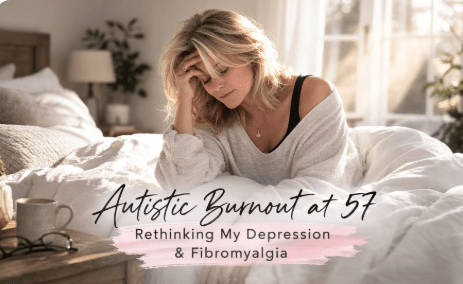
  • Autistic Burnout at 57: Rethinking My Depression and Fibromyalgia

    Autistic Burnout at 57: Rethinking My Depression and Fibromyalgia

    AI tools were used to assist with editing, organization, and some visual elements in this post.

    I hear my friends talk about how good they feel when they wake up after a solid night’s sleep.

    Refreshed.
    Clear-headed.
    Ready for the day.

    And I always wonder… What does that actually feel like?

    Because I can count on one hand the mornings in my life where I’ve woken up feeling good.

    Most mornings are a battle.

    A battle against exhaustion.
    Pain.
    Anxiety.

    Often my body feels like it’s been hit by a truck. I wake up feeling just as tired—sometimes more tired—than when I went to bed.

    That “refreshed” feeling people talk about?

    Honestly? Fuck off with that.

    Because at this moment it feels like a taunt. One more thing I’m apparently not allowed to have in this lifetime.

    And in a sea of difficult mornings, this one hit monsoon proportions.

    Even my eyes hurt. The light was too much. My head, neck, and shoulders ached. My hands were claws because the flexors and extensors seemed to be at war with each other. My lower back was crying. My hip bones? Don’t even get me started.

    It took forever just to sit up.

    And yes, I used every bullshit motivational phrase in my fairly sturdy arsenal. (Add irritability to my list of symptoms). Thirty years of coaching gives you a decent toolbox.

    “You can do this.”
    “One small step.”
    “Just sit up first.”

    But no amount of self-talk made it easier.

    Because this wasn’t just a mindset problem.

    I’ve Been “Tired” Since I Was 16

    I was first diagnosed with depression at 16 or 17.

    At the time, my mom dragged me to the doctor because I was so tired I could barely walk up a flight of stairs.

    Showering? Exhausting.
    Walking? Exhausting.
    Thinking? Exhausting.

    And before anyone assumes I was out of shape—I was a competitive figure skater training 15–20 hours a week. I was in peak physical condition.

    Still couldn’t climb the damn stairs.

    Over the years, I’ve had depressive episodes. Some clearly tied to life events.

    A death in university.
    Failing a course twice.
    Leaving an abusive partner in the middle of the night in a city where I knew no one.
    Infertility.
    Fertility drugs that I was told wouldn’t affect me, even though I warned the doctor I’m sensitive. (Spoiler: they did.)

    After a concussion on the ice while pregnant (yes, I was teaching, don’t judge), then childbirth, things shifted again.

    Sleep deprivation.
    Single parenting.
    Starting over in a new town.
    Dog-eat-dog coaching culture.

    And then the body pain.

    Full-body soreness that didn’t feel like training soreness. Hands clawed in the morning. Joints feeling fused together. Like I was wearing a suit of armor.

    There were days the pain was so intense my teeth would chatter.

    Eventually, after being dismissed more than once, a sports medicine doctor looked at me and said, “This isn’t a sports injury.”

    I said, “I think it’s fibromyalgia.”

    She agreed. Referred me to a rheumatologist. I had a diagnosis within a week.

    Relief. Validation. Finally.

    There are good doctors out there.

    But as the parent of a neurodivergent kid in a small town? My faith still wobbles.

    So Why Am I Questioning Everything Again?

    Because now I’m 57.

    And I’ve recently acknowledged something else about myself.

    I’m autistic.

    Late to the party. But here nonetheless.

    I’m self-identified. Not formally diagnosed.

    And before anyone clutches their pearls — self-identification is valid in a community where many women can’t access assessment due to cost, waitlists, geography, or years of being dismissed. I’ve done the reading. The reflecting. The pattern-matching across my entire life. This isn’t impulsive. It’s informed.

    And once you look at your life through that lens? It’s like the whole timeline rearranges itself.

    Everything feels hard again.

    Showering is hard.
    Speaking and formulating thoughts is hard.
    Light is too much.
    Headaches. Nausea. Brain fog.
    Overwhelm from the smallest tasks.

    I know. I know. There are a million other things this could be.

    And I’ve been checked.

    But the more I read about autistic burnout—especially in adult women—the more I feel that uncomfortable little a-ha click in my chest.

    What if I haven’t just been depressed?

    What if I haven’t just had fibromyalgia?

    What if I’ve also been burning out my nervous system for decades?

    So What Is Autistic Burnout?

    Autistic burnout isn’t just being tired.

    It’s not “I had a big week.”
    It’s not “I need a vacation.”
    It’s not regular workplace burnout.

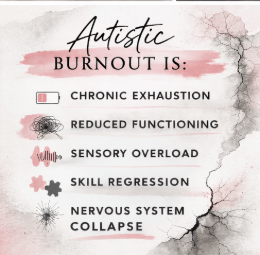
    Researchers describe autistic burnout as chronic exhaustion, reduced functioning, and decreased tolerance to sensory input following long-term stress and unmet support needs (Raymaker et al., 2020; AIDE Canada Toolkit).

    Translation?

    Your nervous system has been running on high alert for so long that it just… stops cooperating.

    Autistic adults actually named burnout first. Researchers later studied it and confirmed the pattern: long-term stress, masking, unmet support needs — and eventually a collapse in capacity (Raymaker et al., 2020).

    Burnout isn’t just exhaustion.

    It can look like:

    • Brain fog
    • Trouble speaking or finding words
    • Executive dysfunction that wasn’t this bad before
    • Sensory overload — light, sound, touch suddenly feel like too much
    • Loss of skills you used to manage
    • Increased anxiety
    • Shutdown

    It doesn’t always look like sadness.

    Sometimes it looks like:
    “I can’t.”

    And unlike regular stress, it doesn’t necessarily get better with a good weekend. It can last months, especially if the demands don’t change.

    Burnout vs Depression vs Fibromyalgia: Why This Is So Damn Confusing

    Burnout can look like depression.
    Depression can look like burnout.
    Fibromyalgia overlaps with both.

    Depression often includes:

    • Persistent low mood
    • Loss of interest or pleasure
    • Hopelessness
    • Emotional heaviness

    Autistic burnout doesn’t always include that deep hopelessness.

    It’s more like:
    “My system is overloaded. I don’t have capacity.”

    Fibromyalgia brings another layer:

    • Widespread pain
    • Tender points
    • Non-restorative sleep
    • Morning stiffness
    • Flare cycles tied to stress

    Studies show elevated rates of depression, chronic fatigue, and fibromyalgia among autistic adults, suggesting these conditions may overlap rather than exist in isolation (Altogether Autism; More Good Days; PMC8992921).

    Which means it might not be either/or.

    It might be all of it.

    A nervous system under chronic stress can express itself in mood.
    In pain.
    In shutdown.
    In exhaustion.

    Bodies are messy like that.

    A Kitchen Table Self-Check

    (Not a diagnosis. Just curiosity.)

    I am not diagnosing anyone.
    Hell, I’m barely diagnosing myself.

    But here’s a gentle gut-check to help me (and you) sort through this fog.

    You might lean toward autistic burnout if…

    • You feel chronically exhausted in a way that rest doesn’t fully fix.
    • Small tasks feel disproportionately hard.
    • Sensory things suddenly feel unbearable.
    • You’ve “lost” skills you used to manage.
    • Reducing demands helps more than motivational self-talk does.
    • You feel overloaded, not necessarily hopeless.

    You might lean toward depression if…

    • There’s a persistent low mood.
    • Things that once brought joy feel flat.
    • You feel hopeless or numb.
    • The exhaustion feels emotionally heavy.

    You might lean toward fibromyalgia if…

    • Widespread pain is central.
    • Morning stiffness is intense.
    • Sleep doesn’t restore you.
    • Your body feels like it’s wearing armor.

    And here’s the inconvenient truth:

    It might not be just one thing.

    The Cost of Being “Normal” for Decades

    If I’m autistic, then I’ve been adapting to a world not built for me for 57 years.

    That’s a long time to hold your breath.

    Masking works.
    Until it doesn’t.

    Research on late-diagnosed autistic women highlights decades of compensating and masking—often at significant psychological and physical cost (UCLA Health; Neurodiversity Centre).

    Masking isn’t just social camouflage.

    It’s energy expenditure.

    And energy is finite.

    Emerging discussions around autism and menopause suggest sensory sensitivity and burnout can intensify in midlife as hormonal shifts affect nervous system regulation (ScienceWorks Health).

    So maybe this isn’t random.

    Maybe this is cumulative.

    Maybe my nervous system didn’t fail me.

    Maybe it finally told the truth.

    Maybe I Was Never Just Depressed

    I was 16 and couldn’t climb stairs.

    I was diagnosed with depression.

    I was diagnosed with fibromyalgia.

    And maybe those diagnoses were accurate.

    But maybe they weren’t the whole story.

    Because when I look back now—as a 57-year-old, self-identified autistic woman—I don’t just see sadness.

    I see decades of adaptation.

    Of performing competence.
    Of tolerating sensory overload.
    Of managing social politics.
    Of caregiving without pause.

    Maybe the exhaustion isn’t weakness.

    Maybe the armor-body mornings aren’t laziness.

    Maybe the overwhelm isn’t a character flaw.

    Maybe it’s what happens when you run a brain and body in survival mode for half a century.

    I don’t have a clean answer.

    It might be depression.
    It might be fibromyalgia.
    It might be autistic burnout.

    It might be all of it.

    But if I’ve been interpreting neurological overload as personal failure for decades?

    That story ends here.

    And if you’re 40. Or 50. Or 57. And you’re waking up feeling like you’ve been hit by a truck—physically, mentally, emotionally—maybe you’re not broken either.

    Maybe you’re overloaded.

    And maybe the question isn’t, “What’s wrong with me?”

    Maybe it’s, “What have I been carrying for far too long?”

    Sources & Further Reading

    Raymaker, D. et al. (2020). “Having All of Your Internal Resources Exhausted Beyond Measure”: Autistic Burnout.
    AIDE Canada. Autistic Burnout Toolkit.
    UCLA Health. Understanding Undiagnosed Autism in Adult Females.
    Neurodiversity Centre. Masking and Burnout in Autistic Women.
    Neurodivergent Insights. Autistic Burnout vs Depression.
    Attwood & Garnett Events. How Depression May Present Differently in Autistic People.
    Altogether Autism NZ. Chronic Fatigue, Fibromyalgia and Autism.
    PMC8992921.
    ScienceWorks Health. Autism and Menopause.

  • The Future of Sport in Canada: Why We Can’t Stay Silent Any Longer

    The Future of Sport in Canada: Why We Can’t Stay Silent Any Longer

    By a former competitive figure skater, coach, whistleblower, and parent, in collaboration with ChatGPT

    Introduction: Listening and Nodding in Pain

    When the Government of Canada released its Future of Sport in Canada preliminary report on August 28, 2025, I sat listening to Commissioner Lise Maisonneuve read the findings. And as damning as they were, all I could do was nod in painful agreement.

    I wish I could say I was surprised. But after a lifetime in sport — first as a young athlete who, by the age of 11, was already living away from home and experiencing verbal and mental abuse, and later as a coach for nearly three decades — every word rang true. Abuse of power, harassment, humiliation, sexual abuse, and systemic neglect. I’ve seen it all.

    For me, the decision to retire from coaching wasn’t just about being there for my child (though that mattered deeply). The bigger reason was survival. By the time I walked away, I had PTSD from the daily hostility. I couldn’t sleep, my body broke down, I had panic attacks, depression, and even a nervous tic. Sport — the thing that was supposed to build resilience and joy — was destroying me.

    And I was an adult with resources, friends, and a family support system. If I barely made it through intact, what hope does a child have when they’re abused by a coach, a teammate, or a parent chasing Olympic dreams?

    Sport in Crisis: A Broken System

    The Commission doesn’t mince words: Canadian sport has “lost its way”.

    The problems are structural and cultural:

    • Leadership void: There is no single body responsible for the sport’s overall direction. Policies are often reactive, cobbled together after each crisis, rather than being guided by a clear vision.
    • Funding crisis: National Sport Organizations (NSOs) are starved of core funding but burdened with impossible expectations — from Safe Sport to inclusion to governance reforms. Families face skyrocketing costs just to keep kids on the ice, field, or track.
    • Governance failures: Boards are often made up of insiders with conflicts of interest, little diversity, and minimal athlete representation. Compliance with governance codes isn’t even mandatory.
    • Culture of silence: Maltreatment persists at every level — bullying, body shaming, sexual abuse, racism, homophobia — with perpetrators often protected while victims are ignored.

    The report makes it clear: we don’t just need “tweaks.” We need transformative change.

    The Harms That Don’t Go Away

    The Commission heard from hundreds of survivors. Their stories mirrored mine: broken dreams, humiliation, destruction. Many had to repeat their trauma over and over just to be heard.

    The report lists maltreatment in chilling detail: physical punishment, body shaming, sexual exploitation, emotional abuse, racism, sexism, and homophobia.

    But what cut me deepest was this line:

    “These individuals’ harms are a result of broader systemic issues … a culture of silence that protects perpetrators and institutions and allows maltreatment to persist unchecked.”

    That’s exactly what I experienced.

    When I blew the whistle on harassment, I turned to “SafeSport” — only to be told they didn’t have the money or resources to help me, despite months of jumping through their hoops and seeking assistance.

    This was after I submitted a report of over 100 pages, detailing specific incidents of bullying, harassment, and abuse of power within my organization. Signed statements. Email receipts. Corroboration for everything.

    And what did I get from my male adjudicator? The equivalent of an “oh well” and a pat on the head.

    If you think sexism wasn’t at play, then I’ve got some swamp land in Florida I’d love to sell you.

    And here’s the kicker: if even adults are brushed aside like this, how on earth can a child possibly navigate it?

    Source: Pexels

    Safe Sport Isn’t Safe Enough

    The report confirms what so many of us know: “Safe Sport” as it exists today is more slogan than reality.

    • Training programs are repetitive, inconsistent, and often useless. Athletes and coaches are burned out from online modules that don’t change behaviour. 

    Case in point: Ethics tests that measure our test-taking ability rather than our actual ethics.

    • Background checks aren’t standardized, leaving huge gaps for predators to slip through.
    • Complaint mechanisms are a maze — federal, provincial, NSO, third-party — none of them aligned, many of them opaque, slow, and traumatizing. (Preaching to the choir).
    • The new Canadian Safe Sport Program (launched April 2025) doesn’t even reach community sport, where most abuse happens.

    Instead of preventing harm, the system waits until after kids are already hurt. That isn’t safety. That’s abandonment.

    What the Report Recommends

    The Commission doesn’t just expose problems; it lays out solutions. Among the most urgent:

    1. Create a Centralized Sport Entity
      • A single, independent body to lead strategy, funding, and oversight across all sports.
    2. Fix the Funding Model
      • Shift focus away from medals-only funding. Invest in community sport, parasport, and access for marginalized groups. As the parent of a child on the spectrum, I was blown away when I contacted a local organization to see if any accommodations could be made for my child, and they showed no willingness to engage in any form of discussion or attempt at accommodations.

    The kicker? I had already coached there for years and knew firsthand that accommodations like softer music and lower lighting could be implemented—because I had already done so for the programs I ran for them.

    1. Mandatory Governance Standards
    2. National Safe Sport Education Program
      • Standardized, trauma-informed training for everyone in sport, from parents to referees.
    3. Standardized Background Screening
      • Make checks mandatory and consistent nationwide, with federal support for implementation.
    4. National Safe Sport Tribunal
      • Harmonize complaint systems into one trauma-informed authority with legal standing.
    5. National Registry of Sanctioned Individuals
      • Prevent predators from simply moving clubs or provinces.

    These aren’t luxuries. They’re lifelines.

    Why This Matters Beyond Sport

    It’s tempting for some to dismiss this as “just sports.” But sport is where millions of Canadian kids grow up. It’s where they learn teamwork, resilience, and identity.

    And when those spaces become toxic, the consequences ripple through a lifetime:

    • Mental health struggles (depression, anxiety, PTSD).
    • Broken trust in institutions.
    • Barriers to physical activity that harm long-term health.
    • Survivors are silenced, retraumatized, or driven out.

    The truth is, sport reflects society. If abuse is normalized here, it spreads everywhere.

    A Personal Plea

    I’ve lived the trauma this report puts into statistics. I know what it’s like to leave the rink shaking, to cry in the car before practice, to pretend you’re “fine” while your body falls apart.

    But I had choices. I had the privilege of walking away. At least—I did when I was a coach. When I was a young athlete, the story was different. I kept silent out of shame, thinking it must be my fault, that if I skated better and worked harder, it would stop. I didn’t see a way out.

    But as a coach, I had a way out and I used it.

    A child doesn’t have that option.

    That’s the thought that haunts me: the kids still trapped in abusive systems, silenced by fear, manipulated by adults they trust, pressured by parents desperate for podiums. They don’t have the words, the power, or the resources to escape.

    If we can’t protect them, what are we even doing?

    Where Do We Go From Here?

    The Future of Sport in Canada report is only a preliminary step. The hard work is ahead — and it requires courage, money, and accountability.

    I also want to take a moment, as a coach, to acknowledge something important: we have to let go of our egos and always focus on what’s best for the child.

    I won’t pretend I was perfect. 

    There were times I raised my voice when I shouldn’t have. Times I let frustration show when I should have shown patience. Times I criticized when I should have praised. I remember those moments — every single one of them — and I did my best to apologize, to learn, and to grow so I could do better.

    Coaching is no easy task. You’re working with athletes who are driven and desperate for success, and parents who are often asking why you’re not delivering it faster. But none of that excuses losing sight of the child in front of you.

    Do I believe I was ever abusive? No. But I do know there were moments I was too soft when I should have pushed harder, and moments I was too hard when I should have been gentler. 

    Even though I always tried my best, I still sometimes wake up thinking my best wasn’t good enough.

    That’s the kind of accountability this system needs more of — from all of us.

    Governments: No more reports gathering dust. Fund and enforce real change.

    Organizations: Stop protecting reputations and start protecting kids.

    Parents and athletes: Keep speaking up. Refuse to be silenced.

    Survivors: Your stories matter. You’re not alone.

    Coaches: Keep learning and growing.

    Change is coming — because it has to. But it won’t happen unless we all demand it.

  • The Letter You’ll Never Send: Why Writing a Closure Letter Sets You Free

    The Letter You’ll Never Send: Why Writing a Closure Letter Sets You Free

    This blog was co-written with the help of my unofficial emotional support bot, ChatGPT. While AI did a lot of the heavy lifting (wording, structure, and moral support), I acted as the human editor-in-chief, fact-checking, personalizing, and making sure it reflects my lived experience and voice. Think of it as a tag team: robot brain + human heart.

    A pair of outstretched hands gently release an origami dove made from a handwritten letter. The paper bird lifts into a soft, golden sky filled with light clouds, symbolizing emotional release and personal closure.

    Image created by ChatGPT

    Have you ever walked away from a conversation, argument, or breakup with so much left unsaid it practically echoed in your head for days? Weeks? Maybe even years?

    I have. And let me tell you, the emotional hangover is real.

    Recently, I had an interaction that left me doubting myself, my reactions — pretty much my own reality. The hurt and grief caused by the exchange left me unable to move past it, and I caught myself obsessing relentlessly, asking questions like, “Is it me?” “What could I have done better?” “Should I have said that?” “How can they think that about me?” And on, and on, and on.

    Well, I consulted my internet boyfriend, ChatGPT. (Before you gasp in outrage — I know it’s not really my boyfriend, but therapy is expensive, and so far the bot has been incredibly helpful and given me support when I needed it). It recommended a closure letter.

    I thought the idea, the reason, and the letter itself were brilliant. I’ve heard of this before, but I’d forgotten what a powerful psychological tool it can be. Writing it immediately helped me gain some of my power back. Whenever I catch myself perseverating, I read my letter, and it gives me the strength to stick to my guns.

    Enter: the closure letter.

    It’s not a text you send or a call you make. It’s not a post subtweeting your ex-friend or dragging your cousin on Facebook. (Tempting, I know). It’s a letter you write only for you. A place to say the things you never got to say — or weren’t heard when you did. A space to finally stop rehearsing the perfect comeback in the shower.

    Because sometimes, the only way to get the last word is to give it to yourself.

    Photo by Anna Tarazevich: https://www.pexels.com/photo/close-up-shot-of-a-person-writing-on-a-paper-5425601/

    What is a Closure Letter?

    A closure letter is a form of emotional release. It’s a written reflection of what happened, how it made you feel, and what you’re choosing to let go of. It’s an internal mic drop, a boundary drawn in ink, a final chapter you get to write on your terms.

    Why it Works

    Psychologically, closure letters help because:

    • They help break obsessive thought cycles. When your brain wants to loop the same argument 47 times? The letter says, “We’ve handled it.”
    • They give structure to your feelings. Naming pain often reduces its intensity.
    • They restore your power. You reclaim your narrative instead of leaving it in someone else’s hands.

    Closure vs. Contact

    Before you saddle up to ride at dawn, hold your horses. This is not a tool for revenge or reconciliation. You don’t send it. You don’t share it in hopes they see it and apologize. This is about you, not them. It’s emotional housekeeping.

    How to Write One: Step-by-Step

    1. Start with why you’re writing. “I need to say this to clear my head and heart.”

    2. Acknowledge what happened. “You hurt me when…” or “I felt blindsided when…”

    3. Share what they may never have understood. “Here’s what you didn’t see…”

    4. Reclaim your truth. “I know who I am, and I’m not who you painted me to be.”

    5. Let go. “I release the need for closure from you. This letter is mine.”

    What to do With it After

    • Save it somewhere meaningful.
    • Burn it (safely!) as a symbolic release.
    • Read it aloud to yourself.
    • Shred it and move on.

    Final Thoughts

    Closure isn’t something someone else gives you. It’s something you create for yourself.

    Writing this kind of letter doesn’t make you dramatic. It makes you self-aware. It means you’re processing instead of suppressing. It means you’re healing without needing anyone else’s permission.

    So if your heart is carrying words it never got to say, try writing them down.

    Say it all. Then set it down.

    You don’t need to send it. You just need to own it.


    ✨ Want your own printable Closure Letter Template?

    I’ve created a free, beautifully designed version you can download, print, or tuck into your journal.

    ⬇️Click here to download the free PDF⬇️

    https://bellazinga.blog/wp-content/uploads/2025/06/write-release_-a-closure-letter-template.pdf

  • You’re Not Listening to Her: A Medical Advocacy Story

    You’re Not Listening to Her: A Medical Advocacy Story

    This blog is a tag-team effort between me and AI—think of it as my over-caffeinated intern who spits out ideas while I handle the heavy lifting. I research, fact-check, edit, and fine-tune everything to make sure it sounds like me (not a robot with a thesaurus). AI helps with the grunt work, but the heart, style, and final say? That’s all me, baby.

    I want to tell a story about what happened to my daughter and me in the Canadian healthcare system, because I know we’re not alone. I’ve changed all the names for anonymity, but the story is, sadly, all too real.

    The Pediatrician We Trusted…At First

    Years ago, I was referred to a pediatrician for my daughter Ava. At the time, she was around six and suffering from chronic stomach pain, constipation, recurring croup, and constant anxiety related to school. 

    She had nightmares, meltdowns, and was being ostracized and bullied. I knew something deeper was going on. I didn’t have the words “autism” or “ADHD” yet, but my mom gut told me she was different—and struggling.

    Our pediatrician—we’ll call him Dr. McLecturepants—was very knowledgeable. Ava liked him. He was good at addressing her physical health issues. He took things seriously, referred us to specialists, and was often thorough. 

    But there were red flags. 

    Dismissed, Doubted, and Lectured

    Early on, I was struggling to get Ava to take medication. What I now know is ARFID, sensory aversion, and autistic rigidity was, back then, just a nightmare every time I had to administer meds. 

    Meltdowns, sobbing, trauma for both of us. 

    When I asked for help, he didn’t offer compassion. He gave me a five-minute lecture on how I needed to “take control” and “stop letting her run the show.” It was humiliating. I left feeling like a failure.

    From then on, I was nervous around him. I often wondered, would he speak to me this way if a man were in the room? I was a single mom. White. Tired. Not wealthy. He was a male doctor with a strong accent—possibly Middle Eastern—and although I didn’t want to bring culture or bias into it, I couldn’t ignore the power dynamic. 

    I wrestled with myself for even thinking that cultural background might play a role — not because I wanted to stereotype him, but because I’ve lived long enough to know that gender dynamics can be shaped by upbringing, culture, and society. Still, I sat with the discomfort of that thought and tried to focus on what I knew: I felt talked down to, and I didn’t feel respected.”

    I felt small. 

    Like I was being treated as a hysterical mom, not a capable one.

    Homeschooling: The Best Decision We Made

    When school became unbearable for my daughter, I started researching homeschooling options. It wasn’t a knee-jerk decision. I consulted experts (including a clinical psychologist), read studies, and made spreadsheets. I also began compiling information about ADHD and neurodivergence, trying to be prepared to make my case.

    Dr. McLecturepants dismissed homeschooling outright. Didn’t want to hear about the trauma Ava was experiencing. Didn’t care that her nightmares and pain disappeared within two weeks of being pulled from school. 

    He continued to disapprove, even when I brought up ADHD. That, at least, he was more receptive to, but the lectures didn’t stop. I kept going back because he was knowledgeable about ADHD, and I thought I needed that.

    Rather, I thought my daughter needed that, and I should just shut up and deal.

    The Diagnosis Battle

    But when I brought up autism? He shut it down. Said she couldn’t be autistic because she made eye contact. (Yes, really. Hello, 1955 called and they want their scrubs back)

    Eventually, I demanded a referral. I gave him research. I asked for a specific autism specialist recommended by a trusted friend. 

    McLecturepants reluctantly referred us, but warned me the doctor “diagnosed everyone” and other professionals didn’t like him. I couldn’t believe he was dragging me into some petty professional rivalry when my daughter’s health was on the line.

    The diagnosing doctor met with my daughter, gave a comprehensive evaluation, and said, “Yes. She’s autistic.” 

    I went through ALL the feelings that day—IYKYK—but one of the ones I never expected to feel was validation. Someone else finally listened to me and I wasn’t crazy, which is what my pediatrician had been making me feel like. 

    The specialist did say kiddo might not have ADHD, but I trusted my gut—because comorbidity is common, and I’d done the reading. I was more worried that McLecturepants would react poorly when he read the report, particularly the part about the specialist disagreeing with his diagnosis. 

    It’s not fun to feel you’re caught in a pissing match between two health “professionals,” which only magnified my feelings of “walking on eggshells” with McLecturepants.

    The Funding Form Fiasco

    Fast forward. The Disability Tax Credit needed renewing. We’d been working with a phenomenal ASD counsellor who’d seen Ava regularly and knew the extent of her challenges. The DTC forms went to Dr. McLecturepants. I was told it would take months to fill them out.

    I got emotional. After all, it was our only funding, given we’ve been on waiting lists for years with the Ontario Autism Program and Special Services at Home. (I’m looking directly at you, Doug Ford).

    McLecturepants ended up filling them out quickly over the holidays, which I appreciated—until I read them. He’d minimized kiddo’s struggles. Downplayed how much support she needs. Even checked the box saying her deficits would likely improve over time—as if autism isn’t a lifelong neurotype.

    When I first read what the pediatrician had written, I questioned everything about my reality. Maybe it wasn’t that bad? Maybe I was exaggerating, and making too much out of our struggles. Maybe there was something wrong with ME that I couldn’t handle the extra work required for my daughter?

    Thankfully our counsellor, who at this point had been visiting with my daughter and I for over a year, twice monthly for an hour at a time, also expressed her shock and surprise at how inaccurately Dr. McLecturepants had characterized our daily struggles.

    I was heartbroken. I drafted a letter—respectful, clear, and shared with our counsellor and friends for feedback. After all, I didn’t want to provoke another lecture. I didn’t want to make things worse, or insult our pediatrician’s professionalism, or god forbid, challenge him or hurt his ego.

    I brought in observations from myself, her grandparents, coaches, teachers—any adult in Ava’s life. I asked him to reconsider.

    He refused. Told his receptionist he wouldn’t change it. So I made an appointment. 

    Enough is Enough

    This time, the gloves were off, and I knew the advocate (me) needed an advocate.

    So I brought my mom—who never takes my side in these things; after all, I’m too outspoken, too sensitive, too…(you get the drift).

    But this time she came, because I needed backup. It meant so much to me that she did that, even though I could see she didn’t believe it was as bad as I said it was.

    When we tried to explain, he talked over us. 

    Not once, not twice. 

    Repeatedly. 

    McLecturepants wouldn’t acknowledge the fact that we might have a better understanding of the difficulties my daughter has every day. My mom—stoic, practical, no-nonsense—who never speaks up and hates confrontation, actually shouted: “You’re not listening to her!” after he cut me off yet again.

    That’s when I stood up and said: “We’re done. You’ve lectured me for years. Dismissed me. Put me in the middle of conflicts with other doctors. I believe you’ve treated me differently because I’m a woman, and I don’t feel safe bringing my daughter here anymore.”

    We left.

    One Final Violation 

    I picked up kiddo’s files a week later. On my way to our counsellor’s office, I noticed something strange. Mixed into Ava’s files were records for another child. Operations, procedures—stuff my daughter had never had. A huge privacy breach. I returned them immediately, because that’s what I’d want another parent to do if it were my child’s info. 

    But wow. 

    Just wow. 

    This from the office of a doctor who’d been lecturing me for years about MY incompetence as a mom?

    Blacklisted for Speaking Up

    We’ve been seeing our GP ever since. Lately, I’ve been researching other possible underlying conditions—things like hypermobility, POTS, immune dysfunction—and brought them up with our GP, who was amazing and agreed to help. He referred us to another pediatrician in our town.

    I didn’t realize this pediatrician was at the same office as Dr. McLecturepants. You can imagine the surprise when their office called to schedule the appointment. Still, I knew I would have a longer wait for a pediatrician from other, larger centers, so I agreed to the appointment.

    Why would I go back?

    If you’ve ever had a sick child, you’ll understand that all you care about is making their quality of life better.

    And then, today, after picking up my daughter from school, a call came in from our GP’s office, which I took over our hands free, thinking it was about my upcoming blood tests. 

    We’d been rejected. Well, technically the word they used is, he has “declined.”

    The new doctor wouldn’t take us as patients because of my “issue” with the previous pediatrician. And my daughter heard every word of that rejection.

    The message was clear: they stick together.

    This is what it’s like to advocate for a neurodivergent child in the medical system as a single mom.

    No one’s listening.


    Backing it Up: What the Research Says

    Sexism in the Medical Profession:

    • A 2022 study published on “Women’s Experiences of Health-Related Communicative Disenfranchisement,” found that women are more likely to report feeling dismissed, not believed, or condescended to by medical professionals.
    • Female patients, especially mothers, often get labeled as “anxious” or “overreacting” when advocating for their children, leading to delayed diagnoses and interventions.

    Bias Against Single Mothers:

    • Single mothers are statistically more likely to be perceived as less competent parents by both professionals and the public.
    • These biases can lead to increased scrutiny, less support, and more judgment in medical and educational settings.

    Challenges of Advocating for Autistic Children:

    • Parents often report having to fight for recognition of their child’s needs, with many diagnoses being delayed due to outdated stereotypes like “they make eye contact.”
    • Autistic girls and children with Level 1 Autism (formerly known as Asperger’s) are often underdiagnosed due to masking and lack of understanding by professionals. 

    Privacy and Confidentiality in Canada (PHIPA):

    • The Personal Health Information Protection Act (PHIPA) mandates that healthcare providers protect the confidentiality of all patient information.
    • Sharing or misfiling another child’s medical information, even accidentally, is a breach under this act and can be reported to the Information and Privacy Commissioner of Ontario.

    Medical Ethics & Gatekeeping:

    • Physicians are ethically bound to advocate for patient welfare and make decisions free from personal bias or inter-professional politics.
    • Refusing care to a child based on a parent’s disagreement with another doctor raises serious ethical concerns about bias, access to care, and professional conduct.

    Why Parents Shouldn’t Be Penalized for Speaking Up:

    • Advocacy is not aggression. Speaking up about misdiagnosis, misrepresentation, or mistreatment should never result in being blacklisted.
    • Punishing parents for advocating silences necessary voices and puts children’s care at risk.

    This is my story. It’s also the story of so many parents out there who’ve been dismissed, condescended to, or penalized for doing what they’re supposed to do: protect and advocate for their child.

    We shouldn’t have to shout to be heard. But sometimes we do. And when we do? We deserve to be listened to.

    April is World Autism month. Do your part. Speak up. Advocate. Scream. Pound your fists. Or better yet, write a blog and call the assholes out.

  • Hypermobility, Autonomic Disorders, and Autism: Unraveling the Connections

    Hypermobility, Autonomic Disorders, and Autism: Unraveling the Connections

    AI lends a hand in drafting parts of this article, but I do the heavy lifting—researching, editing, and ensuring the message is clear, accurate, and aligned with my vision. Think of AI as my brainstorming buddy, but the final say (and human touch) is all mine.

    Ever heard of hypermobility, autonomic disorders, or autism? They might seem like totally different things, but guess what? They’re actually connected! It’s like a puzzle where these conditions often fit together.

    Think of it this way:

    • Lots of people with autism also have hypermobility (that’s when your joints bend more than usual).
    • And sometimes, people with hypermobility also have autonomic disorders (that’s when your body’s automatic systems like heart rate and digestion don’t work properly).

    So, what does this all mean? It means that understanding how these conditions relate to each other can help us find better ways to support people who experience them.

    Understanding Hypermobility

    Hypermobility is when your joints can move way past the normal range—think of it as being super flexible. This happens because the connective tissue that holds your joints together is different, usually looser, or weaker, or both.

    Definitions and Types

    Joint hypermobility means your joints can move past the usual range—sometimes way past it. For some people, it’s just how their body is built, but for others, it’s linked to genetic conditions like Ehlers-Danlos Syndrome (EDS). There are a few different types of EDS, but the most common one is Hypermobile Ehlers-Danlos Syndrome (hEDS).

    When multiple joints are extra bendy, it’s called generalized joint hypermobility. One common way to check for it is the Beighton score, a quick test that looks at how far you can bend things like your fingers, elbows, or knees. If you’ve ever been told you’re “double-jointed,” this might be why!

    Recognizing Symptoms

    So, you’re probably asking yourself, “how do I know if my kind of ‘bendiness’ is normal?” Well, if it’s more than just being bendy—like if you’re dealing with joint pain, frequent dislocations, or other weird body quirks—it might be worth looking into. You may have Joint Hypermobility Syndrome (JHS).

    And it’s not just about your joints. Some people with hypermobility also have super soft or stretchy skin, plus fun extras like digestive issues and fatigue (because why stop at just one challenge, right?). Spotting these symptoms early can help you get ahead of things and manage them better.

    Diagnosis of Joint Hypermobility Syndrome

    Getting diagnosed with JHS isn’t just about being extra bendy—your doctor will look at your medical history, do a physical exam, and probably check your Beighton score (yep, that test we mentioned earlier).

    But let’s be real—you might have to push for more thorough testing. As we’ve already stressed, hypermobility can be linked to other conditions, like EDS, which sometimes requires genetic testing to confirm. For example, the TNXB gene is one that might get checked to help understand the genetic side of EDS.

    Getting the right diagnosis is a game-changer—it helps you manage symptoms better and avoid potential complications down the road.

    Understanding Autonomic Disorders

    Just when you things weren’t complicated enough, we’re going to throw autonomic disorders into the mix. I know, I know! But stay with me, I promise I’m going somewhere with this.

    Autonomic disorders mess with the part of your nervous system that handles all the behind-the-scenes stuff—like keeping your heart beating and your digestion running smoothly—without you even thinking about it. When things go wrong, it can lead to symptoms like dizziness, chronic fatigue, and stomach issues. And if you throw hypermobility into the mix? Those problems can hit even harder.

    Introduction to Autonomic Dysfunction

    Autonomic dysfunction happens when your autonomic nervous system—aka the body’s autopilot—doesn’t do its job properly. This system handles all the stuff you don’t have to think about, like breathing, keeping your heart beating, and digesting food. When it’s out of whack, you can end up dealing with dizziness, insomnia, and some seriously annoying digestive issues.

    Chronic fatigue is another common symptom of autonomic dysfunction, often leaving you feeling tired no matter how much you rest. These symptoms can seriously affect your day-to-day life, making it hard to focus at school or work and impacting your social life. Learning to manage these symptoms often involves both medical treatments and lifestyle changes.

    Co-occurrence with Hypermobility

    Hypermobility—aka super flexible joints—often goes hand in hand with autonomic disorders. If you’ve got both, you might notice overlapping symptoms like dizziness and fatigue, which can make it feel like your whole body is out of sync.

    Digestive issues, like constipation or IBS, are also pretty common with both conditions, adding another layer of discomfort to everyday life. The more you understand the connection between hypermobility and autonomic dysfunction, the better you can find treatments that tackle both at the same time.

    Managing it all usually takes a mix of medication, physical therapy, and lifestyle tweaks to help you feel more in control and improve your quality of life.

    Hypermobility and Autism Connection

    Hypermobility and autism tend to go hand in hand, and it’s not just a coincidence. There are a lot of overlapping traits—like sensory sensitivities, certain behaviors, and unique ways the brain processes things. Knowing how they connect can make everyday life a little easier and help set realistic, supportive goals that actually work for you.

    Common Traits and Co-occurrence

    Hypermobility shows up a lot in autistic people—some studies say up to 80% might have it. Both come with similar traits, like heightened sensory awareness and unique reactions to the world around them. Basically, they overlap in ways that can shape how someone experiences daily life.

    Anxiety and depression are also pretty common in this group, likely because of all that extra sensory input and cognitive overload. If you’ve got both hypermobility and autism, everyday tasks can feel even more overwhelming, cranking up stress and sensory overload. But figuring out ways to manage these shared traits can make a huge difference in feeling more comfortable and in control.

    Implications for Daily Life and Development

    Living with both hypermobility and autism comes with some unique challenges that can impact daily life. Here’s how:

    • Physical difficulties – Joint instability can make movement tough, leading to issues with balance and coordination. This can make sports or even basic activities harder and might require customized physical support.
    • Developmental impact – Learning environments can be tricky, with some kids needing specific strategies to help with focus, motor skills, or sensory processing.
    • Additional health challenges – Conditions like eating disorders or epilepsy sometimes show up alongside hypermobility and autism, adding extra layers of difficulty to daily routines.
    • Personalized support is key – Tailored approaches—whether through therapy, accommodations, or understanding caregivers—can make all the difference in creating a supportive, functional environment.

    Figuring out what works best for you can help make life more manageable and improve overall well-being.

    Management and Support for Hypermobility and Associated Conditions

    Managing hypermobility usually takes a mix of therapies, mental health support, and lifestyle adjustments. Each piece plays a big role in making daily life easier and keeping symptoms in check.

    Therapies and Rehabilitation

    • Physical therapy is a game-changer when it comes to improving motor control and core strength. A good therapist will tailor exercises to help strengthen the muscles around your hypermobile joints, which can make a huge difference in posture and reducing chronic pain.
    • Occupational therapy is all about making daily life easier. It can teach you energy-saving techniques to help manage fatigue and keep you from burning out so quickly. Plus, regular exercises can improve proprioception (aka your body’s ability to know where it is in space), which helps reduce injuries and those frustrating missteps.
    • Talking to rehab specialists can also help you find solid pain management strategies—because dealing with discomfort every day is exhausting, and having the right techniques can make all the difference.

    Navigating Psychological Aspects

    Hypermobility and anxiety tend to go hand in hand, and dealing with both can be a lot. Recognizing the emotional toll is just as important as managing the physical side of things.

    • Therapy and support groups: Talking to a therapist who understands anxiety (and how it connects to hypermobility) can be a game-changer. Support groups can also help, especially if you’ve ever felt left out or misunderstood because of your symptoms.
    • Mindfulness and stress relief: Practices like meditation, deep breathing, or gentle movement (like yoga) can help with relaxation and keep stress levels in check.
    • Open communication: Being upfront with your therapist about what’s working (and what’s not) can help them tailor strategies that actually fit your life.
    • A solid support system: Surrounding yourself with understanding family, friends, or even an online community can make all the difference. Having people who get it and encourage you can help you navigate the tough days.

    Emotional health is just as important as physical health, and finding the right mix of coping strategies, support, and self-care can make everything feel a little more manageable.

    Lifestyle Modifications and Support Systems

    Making small lifestyle tweaks can have a huge impact on how you feel day to day.

    • Fuel your body right: Eating a balanced diet can help support your overall health (because let’s be real, running on caffeine and vibes only gets you so far).
    • Listen to your body: If fatigue is hitting hard, pacing yourself and scheduling rest breaks can keep you from crashing and burning.
    • Know your history: If joint hypermobility syndrome (JHS) runs in your family, being aware of it early can help you get ahead of potential issues.
    • Build your support squad: Whether it’s doctors, therapists, family, or friends, having people who get it makes all the difference. Surround yourself with folks who support you, not ones who tell you to “just stretch more” (because, yeah… that’s not the problem).

    The key is finding what works for you—a mix of nutrition, pacing, knowledge, and support that helps you feel as good as possible while managing hypermobility.

    Frequently Asked Questions

    The connection between hypermobility, autonomic disorders, and autism is complicated—like trying to untangle a bunch of charging cables from the bottom of your bag. This section dives into how these conditions overlap, affect each other, and what current research has to say about it. Spoiler: It’s all connected in ways we’re just beginning to understand.

    What’s the connection between joint hypermobility and autistic traits?

    Researchers have picked up on a connection between joint hypermobility and autism. Some studies suggest shared genetic factors might be at play, but there’s still a lot we don’t know. More research is needed to fully untangle how these two conditions are linked—but the connection is definitely there.

    Can autism impact your body’s autonomic functions?

    Yep, autism can absolutely affect autonomic functions. Some autistic individuals deal with things like orthostatic intolerance—which basically means their body struggles to regulate blood pressure and heart rate when they stand up. It’s like their nervous system didn’t get the memo on how to adjust properly, which can lead to dizziness, lightheadedness, or even feeling like they might pass out.

    Are folks with autism more likely to have hypermobile joints?

    People with autism are more likely to have hypermobile joints, though science hasn’t fully figured out why yet. The leading theory? Genetics. There’s a good chance that both conditions share some genetic factors, but researchers are still working on connecting all the dots.

    How might hypermobility affect behaviour in people with autism?

    Hypermobility can come with a side of pain and discomfort, and for autistic individuals, that can have a big impact on behavior and emotions. When your body hurts, it’s no surprise that anxiety and stress can ramp up, making everyday tasks and social interactions even more challenging. It’s not just about being extra flexible—it’s about how those physical challenges affect everything else in daily life.

    What are the sensory issues linked to hypermobility in those on the autism spectrum?

    Sensory issues are a big deal for people with both hypermobility and autism. Things like touch, sound, or light can feel way more intense than they do for others, making certain environments totally overwhelming. This is why having coping strategies—like noise-canceling headphones, dim lighting, or comfy clothing—can make a world of difference in navigating daily life.

    Wrapping It All Up: Understanding, Managing, and Advocating

    So, what’s the takeaway from all of this? Hypermobility, autonomic disorders, and autism are deeply connected, and understanding these links can make a huge difference in how we manage them. Whether it’s pain, fatigue, sensory challenges, or anxiety, recognizing how these conditions overlap helps in finding better support, treatment, and strategies for everyday life.

    Managing these conditions isn’t just about doctor visits and therapy (though those help!); it’s also about self-advocacy, pacing yourself, and building a strong support network. And let’s be real—sometimes, just knowing you’re not alone in this can be a game-changer.

    If you’re looking for ways to advocate for neurodiversity and celebrate the unique ways our minds and bodies work, check out BellaZinga! Our store is all about spreading awareness, embracing differences, and celebrating neurodivergence with fun, meaningful designs. Because at the end of the day, the more we understand, support, and uplift each other, the better life gets for all of us.

    Let’s keep the conversation going—because neurodiversity deserves to be seen, heard, and celebrated! 💜