A closer look at Ontario’s new attendance, participation and exam requirements, and what they could mean for students with EBSA, autism, anxiety, IEPs and other support needs.
Transparency note: I’m currently knee-deep in the usual back-to-school madness and wanted to get this information out quickly while it was timely. I used ChatGPT to help me organize my research and thoughts and turn them into a coherent post. The opinions, concerns, and conclusions are my own.
So… I have some thoughts about the “Back to School Letter to Students and Families” from Ontario’s Minister of Education.
Particularly this little line:
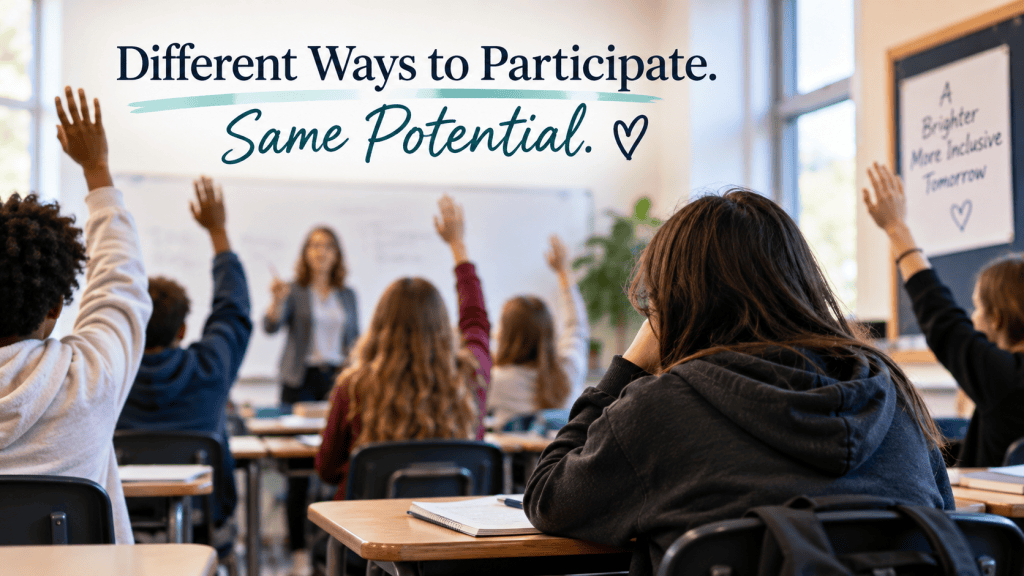
“Attendance and participation in the classroom will also count toward final marks.”
Because if you’re the parent of an EBSA kid, an autistic kid, a child with anxiety, chronic illness, selective mutism, an IEP, or really any child whose disability affects their ability to physically attend and participate in school, that sentence probably made your stomach drop a little.
So I took a gander at the new assessment policy and the 2026–27 enrolment and attendance rules to figure out what this might actually mean for our kiddos.
First, Let’s Talk About the Attendance-Sized Elephant in the Room
I’m delighted to report this part isn’t as frightening as I thought it might be:
For Grades 9 and 10, attendance and participation are now worth 15% of the final grade. In Grades 11 and 12, they’re worth 10%.
BUT, and this is a pretty important but:
“Excused absences do not negatively affect a student’s mark.”
The attendance criteria used to determine that portion of the grade specifically refer to unexcused absences.
And this is where EBSA//School Refusal families need to know the rules.
Ontario’s own mental-health policy states that if a student is unable to attend school because of a mental-health concern, their absence must be excused under the Education Act as sickness or another unavoidable cause.
Medical absences can also be excused.
And even when a family doesn’t yet have appropriate supporting documentation for a mental-health absence, a principal can temporarily excuse the student following a written request from the parent or the student, if they’re an adult.
That matters.
Because “my child isn’t attending school” and “my child has unexcused absences” are not necessarily the same thing.
There are also other attendance codes and circumstances that may apply. Students on officially modified or part-time schedules can have time recorded as non-instructional rather than absent. The enrolment instructions even specifically address autistic students receiving certain outside autism supports.
So one of my biggest takeaways for EBSA/School Refusal parents is this:
Pay attention to how your child’s absences are being coded.
If your child is unable to attend because of documented disability, illness or mental-health needs, don’t simply assume everyone understands why those absences are occurring. Have the conversation. Put things in writing. Ask whether the absences are being recorded as excused.
Because under this new grading system, that distinction matters.
So Many Questions, So Little Time
The new “attendance and participation” criteria don’t just look at whether students come to school.
At the highest achievement level, students are expected to consistently:
• participate in class discussions and contribute ideas • ask relevant questions • respect the contributions of others and demonstrate positive leadership • contribute to fostering a positive classroom culture
And variations of those same criteria appear at every achievement level.
Anyone who knows me, knows I need more clarification on this issue.
What does that look like for the autistic student who rarely speaks spontaneously in class?
The student with severe social anxiety?
The selectively mute student?
The kid who needs substantially more processing time before answering?
The student whose previous experiences with bullying have taught them that putting themselves out there socially is unsafe?
The black-and-white thinker who struggles with certain social interactions?
The child who is using every ounce of their nervous system just to remain in the classroom?
Are they less knowledgeable about science because they don’t ask questions aloud?
Do they understand English less because they don’t contribute to a group discussion?
Should a shy or anxious child receive a lower math mark than an outgoing child who happily raises their hand?
Because that’s where I think this policy gets very murky.
I went looking specifically for language in the new participation criteria explaining how these requirements should be applied to students with disabilities, IEPs, autism, communication differences or anxiety.
I couldn’t find it.
There is no blanket exemption for special-education students that I can see.
HOWEVER, that does not mean our kids suddenly lose their accommodations.
Ontario’s special-education policy says that assessment strategies must be adjusted to a student’s individual strengths and needs so that they have the opportunity to demonstrate the full extent of their achievement.
And Ontario’s human-rights framework requires schools to accommodate disability-related needs, including, where appropriate, the way students are evaluated.
So I think this is going to be an extremely important conversation for parents to have during IEP reviews this year.
If your child’s disability affects speaking in class, group participation, communication, physical presence in the classroom, social interaction or another one of these new criteria, ask:
“How will my child’s disability-related needs and IEP accommodations be taken into account when their attendance and participation mark is determined?”
And get the answer documented.
As for the return of exams?
Maybe surprisingly, I have less of an issue with that. (I know, I know, who are you and what have you done with Jill).
Our kids are capable of writing exams.
But their IEP needs still need to determine the how, where and conditions under which they write them.
A student who needs extra time should receive extra time.
A student who needs a quiet room shouldn’t suddenly have to write in a gym with 200 other kids.
A student who uses assistive technology should continue to have access to permitted accommodations.
Assessment accommodations are not giving kids an advantage. They’re allowing them to demonstrate what they actually know.
So I’m not sounding the alarm bells quite yet about attendance.
There are actually some significant protections written into the policy for kids who genuinely cannot attend.
But that participation rubric?
Yeah. I’m watching that one very closely.
Because participation can look very different from one nervous system to another.
And being quiet should never be confused with having nothing to contribute.
Don’t Take My Word for It
I’m a parent and advocate, not an education lawyer or Ministry policy expert. I’ve done my best to interpret these changes accurately, but I strongly encourage you to read the source documents yourself, particularly if you’re advocating for accommodations or supports for your own child.
Images created with AI. AI was also used for editorial feedback. All written content is my own.
I’d spent the morning online with my Care Coordinator for the Ontario Autism Program. It was our welcome call, where she introduced herself, explained the core services available, and talked about our upcoming Determination of Needs assessment. We’ve waited five years for this, so I was happy to finally get it, although we still have to wait until November for our DON.
Regardless, it was a heavy hour, because you discuss all the struggles your child has and all the help she needs, instead of bragging about all her amazing strengths and gifts.
After the call, I used my notes to organize a previous document I’d made about the therapies and struggles kiddo has into a new document, according to the 10 domains they would be asking about in the upcoming 3.5-hour-long interview. When I was done, it was pages and pages of information about the struggles my child has fitting into a neurotypical world when she is neurodivergent with additional comorbidities.
One of which is ARFID.
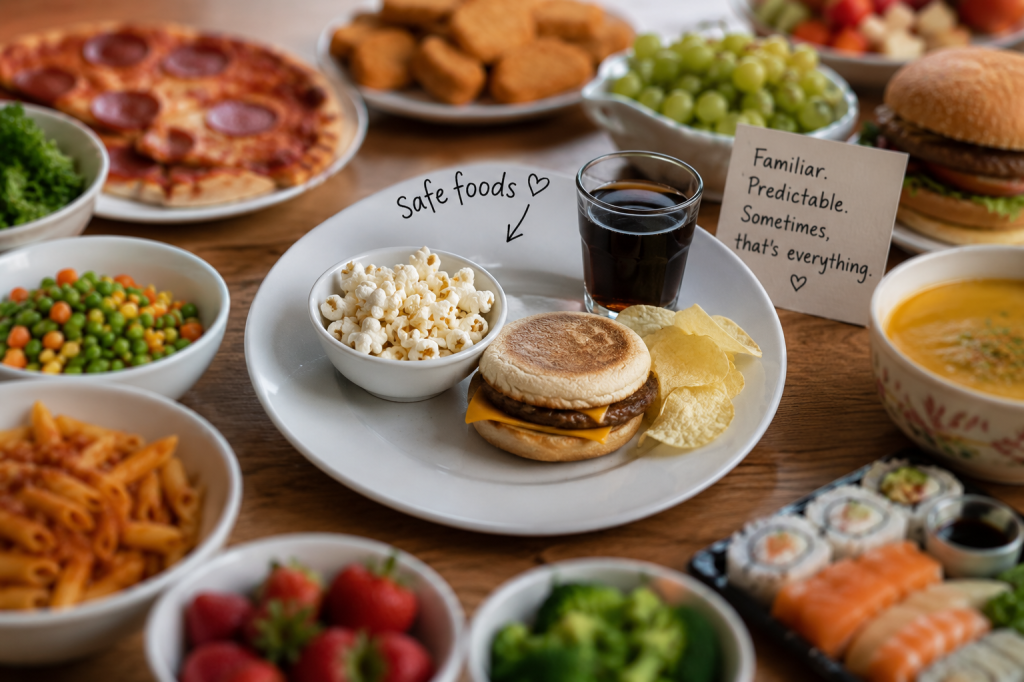
Welcome to the ARFID Safe-Food Universe
Speaking of ARFID, this is where things get interesting.
See, our family struggles with ARFID (Avoidant/Restrictive Food Intake Disorder), and it’s been a lifelong challenge, like many families out there. It’s not just picky eating. In fact, it is much more serious. But, as with many other things relating to autism, this is often misunderstood and characterized as just willfulness or a control issue.
Judgements abound from well-meaning yet ignorant individuals with nary a speck of knowledge about ARFID and autism who feel they can lecture me about just “making her eat it,” “letting her go hungry,” or my personal favourites, “If it was my kid, she wouldn’t do that,” and “You need to set stronger consequences and rules.”
Sure, Jan. Sure.
Anyhoo.
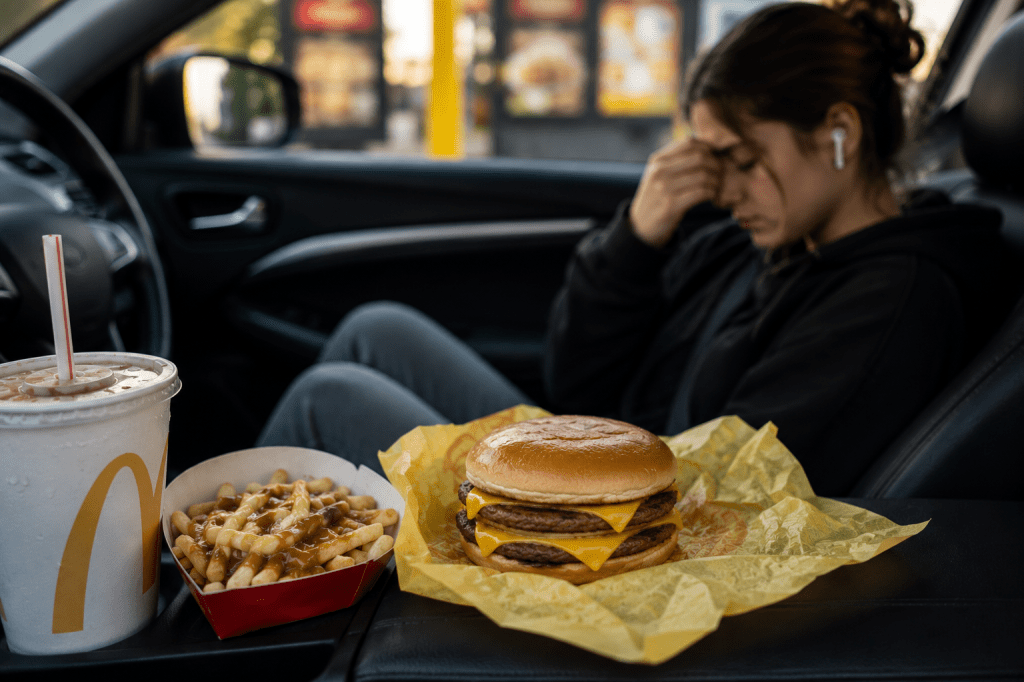
For the past few years, McDonald’s has been one of our reliable staples, even when other “safe foods” come and go in the ARFID universe. (I’ll get to safe foods in a bit.) Specifically, the Double Cheeseburger Extra Value Meal. No pickles or onions on the burger, Coke to drink, and poutine instead of fries.
For LITERALLY the past three or four years, we have been ordering this at the drive-through at our local McDonald’s, so it is safe to say we are regulars. And frankly, given the specifics of the order, I’m not sure why remembering us is such a big deal.
But here’s where things get murky.
The number of times I’ve had to explain that I need THAT specific meal, even when staff members have argued that the EVM wasn’t on the menu anymore…
(Apologies, this happened at the Wellington Street McDonald’s in London on more than one occasion.)
And newsflash: imagine their surprise when, EVERY time they tried to give me a different meal, I walked in, showed them their self-serve kiosk, and pointed out the EVM Double Cheeseburger Meal.
The problem with our local McDonald’s in St. Thomas isn’t with not knowing the EVM meal is available. It’s with always trying to sell me the McDouble Meal.
And I get it. I mean, these kids and adults working there are trying to save their customers money. After all, the McDouble Meal is nearly $5 less than our good ol’ EVM. But the problem is, every time, I have to assert myself that I specifically need the EVM…and of course they think I’m crazy.
What they don’t understand is the severity of ARFID. The fact that it is a classified eating disorder that can make it incredibly difficult for kids on the spectrum to get the nutrients they need, or sometimes to eat enough at all. Some kids with severe ARFID require nutritional supplementation or feeding tubes.
Everything about that meal can be a trigger if it isn’t the same every time. From the name, to the packaging and wrapping, to the way the cheeseburger is made, to how it’s stacked, to the size of the Coke that comes with the meal. Small for the McDouble Meal. Medium with our reliable EVM. Even the mixture of syrup to carbonation in the drink can cause issues, and kiddo will not drink it.
We now have a standing ritual that, before driving away from the drive-through window, we check that we have straws, a fork, and that the mixture of the pop is okay, because if it’s not, I will have to turn around and drive back. And this happens far too often.
The last time this particular carbonation faux pas occurred, it was with a new, young worker at the window. When I hadn’t moved on and had to get her attention, she literally rolled her eyes at me and tried arguing.
Now, I’ve worked in service for 20 years, out in Banff, Alberta, and I know that arguing with customers is never a good idea. But argue and throw attitude she did. This is not to say I wasn’t a little hot under the collar myself by the time I got my third stink-eye from her.
But this is what happens to families supporting neurodivergent kids on the daily.
So, Back to the Plot of the Story
Today, we went through the drive-through. I had just seen news saying Dolly Parton had died, and both kiddo and I were reeling. Needless to say, when I pulled up to order, I wasn’t paying attention.
I did my usual spiel: “I’ll have a Double Cheeseburger Extra Value Meal, no pickles or onions on the burger, Coke to drink, and poutine instead of fries.”
Now, normally I check the screen and make sure it is the EVM. The past six months or so, I’ll order the EVM and the cashier will then ring it in as a McDouble Meal. I correct them, and sometimes they’re great about it. Sometimes they argue.
One lady was super nice. As I was getting a little flustered, she actually said, “I’m not trying to upset you. I just want to get you a good deal.” I appreciated that. And I felt badly, because I don’t want to be THAT person. You know. Entitled. White. Privileged.Yada, yada, yada.
When I got to the window that time, I explained that my kiddo had autism and it was super important that she get the same meal every time, or she couldn’t eat it. Of course, I didn’t explain ARFID, because just explaining about kiddo’s autism felt like a step I didn’t really want to take.
But…and this is the important part… I felt like I had to in order to stop having to constantly explain why I needed this exact meal.
Needless to say, after this exchange, I’ve been getting the correct meal…er…for the most part. They have new staff all the time, but they’re pretty good, though slightly puzzled, when I correct them and insist on the more expensive meal.
Today, however, I fell short. My usual hypervigilance was not at its best, and we drove up to the window to pay.
“McDouble Meal?” the attendant asked.
Now, this is an attendant who always waits on us. She’s lovely. And she has literally taken our money hundreds of times. We order this meal on average three to five times weekly, for the past three years. Do the math.
And I’m pretty sure they have cameras that can see into our car when we order, so she knows us. My daughter is always with me in the passenger seat. And the specific order, always rattled off in exactly the same way, should have tipped her off.
But this time, it didn’t.
So I’m now at the window, paying for a McDouble Meal, worried about how kiddo will take this, wondering if I can try to pass this off as the EVM. I mean, maybe she won’t notice?
Please God, make her not notice.
And I’m frustrated that after spending thousands at this McDonald’s, here I am, yet again, having to go through this constant defence of getting the specific thing I ordered. The one safe meal my daughter will eat TODAY.
And Then Our McDonald’s Burger Came
We pull up to the next window, and the young man is sweet, and he hands me a small Coke.
Not a medium.
I freeze. Like, literally, deer-in-headlights freeze.
He looks at me and can tell something’s wrong. Now my anxiety is kicking in, but I don’t want to cause a scene. So I turn to kiddo and ask her if this size is good. She says yes, but she’s starting to get nervous. I’m now on high alert, looking for signs of a meltdown, which could occur.
The young man asks me to pull up to the next window to get our food. As we wait, I’m trying to explain that the poutine is the same, and the burger should taste the same.
But kiddo is getting upset.
And sure enough, the burger comes.
Different wrapping. Different look. Different feel.
FUCK.
And now she’s crying and apologizing. She’s telling me she’s sorry, but she can’t eat it, and she’s being made to feel like there’s something wrong with her because she can’t.
So I reassure her as I drive in a circular pattern back into the drive-through line and pull up to order again. The same person takes my order.
“McDouble?” she says, or something along those lines.
And I say something like, “No. I want the….(insert spiel here)…remember, that’s what I ordered the first time. The EVM. Have you heard of ARFID? It’s an eating disorder, and it makes it hard for kids with autism to eat certain foods. She has to eat the same foods every time, and the EVM Meal is one of those. So I’ve got an upset kid with autism beside me because we didn’t get the order right the first time.”
I’m not yelling. But I’m blunt. And I offer no other explanation.
Silence.
I roll up to the window and pay. Frost. Silence.Might as well have been at Wendy’s.
I roll up to the next window. We get our medium Coke, and the young man is somber and respectful and subdued. We roll up to the third window to get the meal we originally wanted, after paying an extra $10 for a meal I didn’t order, didn’t want, and have a history of having to fight for.
I might also mention that at.no.time.did.anyone offer to refund us our money for the mistake in the first order.
The Drive Home
Sure enough, I’m replaying this all the way home from St. Thomas to Port Stanley. Feeling, in turn, ashamed for not being kinder, frustrated because I am ALWAYS having to explain a simple order to the people in the drive-through, and wondering whether, moving forward, we should even continue to go to this McDonald’s.
What is very clear to me is that there is a gap in understanding somewhere. There isn’t enough understanding of autism and invisible disabilities, there isn’t enough understanding of ARFID, or, probably, both.
So now I’m in the position of thinking maybe I should go in and explain why this particular meal is necessary.
But will they believe me?
How many times have parents of kids with ARFID been disbelieved?
And here’s the other thing. My kiddo doesn’t “look autistic.” She’s beautiful, tall, and normally happy as she sits next to me in the passenger seat, most times with earbuds in to help her deal with her sensory sensitivities. She doesn’t “look” like she has an eating disorder.
And I’m sure after today, everyone on the McDonald’s side thinks I was being a complete and utter bitch.
Frankly, I’m soooo tired of having to explain my daughter’s disability to people, because I have to do it so often. And all I wanted was to get my daughter the fucking meal I ordered so she’d eat something substantial for the first time that day.
So.
In an effort to advocate for others out there who may feel this same frustration, and in an effort to explain why this particular meal is so important, here’s some information about autism and ARFID that I wish more people knew.
And YES…I AM talking to you, McDonald’s employees and managers. If you know better, maybe we can ALL do better, myself included.
A Quick Primer on Level 1 Autism and ARFID
First, Level 1 autism does not mean “Autism Lite™.” It doesn’t mean “barely autistic.” It doesn’t mean someone only has a little bit of autism. And it certainly doesn’t mean the disability only exists if you can recognize it through the passenger-side window of a car.
Level 1 autism means a person requires support. My daughter can talk. She’s smart, funny, beautiful and sarcastic. She can also experience significant sensory sensitivities, anxiety, difficulty with unexpected changes, and a nervous system that can become completely overwhelmed by something another person might barely notice.
Which brings us to ARFID.
ARFID stands for Avoidant/Restrictive Food Intake Disorder. It is an actual eating disorder. It isn’t picky eating, bad parenting or manipulation. And it isn’t something you fix by saying, “She’ll eat when she’s hungry enough.”
Sure, Jan.
For people with ARFID, things like taste, smell, texture, temperature, appearance and consistency can determine whether a food feels safe enough to eat. Things most of us wouldn’t even think about, like packaging, presentation, drink size or whether something looks slightly different than usual, can matter too.
And safe foods can disappear. That’s one of the particularly shitty parts of ARFID. Something your child reliably ate for months, or even years, can suddenly become something they simply cannot eat.
My daughter’s safe-food list is already severely limited, so when she has a substantial food that is safe, I protect the ever-loving shit out of it.
Would I prefer that safe food to be grilled salmon, broccoli and quinoa? Absolutely.
The ARFID gods have declined my request.
Instead, one of her safe foods is a McDonald’s Double Cheeseburger Extra Value Meal, no pickles or onions, Coke, poutine instead of fries.
And “basically the same thing” doesn’t necessarily mean the same thing to an autistic brain with ARFID. Different wrapper, different drink size, different presentation, different appearance, something assembled differently, even Coke with a different syrup-to-carbonation ratio.
To most people? Meh.
To her nervous system? This isn’t the food I know. I can’t eat this.
And she isn’t choosing that response.
Today my daughter sat beside me crying and apologizing because she couldn’t eat a hamburger.
Think about that.
She wasn’t throwing a tantrum because she didn’t get what she wanted. She wasn’t demanding I buy her something better.
She was apologizing because her disability wouldn’t allow her to eat the food sitting in front of her.
That’s ARFID.
That’s why the wrapper matters. That’s why the size of the Coke matters. That’s why I check the carbonation. That’s why I will drive around and buy the entire damn meal again.
And that’s why, when someone helpfully tries to save me five bucks by substituting a cheaper meal, I keep saying, “No, thank you. I need the Double Cheeseburger Extra Value Meal.”
Trust me. I would LOVE to save the five bucks. I’d love to save the whole damn amount and make her a sandwich at home.
But feeding a child with ARFID isn’t about winning a parenting battle. Sometimes it isn’t even about creating the nutritionally perfect meal. Sometimes the goal is simply getting enough food into your kid.
And right now, McDonald’s happens to make one of the increasingly few substantial meals my daughter can reliably eat.
And Finally, My Part in This
I also want to be fair. I could have handled today’s interaction better.
I was frustrated. I was worried about my daughter. I’d already spent the morning cataloguing pages and pages worth of the ways she struggles in a world that wasn’t exactly designed with her in mind. Then I watched her cry and apologize because she couldn’t make herself eat a hamburger.
So yes, when I went around that drive-through the second time, I was blunt. Probably too blunt. And to the employee on the receiving end of that frustration, I’m sorry.
She didn’t know what had happened inside my car after we left that first window. She didn’t know about ARFID. She didn’t know about my morning, our five-year wait for autism services, the super-long document, the shrinking safe-food list, or the crying teenager sitting beside me. She just knew an irritated woman had come back through her drive-through.
I can own that.
But I also think there’s something worth learning from what happened. I don’t expect every McDonald’s employee to understand autism, ARFID, sensory processing or restrictive eating disorders. I don’t expect them to understand why on God’s green earth I’m insisting on paying MORE MONEY for what appears to be almost exactly the same hamburger.
I just need them to believe me when I say I need the thing I ordered.
I shouldn’t have to disclose my daughter’s disabilities through a drive-through speaker to justify buying a particular cheeseburger. And she shouldn’t have to “look autistic” or “look like she has an eating disorder” for her needs to be real.
Sometimes when someone says, “No, thank you. I know that’s cheaper, but I need the meal I ordered,” there may be a reason you can’t see.
You don’t have to understand it. You don’t even have to know what it is.
Sometimes, you just need to give them the damn cheeseburger.
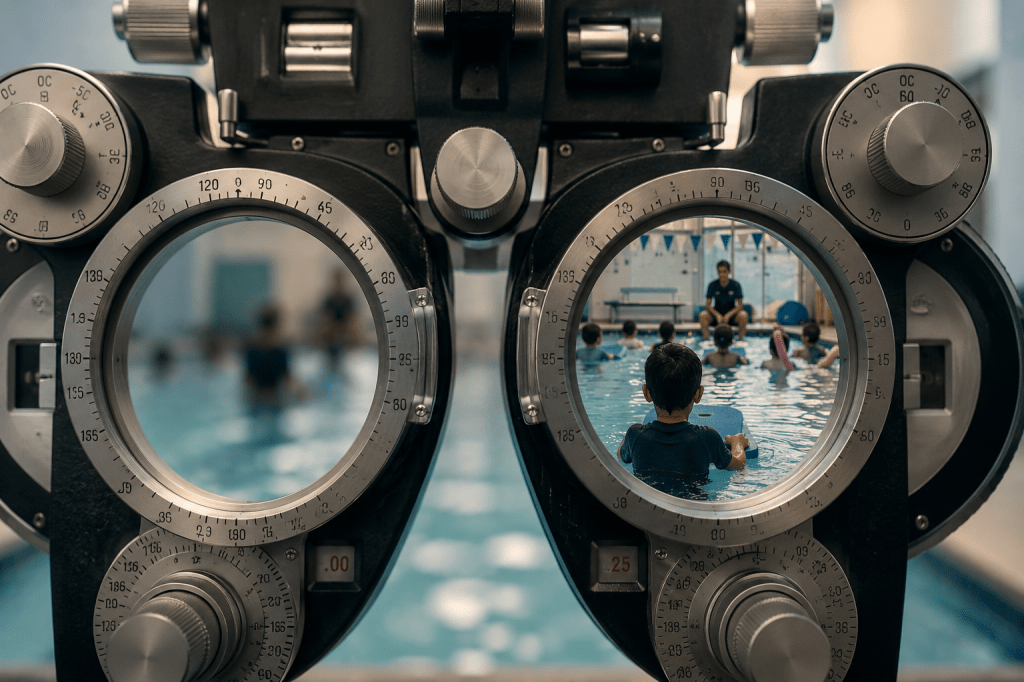
My dad is a retired optometrist, and I remember him using a machine on people that helped sharpen their vision. It was a cumbersome thing, two huge steel circles side by side, akin to the eyeballs of some otherworldly praying mantis. He’d put it up to your face, as close as you could stand, and while you were wearing these colossal frames, he’d switch the lenses for each eye until you had perfect vision between them.
Always in his calm, soothing voice: “Is it clearer here?” Flip lens. “Or here? How about now, better here?” Flip. “Or here?”
Through this process, you could suddenly see things with more sharpness and acuity, noticing details like shading and definition that were so subtle, you were unaware you were even missing them.
I noticed a few of those details today.
Since my own neurodivergent diagnosis, each day seems to hold some sort of new awakening, an awareness of just how hostile the world around us can be to people who don’t experience things the same way. I was watching my daughter during her swimming lessons and marveling at how well she was doing. In my head, I was, once again, coming to the realization of just how differently she sees, and more importantly FEELS, the world around her. And how much confusion, overstimulation, and even pain all of those sensory inputs can cause her.
As I was (yet again) reminding myself of her tenacity and bravery, my attention shifted to the other end of the pool.
The Kid Who Couldn’t Sit Still
There was a young lifeguard, maybe 16–17ish, give or take (at my age, they all look so young!), teaching a group of seemingly five-to-eight-year-olds. They were backed against the pool’s edge in the shallow end, holding their flutterboards in front of them while he gave instructions.
What caught and held my attention was the instructor shouting, “Jordan, listen to me. Stop messing around or you won’t get to go.”
The kiddo in question was obviously fidgeting, dunking under the water, and having trouble sitting still long enough to listen. As I watched, I saw the instructor demonstrate that he wanted the kids to push the flutterboard in front of them with straight arms and practice their scissor kicks behind them. Of course, he was about 10–15 feet away from the kids, and with all the sights, sounds, and sensations they were experiencing in the pool, it was likely difficult for some of them to pay attention.
But that wasn’t what caused my ears to perk up with a “Wuh-ohhh,” à la Scooby-Doo.
He then proceeded to tell them he wanted them to practice the technique and swim to him, one at a time. Given that each child took several minutes to swim to the instructor and back to the wall, the result was that the children at the end of the line were standing still, doing nothing, in the hot sun, for many minutes at a time.
But what really creamed my corn and baked my cheese (it’s lunchtime and I’m getting hungry) was that instead of letting Jordan go first, because this was the child who was obviously having the hardest time standing still and seemed to require movement to attend, he rewarded the kids who had been standing quietly and listening.
And this broke my heart.
First, as a figure skating coach of nearly 30 years, who is NCCP Level 3 certified and Level 4/5 trained, and who spent the better part of my career not only learning best practices for coaching but teaching them to others, no child should be standing around waiting their turn for that long. There were a million ways this young instructor could have engaged all the students at once.
He could have had them perform the skill together without venturing into the deep end, so they could simply touch down in the shallow end. He could have given the waiting kids a skill or fun game to practice in the water, perhaps holding onto the side of the pool and practicing their kicks 20 times, then grabbing their board, swimming out to him and back, where he could give feedback as they went.
This is a fairly standard coaching faux pas. But it’s made worse when you consider that out of those five kiddos, statistically there’s a decent chance at least one of them was neurodivergent.
Take one guess which kiddo had caught everyone’s attention.
And suddenly, all my daughter’s dance practices came flashing back to me. The ones where the kids who could sit still and take instruction were rewarded, and the ones who couldn’t were punished. Kids with invisible conditions like ADHD, ASD, AuDHD, and a myriad of others can struggle with these skills through no fault of their own.
You wouldn’t ask a hard-of-hearing child to just listen more carefully. You wouldn’t expect a child with a physical disability to simply try harder to make their body do something it cannot do. So why do we get upset and attribute a child’s struggle to follow directions, sit still, regulate their body, or pay attention to a behavioural problem when their brain may literally process those demands differently?
Yet as coaches, instructors, teachers, and parents, we do it all the time.
I know I did it before I became the mom of a neurodivergent child and then was diagnosed myself, at 57, with ADHD and ASD. And I STILL do it in moments of frustration and exhaustion. When it’s the end of a very long day, I sometimes have to consciously remind myself of that familiar phrase: she’s not giving me a hard time. She’s having a hard time.
And suddenly my entire history came rushing back. Being a figure skater in group lessons. The instruction I received in my coaching courses that failed to prepare me for virtually ANY type of neurodivergence. And, more heartbreakingly, all the coaches and instructors who have worked with my daughter who, however well-meaning, and however well they THOUGHT they understood neurodivergence…did not.
My daughter quit dance because of this. Something she was good at, something she loved, and something that was soooo good for her on so many levels. She got tired of watching neurotypical kids who could attend, focus, and progress more quickly receive more attention. And, of course, more attention fostered faster progression, which meant kids like my daughter never had an even playing field.
So, as I mentally prepared the blog I was going to write in my head after this realization, my daughter finished swimming and we came home (after our McDonald’s run, obviously).
As soon as I walked into the house, the smell of burnt plastic assailed my daughter and me. It was so strong when we walked into our mudroom that we almost choked. My kiddo immediately went downstairs to her room, but I, of course, went into threat-response mode. As you do.
I went into the kitchen, where my mom was heating a huge pot of water on the stove. My mom dismissed my sense of smell, telling me nothing smelled and she was just boiling water. The smell wasn’t as bad in the kitchen, but when I went back into the mudroom, there it was again: a melting, burning, plastic smell that made me wary.
Of course, I did a circuit of the house, all the while my mother telling me nothing smelled. But it wasn’t just what she was saying. It was the way she was saying it. As if I was crazy. As if there was nothing to be worried about. As if, yet again, I was making too much out of nothing. As if my concern that something might actually be burning was too much and a bother to her.
As if I was a bother.
So I went upstairs to my room and proceeded to put laundry away. In the process, I got distracted and ended up Marie Kondo-ing my closets, which took the better part of an hour.
(And yes, my daughter and I still live with my parents, and I’ve decided I’m going to stop feeling guilty about that. I needed help raising a neurodivergent kiddo on my own, and now I’m helping care for my father, taking on more responsibilities around the house and yard to make sure everything is okay, and giving my mom longer breaks when she needs them. And I’ve always paid our own way and helped with household bills.)
Anyhoo…where was I before I attempted to justify my existence yet again? Hello, ADHD much?
Oh, right.
After my closets were sufficiently bare, I went back downstairs, and there was the smell again. Just as strong and just as worrisome. So I did another inspection, again to just as much judgment and criticism from my mother.
Boom. Second epiphany.
How many times have kids like Jordan, or even people like me when we were younger, been berated or dismissed because of our extraordinary senses? Sensory differences are incredibly common among autistic and otherwise neurodivergent people. Sounds can be louder. Lights can be brighter. Smells can be overwhelming. Textures can hurt. Things other people barely register can hit our nervous systems like a truck.
How many times each day, in schools, sports, workplaces, and homes, were we made to feel like the way we experienced the world was made up? All in our heads? Too much? Attention-seeking? Misbehaviour? Something we were doing to cause problems for other people?
How many times did we receive the message that we were bad?
How many times were we ignored, dismissed, or punished for our inability to fit neatly into a world that can be profoundly hostile to people whose brains and bodies work differently? And is it any wonder that I now sometimes feel crippling levels of loneliness and a sense of being “othered,” even within my own family?
I remember often feeling like I didn’t fit in. I didn’t share similar interests, struggled to relate on a fundamental level, and couldn’t simply shed injustices or slights the way my brothers seemed able to. And because I couldn’t, the message was always that I was too much.
Which brings me back to Jordan. How many kids like him have been punished instead of accommodated?
Maybe Jordan Wasn’t the Problem
I can tell you that in nearly 30 years of coaching with Skate Canada and going through the NCCP system, there was minimal content devoted to invisible disabilities. Sure, there is an entire branch of coaching designed for Special Olympics, but newsflash: kids like my daughter, who don’t have an intellectual disability, do not qualify.
So where do they go? Are they accommodated in our mainstream coaching systems? What about testing and competitive systems? Are accommodations and scaffolding provided for those kids? Because expecting equality without providing equitable support isn’t actually equality.
Are coaches taught how to recognize when a child isn’t refusing to listen, but can’t process the instruction in the environment we’ve created? Are we changing the environment, or are we trying to change the child?
Because if one child can stand quietly against the wall for ten minutes while another needs to move, why is standing quietly the behaviour we’re rewarding? If one child learns by listening to a verbal explanation while another needs to see it, do it, repeat it, move through it, or receive the instruction one-on-one, why have we decided the first child is the “good listener”?
Maybe Jordan wasn’t the problem. Maybe the lesson was.
And as it became ever more obvious to me today, this world, and so many of the activities within it, still aren’t safe or equitable places for kids with invisible disabilities. It’s as if because you can’t see their disability, it doesn’t exist, and therefore accommodating it is optional.
It isn’t.
Maybe that’s what diagnosis has been doing for me. It’s like my dad’s giant optometry contraption has been sitting metaphorically in front of my face, flipping lenses one at a time.
Is it clearer here? Or here?
And every day, something else comes into focus: my daughter, Jordan, my coaching career, my childhood, my family, myself.
Things that were always there, but whose edges I couldn’t quite see. And now that I can see them clearly, I don’t think I can ever unsee them.
I wasn’t the best version of myself yesterday, and I’m having trouble letting myself off the hook for it.
In the span of about 45 minutes, I lost my temper and spoke harshly to two separate service workers, and I’m deeply ashamed of my behaviour. I pride myself on treating people the way I want to be treated, with kindness, grace, empathy. I’ve spent most of my life trying very hard to be a good person.
Yet in those moments, it was like I was outside myself looking in.
I could feel my cheeks flushing, everything getting hot, my heart rate ramping up. My breathing changed. My thoughts…well, “racing” doesn’t even begin to cover it. I couldn’t hold onto them long enough to put two together coherently. Speaking in full sentences suddenly became difficult.
And here’s the kicker: I lost it over such small, innocent things. Things that most people, and honestly even me on a good day, wouldn’t stress over at all.
But in those moments, all my brain could perceive was:
“Danger! Danger, Will Robinson!”
I was ashamed immediately afterward. I apologized. More than once. Because neither person deserved that.
But I still can’t let it go.
And what I’m beginning to realize is this wasn’t really about McDonald’s or Walmart. This is part of a pattern that stretches throughout my entire life, one that has profoundly affected my mental health, my relationships, and the way I move through the world.
Let me explain.
Already Running on Empty
Yesterday had already been a lot before the cheeseburger meal incident even happened.
I was stressed about money because my car has been making a weird noise and I’m trying to figure out how to cover everything until child support and my next paycheck arrives. Kiddo has been dealing with some ongoing health issues that have been scary, complicated, and exhausting to navigate, and the doctor’s appointment we had just come from required me to do most of the heavy lifting and advocating yet again.
If you’re a parent of a medically complex or neurodivergent kid, you know the drill. You walk in hoping someone will connect the dots, listen carefully, maybe even take some initiative…and instead you leave feeling like you just performed a one-woman TED Talk while simultaneously trying to remember symptoms, timelines, medications, and not sound “too emotional” while doing it.
At the same time, Dad has been very ill for a long time now, and when he has a few bad days in a row, it can feel catastrophic. Mom is exhausted and emotional. I still had work waiting for me at home. The grass needed cutting. My brain already felt like a browser with 47 tabs open and one of them blasting music I couldn’t find.
I’m also starting to realize just how much chronic stress and possible autistic burnout lower my ability to cope with even minor disruptions.
The Cheeseburger Meal
So we stopped at McDonald’s.
Now, for context, kiddo is autistic and likes sameness. Predictability matters. We’ve been ordering the exact same meal for probably a decade. Literally.
Extra Value Double Cheeseburger Meal. No onions. No pickles. Coke. Substitute poutine.
Same order. Same McDonald’s half the time. Often the same employee.
So when the employee suddenly asked, “Did you mean the McDouble?” my brain completely short-circuited.
I said no, the Extra Value Meal, and she said she just wanted to make sure I got the right thing. Which was kind and reasonable. But suddenly I felt confused and flustered and overwhelmed all at once.
Because a few years ago, at another McDonald’s, I had gotten into a weird argument where an employee insisted they didn’t have Extra Value Meals anymore even though I had literally ordered one there the week before. Another voice came over the speaker. They argued with me. I ended up ordering something different, then parked and went inside only to discover the Extra Value Meal still sitting there on the self-order screen like a tiny greasy monument to my growing insanity.
So yesterday, that memory came flooding back instantly.
And suddenly this wasn’t just: “Which burger did you want?”
It was: “You’re confused.” “You’re wrong.” “The script changed.” “You’re not being understood.”
I know how ridiculous that sounds written out. Trust me. But my nervous system did not interpret it as a minor inconvenience. It interpreted it as a threat.
So I clarified I wanted the Extra Value Meal, and when I was answered with, “They’re all Extra Value Meals” I snapped back, “I’ve been ordering this same thing every day for five years, I know you have it.”
Side note: it was probably closer to ten years, but remember…confusion? Racing thoughts? Check and check.
I’m learning that this kind of distress around sudden change and disrupted expectations is actually pretty common in routine disruptions in autism.
By the time I got to the window, I had calmed down enough to apologize. I explained that kiddo is autistic and needs consistency, and the employee was actually lovely about it.
But I drove away thinking: What the hell was that?
Primed
Then came Walmart.
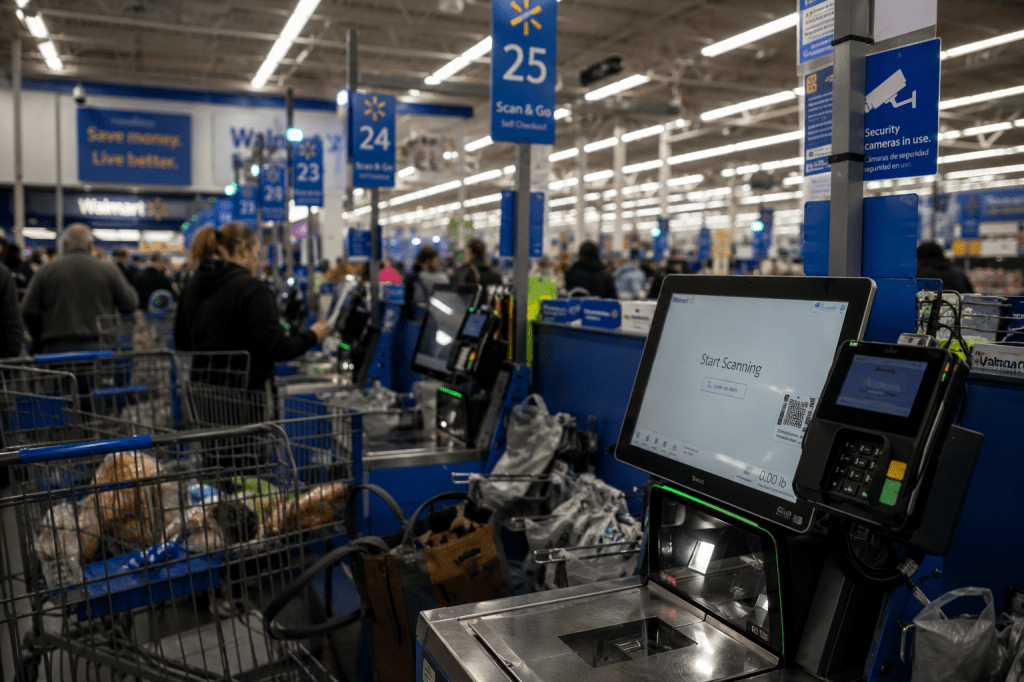
Now let me tell you something about Walmart self-checkout.
I hate it.
Every time I go, my anxiety increases exponentially.
The bustle of people. The carts. The noise. The constant blips from every self-scanner going off at once. I can never tell which sounds belong to my machine and which belong to someone else’s. My brain doesn’t filter them out.
And the heat.
Oh my god, the heat.
I struggle badly with overheating, especially when I’m stressed. It’s not uncommon for me to take off my coat and sweater while scanning groceries because I suddenly feel like I’m boiling alive under fluorescent lighting.
And naturally, I have a system.
Of course I do.
I position the cart just so. Purse on the floor instead of in the cart because someone might take it. Coat off. Sweater off. Scan carefully. Check the screen after every item because with my luck, one won’t scan and I’ll somehow get accused of shoplifting, another weirdly intense fear of mine.
I make little piles after scanning so I know what goes into which bag. Then I bag. Then I reload the cart. Then I double-check the screen. Then I pay.
When I finally walk through those sliding doors into the parking lot and feel the breeze hit my skin, I have NEVER. BEEN. SO. GRATEFUL. to breathe outside air.
Even if it’s a Walmart parking lot.
I’m starting to realize how much of this was probably sensory overload mixed with hypervigilance and an already overloaded nervous system.
So before the interaction even happened, I was already primed. My nervous system was already overloaded, and I still hadn’t recovered from our McDonald’s kerfluffle.
Under Surveillance
Then the scanner glitched.
The first item scanned twice. No problem, I thought. Honest mistake. The employee came over, removed it, and then had to review the video footage to confirm what had happened.
Which, rationally, I understand.
But emotionally? My nervous system immediately clocked it as: You’re under surveillance.
Then later, while scanning cat food, another item accidentally scanned twice. Again.
Only this time, the machine froze and flagged an error. Before I even had time to explain, another employee was there reviewing footage again while I stood there trying to explain that I was literally holding four cans while the screen showed five.
And I could feel the threat response escalating in real time.
Not because anyone was actually accusing me outright, but because my brain had already shifted into hypervigilance mode.
The first video review primed me. The second one confirmed the fear.
By the time the employee kept insisting the scan was correct while I stood there counting cans in my hand like a sweaty, overstimulated Sesame Street character, something in me snapped.
Not in a dramatic screaming way.
But sharply. Harshly.
“What are you not getting? I have four in my hand.”
Even writing that makes me cringe.
Then, because the universe apparently enjoys irony, the machine flagged me again while I was bagging my groceries. Another employee came over and explained the system had become confused by the placement of my reusable bag.
At this point I was internally one blinking fluorescent light away from a full system shutdown.
Later, as I was leaving, I found the first employee again and apologized.
Because she didn’t deserve that either.
The Shame Spiral
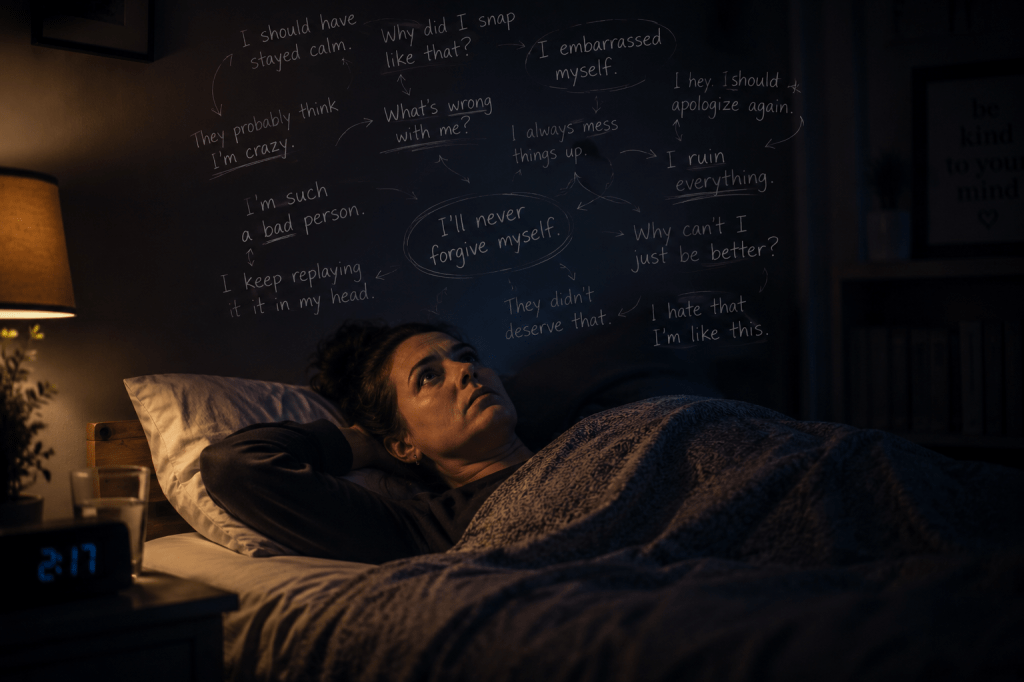
But then came the shame spiral.
And honestly? The shame spiral is the part I know best.
Because this is what I do.
I replay interactions endlessly in my head. I remember coaching moments from years ago where maybe I was too hard on a student. Not abusive. Not cruel. But maybe too intense. Too impatient. Too much.
And I can’t let myself off the hook for it.
Ever.
My brain immediately jumps to:
What’s wrong with me? Why can’t I control myself? Why didn’t I just say this differently? Why am I like this?
And underneath all of it is this terrifying belief I’ve apparently carried my entire life:
If I’m not perfect, I’m bad.
Not imperfect. Not stressed. Not dysregulated.
Bad.
Monster-level bad.
I’m beginning to realize how much rumination and black-and-white thinking have shaped my inner world.
My Map Is Gone
At the same time, I’m also beginning to realize that some of the things I thought were personal failings may actually be connected to being neurodivergent.
Like how deeply routine disruptions affect me.
For example, my mother sometimes tidies or reorganizes my things without asking. She means well. Truly. But it drives me absolutely insane.
Why?
Because I have a system.
I know where things are. It may not look organized to anyone else, but it works for me. So when I go to grab medication or keys or paperwork and it’s suddenly been moved, it doesn’t just mildly annoy me.
It disrupts the entire flow of my day.
It feels like my map is gone.
And if I’m already overwhelmed, that unexpected obstacle can feel enormous.
The same goes for interruptions.
If I’m hyperfocused on something and someone suddenly pulls me away from it, my reaction is almost physical. It feels jarring. Like my brain is being yanked out of one mode and shoved violently into another before I’m prepared.
Apparently distress around interrupted hyperfocus is also pretty common in neurodivergent adults, which honestly made me feel both validated and mildly attacked.
I used to think this just meant I was difficult. Anal. OCD. Controlling.
Now I’m wondering if it’s something else.
Maybe I’ve spent my entire life trying to manage an overloaded nervous system without understanding that’s what I was doing.
Understanding vs Excusing
And maybe that understanding matters.
Not because it excuses hurting people.
It doesn’t.
I am still responsible for how I speak to people. Full stop.
But maybe understanding the wiring underneath it all helps explain why some things feel so disproportionately overwhelming to me. Maybe it explains why I have to work harder than the average person to regulate myself when I’m overloaded.
And maybe, just maybe, understanding that isn’t “playing the victim.”
Maybe it’s finally learning to stop treating myself like a monster every time I struggle.
I don’t have neat answers yet.
I don’t know how to completely let myself off the hook while still holding myself accountable.
I don’t know how much of this is autism. Or ADHD. Or stress. Or perimenopause. Or burnout. Or just being human.
Probably all of the above.
What I do know is this:
I don’t think I was ever really angry about the cheeseburger meal.
This blog is a tag-team effort between me and AI. Think of it as my over-caffeinated intern who spits out ideas and/or helps me organize my thoughts and experiences, while I handle the heavy lifting. I research, fact-check, edit, and fine-tune everything to make sure it sounds like me (not a robot with a thesaurus). AI helps with the grunt work, but the heart, style, and final say? That’s all me.
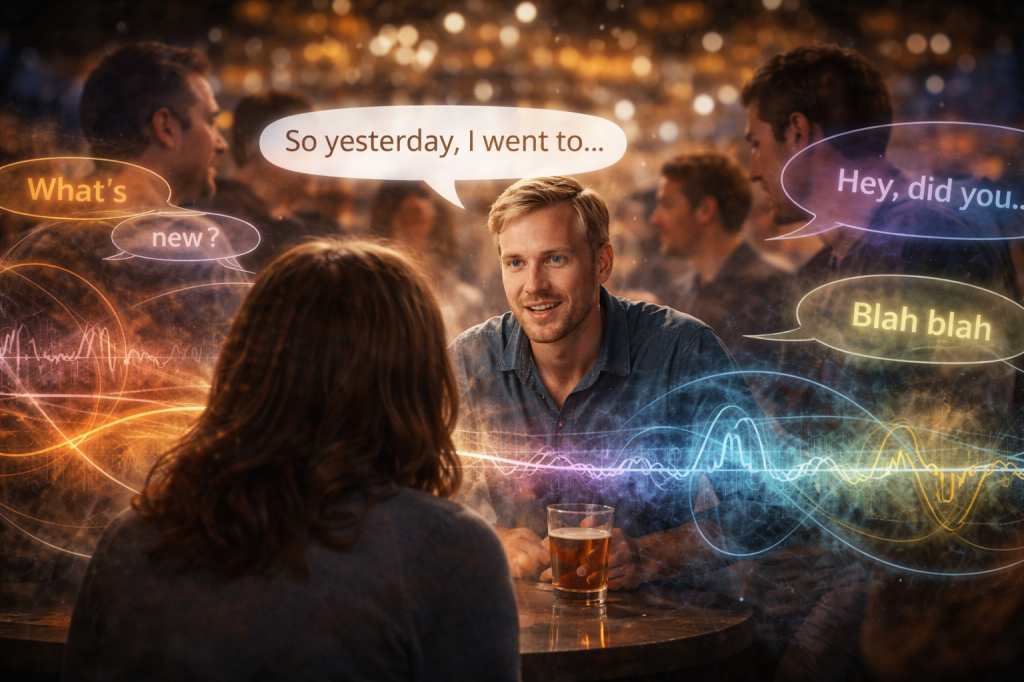
Last night I went out with a bunch of friends. And it was awesome.I had a few drinks, had a few gummies (my new way to combat anxiety and panic attacks), and danced my face off. Yes, I think that’s a thing.
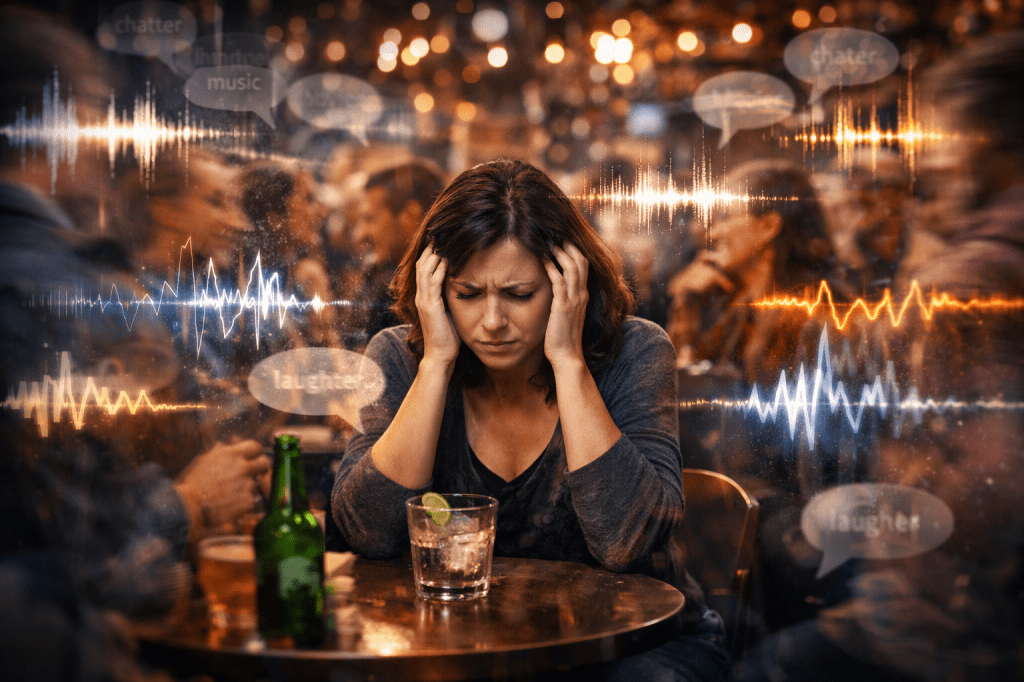
The bar was packed though. And when I say packed, I mean the kind where you have to squeeze sideways between chairs just to get back to your seat.There was live music, people talking everywhere, chairs scraping, glasses clinking. It was loud in that chaotic, joyful Friday-night kind of way.
But when I sat down at the table and tried to join the conversation swirling around me, I suddenly realized something strange.
I couldn’t hear a single conversation.
Not one.
I could see mouths moving. I could hear sound. But it was like every voice blended together into one giant wall of noise.
So I did what I’ve always done in situations like that.
I leaned in. I turned my head so my ear was closer to the person speaking, hoping I’d catch just enough to piece together what they were saying.
Still nothing.
Eventually I just started smiling and nodding when there was a pause in the conversation or someone looked at me like they expected a response. Which means there’s a very good chance I was enthusiastically agreeing with things I had absolutely no context for.
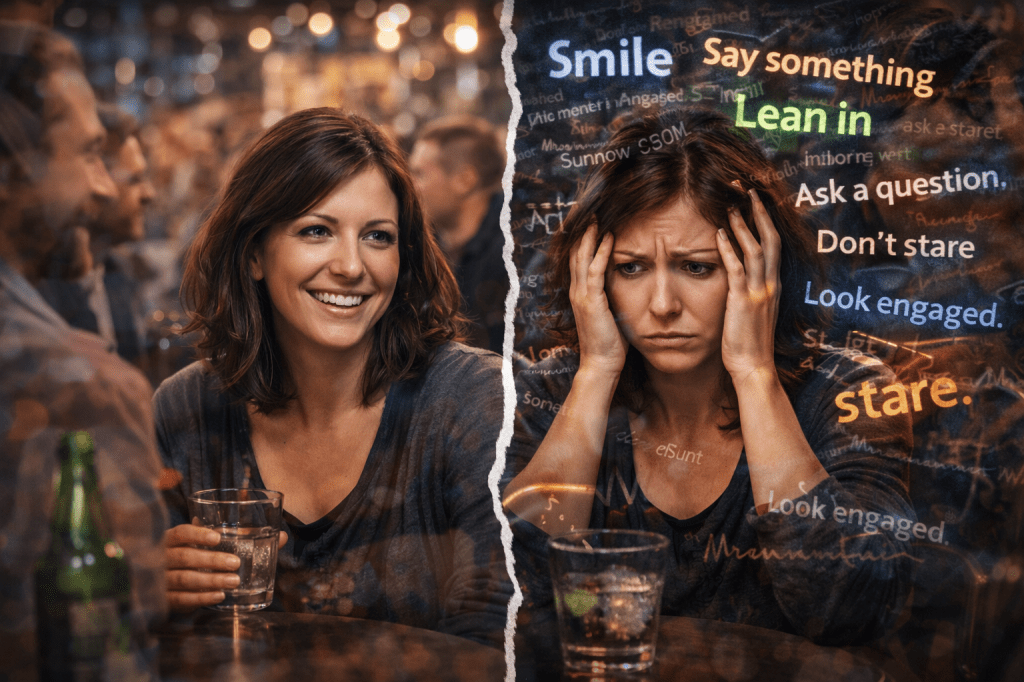
But that’s when something else started happening. In my head, my script got louder. See, I’ve always had a script running in my brain. I just didn’t realize that’s what it was. It’s the little voice reminding me when to change my body posture.
When to lean in. When to smile. When to laugh.
It tells me when I’m making too much eye contact… and when I’m not making enough.
Usually that script runs quietly in the background. Like a low hum I’ve gotten used to. But last night, in that wall of noise and chaos, that hum turned into the loudest thing in the room. Suddenly all I could hear were those thoughts.
You should say something. You’re too quiet. Ask a question. Lean in more. Look engaged. Don’t stare. Smile.
On top of all of that, I started feeling this pressure to make sure the people around me were having a good time. If there was a lull in conversation, I felt responsible for fixing it.
So my brain started cycling through every conversation starter I could think of. Every question. Every social prompt.
Trying to keep things flowing. Trying to keep everyone comfortable. Trying to keep the energy up.
And suddenly it was just… too much.
I couldn’t think. I couldn’t breathe properly. I had this overwhelming urge to put my hands over my ears and hide under the table.
I never let it show.
But under the table, my hands started shaking. Then flapping. It’s something I’ve done my whole life when I’m stressed—shaking out my hands or flicking my fingers to release tension.
Lately though, I’ve noticed I do it more when I’m anxious or overwhelmed. So I ended up doing what I’ve always done.
I sat on my hands.
Trying to make it stop. Trying to make it invisible. And later that night, I started wondering something.
“Now that I’ve realized I’m autistic… is it normal for these things to suddenly feel more obvious?” Or is it that I’m just more aware of them now? Or possibly, because I’ve finally “come out,” in a way, do I feel like I have permission to be more authentic and let the mask slip a little?
Or maybe it’s something else entirely. Maybe after decades of managing the script in my head… I’m just tired. Maybe the older I get, the harder it is to keep covering these things up. Or maybe hormones are part of it too.
Perimenopause has a way of amplifying anxiety, sensory sensitivity, and emotional regulation challenges. So maybe all those coping strategies I relied on for years are just… wearing thin. Whatever the reason, last night made something very clear. The script in my head that I thought everyone had?
Apparently not everyone does.
Why This Happens (And Why You’re Not Alone)
After experiences like that, a lot of late-identified autistic adults start asking the same question:
Why do autistic traits seem more noticeable after we realize we’re autistic?
The answer is usually a combination of several things.
Auditory Processing in Noisy Environments
Many autistic people struggle with something called auditory processing in complex environments. When there are multiple competing sounds—music, clinking glasses, multiple conversations—our brains can struggle to filter out background noise.
Instead of isolating one voice, everything blends together into a wall of sound. Researchers sometimes refer to this as the “cocktail party problem.” Most people’s brains automatically tune into one voice and filter out the rest.
Autistic brains often don’t do this as easily, which is why places like crowded bars or restaurants can quickly become overwhelming.
The Internal Social Script (Masking)
That running commentary in my head? That’s something many autistic adults describe. It’s part of something called masking. Masking happens when autistic people consciously monitor and adjust their behaviour in order to appear more socially typical.
This can include things like:
Monitoring eye contact
Rehearsing responses
Copying other people’s body language
Forcing facial expressions
Scripting conversations in advance
Many autistic women become extremely skilled at masking, often without realizing they’re doing it. But it takes a tremendous amount of energy.
Stimming as Nervous System Regulation
The hand shaking and flapping I mentioned is a form of stimming. Stimming (short for self-stimulatory behaviour), is a natural way many autistic people regulate stress and sensory overload. Common examples include:
Hand flapping
Finger flicking
Rocking
Pacing
Fidgeting
Unfortunately, many autistic kids are taught to suppress these behaviours because they look “different.” Which is why many autistic adults end up hiding them. Like sitting on our hands under a table.
Why Traits Can Feel Stronger Later in Life
A lot of late-identified autistic adults say something similar. Once they understand they’re autistic, it can feel like their traits are suddenly becoming more intense. In reality, several things may be happening.
You’re noticing things that were always there.
You’re becoming aware of how much effort masking requires.
And over time, many people simply become too exhausted to maintain that mask at the same level they did earlier in life.
Hormonal changes during perimenopause and menopause can also increase sensory sensitivity, anxiety, and emotional regulation challenges, which can make masking even harder.
Signs You Might Be Masking Without Realizing It
Many people don’t realize they’ve been masking for years. Some common signs include:
Replaying conversations in your head afterward
Studying other people’s behaviour to copy social cues
Feeling completely drained after social events
Practicing what you’re going to say before speaking
Monitoring your facial expressions and body language constantly
Feeling like socializing is a performance rather than something automatic
For many autistic adults—especially women—masking becomes so automatic that we assume everyone else is doing it too.
Until one day we realize they’re not.
Practical Strategies for Loud Social Environments
If crowded places leave you feeling overwhelmed, a few small adjustments can help.
Choose your seat carefully: Sitting with your back to a wall or closer to the person you want to talk to can reduce sensory input.
Focus on smaller conversations: One-on-one interactions are often easier to process than trying to follow an entire table.
Take short sensory breaks: Stepping outside for a few minutes can help your nervous system reset.
Use subtle regulation tools: Fidget rings, small objects, or even gentle hand movements can help release tension.
Know when it’s okay to leave: Enjoying a social event doesn’t mean you have to stay until you’re completely overwhelmed.
The Realization That Changes Everything
For most of my life, I assumed everyone else had that same script running in their head. That everyone was consciously monitoring their facial expressions, tone of voice, posture, and conversation timing.
Now I’m starting to realize that might not be the case. And that realization changes the way you see a lot of things. Because once you understand how much invisible effort goes into navigating social situations…
You also start to understand why it can be so exhausting. And why sometimes, even when you’re having fun…
Your nervous system still reaches its limit.
If This Sounds Familiar
If you’ve ever:
Struggled to hear conversations in loud places
Felt like you were running a social script in your head
Hidden stimming behaviours to avoid drawing attention
Felt completely drained after social events
You’re not alone. And you’re not broken.Your brain may simply be processing the world a little differently. And understanding that difference can be the first step toward finally giving yourself a little more grace.
Further Reading
If you’re interested in learning more about masking, sensory processing, and autism in adults, these resources are a great place to start:
AI tools were used to assist with editing, organization, and some visual elements in this post.
I hear my friends talk about how good they feel when they wake up after a solid night’s sleep.
Refreshed. Clear-headed. Ready for the day.
And I always wonder… What does that actually feel like?
Because I can count on one hand the mornings in my life where I’ve woken up feeling good.
Most mornings are a battle.
A battle against exhaustion. Pain. Anxiety.
Often my body feels like it’s been hit by a truck. I wake up feeling just as tired—sometimes more tired—than when I went to bed.
That “refreshed” feeling people talk about?
Honestly? Fuck off with that.
Because at this moment it feels like a taunt. One more thing I’m apparently not allowed to have in this lifetime.
And in a sea of difficult mornings, this one hit monsoon proportions.
Even my eyes hurt. The light was too much. My head, neck, and shoulders ached. My hands were claws because the flexors and extensors seemed to be at war with each other. My lower back was crying. My hip bones? Don’t even get me started.
It took forever just to sit up.
And yes, I used every bullshit motivational phrase in my fairly sturdy arsenal. (Add irritability to my list of symptoms). Thirty years of coaching gives you a decent toolbox.
“You can do this.” “One small step.” “Just sit up first.”
But no amount of self-talk made it easier.
Because this wasn’t just a mindset problem.
I’ve Been “Tired” Since I Was 16
I was first diagnosed with depression at 16 or 17.
At the time, my mom dragged me to the doctor because I was so tired I could barely walk up a flight of stairs.
And before anyone assumes I was out of shape—I was a competitive figure skater training 15–20 hours a week. I was in peak physical condition.
Still couldn’t climb the damn stairs.
Over the years, I’ve had depressive episodes. Some clearly tied to life events.
A death in university. Failing a course twice. Leaving an abusive partner in the middle of the night in a city where I knew no one. Infertility. Fertility drugs that I was told wouldn’t affect me, even though I warned the doctor I’m sensitive. (Spoiler: they did.)
After a concussion on the ice while pregnant (yes, I was teaching, don’t judge), then childbirth, things shifted again.
Sleep deprivation. Single parenting. Starting over in a new town. Dog-eat-dog coaching culture.
And then the body pain.
Full-body soreness that didn’t feel like training soreness. Hands clawed in the morning. Joints feeling fused together. Like I was wearing a suit of armor.
There were days the pain was so intense my teeth would chatter.
Eventually, after being dismissed more than once, a sports medicine doctor looked at me and said, “This isn’t a sports injury.”
I said, “I think it’s fibromyalgia.”
She agreed. Referred me to a rheumatologist. I had a diagnosis within a week.
Relief. Validation. Finally.
There are good doctors out there.
But as the parent of a neurodivergent kid in a small town? My faith still wobbles.
So Why Am I Questioning Everything Again?
Because now I’m 57.
And I’ve recently acknowledged something else about myself.
I’m autistic.
Late to the party. But here nonetheless.
I’m self-identified. Not formally diagnosed.
And before anyone clutches their pearls — self-identification is valid in a community where many women can’t access assessment due to cost, waitlists, geography, or years of being dismissed. I’ve done the reading. The reflecting. The pattern-matching across my entire life. This isn’t impulsive. It’s informed.
And once you look at your life through that lens? It’s like the whole timeline rearranges itself.
Everything feels hard again.
Showering is hard. Speaking and formulating thoughts is hard. Light is too much. Headaches. Nausea. Brain fog. Overwhelm from the smallest tasks.
I know. I know. There are a million other things this could be.
And I’ve been checked.
But the more I read about autistic burnout—especially in adult women—the more I feel that uncomfortable little a-ha click in my chest.
What if I haven’t just been depressed?
What if I haven’t just had fibromyalgia?
What if I’ve also been burning out my nervous system for decades?
So What Is Autistic Burnout?
Autistic burnout isn’t just being tired.
It’s not “I had a big week.” It’s not “I need a vacation.” It’s not regular workplace burnout.
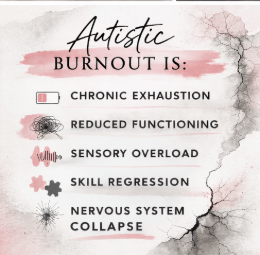
Researchers describe autistic burnout as chronic exhaustion, reduced functioning, and decreased tolerance to sensory input following long-term stress and unmet support needs (Raymaker et al., 2020; AIDE Canada Toolkit).
Translation?
Your nervous system has been running on high alert for so long that it just… stops cooperating.
Autistic adults actually named burnout first. Researchers later studied it and confirmed the pattern: long-term stress, masking, unmet support needs — and eventually a collapse in capacity (Raymaker et al., 2020).
Burnout isn’t just exhaustion.
It can look like:
Brain fog
Trouble speaking or finding words
Executive dysfunction that wasn’t this bad before
Sensory overload — light, sound, touch suddenly feel like too much
Loss of skills you used to manage
Increased anxiety
Shutdown
It doesn’t always look like sadness.
Sometimes it looks like: “I can’t.”
And unlike regular stress, it doesn’t necessarily get better with a good weekend. It can last months, especially if the demands don’t change.
Burnout vs Depression vs Fibromyalgia: Why This Is So Damn Confusing
Burnout can look like depression. Depression can look like burnout. Fibromyalgia overlaps with both.
Depression often includes:
Persistent low mood
Loss of interest or pleasure
Hopelessness
Emotional heaviness
Autistic burnout doesn’t always include that deep hopelessness.
It’s more like: “My system is overloaded. I don’t have capacity.”
Fibromyalgia brings another layer:
Widespread pain
Tender points
Non-restorative sleep
Morning stiffness
Flare cycles tied to stress
Studies show elevated rates of depression, chronic fatigue, and fibromyalgia among autistic adults, suggesting these conditions may overlap rather than exist in isolation (Altogether Autism; More Good Days; PMC8992921).
Which means it might not be either/or.
It might be all of it.
A nervous system under chronic stress can express itself in mood. In pain. In shutdown. In exhaustion.
Bodies are messy like that.
A Kitchen Table Self-Check
(Not a diagnosis. Just curiosity.)
I am not diagnosing anyone. Hell, I’m barely diagnosing myself.
But here’s a gentle gut-check to help me (and you) sort through this fog.
You might lean toward autistic burnout if…
You feel chronically exhausted in a way that rest doesn’t fully fix.
Small tasks feel disproportionately hard.
Sensory things suddenly feel unbearable.
You’ve “lost” skills you used to manage.
Reducing demands helps more than motivational self-talk does.
You feel overloaded, not necessarily hopeless.
You might lean toward depression if…
There’s a persistent low mood.
Things that once brought joy feel flat.
You feel hopeless or numb.
The exhaustion feels emotionally heavy.
You might lean toward fibromyalgia if…
Widespread pain is central.
Morning stiffness is intense.
Sleep doesn’t restore you.
Your body feels like it’s wearing armor.
And here’s the inconvenient truth:
It might not be just one thing.
The Cost of Being “Normal” for Decades
If I’m autistic, then I’ve been adapting to a world not built for me for 57 years.
That’s a long time to hold your breath.
Masking works. Until it doesn’t.
Research on late-diagnosed autistic women highlights decades of compensating and masking—often at significant psychological and physical cost (UCLA Health; Neurodiversity Centre).
Masking isn’t just social camouflage.
It’s energy expenditure.
And energy is finite.
Emerging discussions around autism and menopause suggest sensory sensitivity and burnout can intensify in midlife as hormonal shifts affect nervous system regulation (ScienceWorks Health).
So maybe this isn’t random.
Maybe this is cumulative.
Maybe my nervous system didn’t fail me.
Maybe it finally told the truth.
Maybe I Was Never Just Depressed
I was 16 and couldn’t climb stairs.
I was diagnosed with depression.
I was diagnosed with fibromyalgia.
And maybe those diagnoses were accurate.
But maybe they weren’t the whole story.
Because when I look back now—as a 57-year-old, self-identified autistic woman—I don’t just see sadness.
I see decades of adaptation.
Of performing competence. Of tolerating sensory overload. Of managing social politics. Of caregiving without pause.
Maybe the exhaustion isn’t weakness.
Maybe the armor-body mornings aren’t laziness.
Maybe the overwhelm isn’t a character flaw.
Maybe it’s what happens when you run a brain and body in survival mode for half a century.
I don’t have a clean answer.
It might be depression. It might be fibromyalgia. It might be autistic burnout.
It might be all of it.
But if I’ve been interpreting neurological overload as personal failure for decades?
That story ends here.
And if you’re 40. Or 50. Or 57. And you’re waking up feeling like you’ve been hit by a truck—physically, mentally, emotionally—maybe you’re not broken either.
Maybe you’re overloaded.
And maybe the question isn’t, “What’s wrong with me?”
Maybe it’s, “What have I been carrying for far too long?”
Sources & Further Reading
Raymaker, D. et al. (2020). “Having All of Your Internal Resources Exhausted Beyond Measure”: Autistic Burnout. AIDE Canada. Autistic Burnout Toolkit. UCLA Health. Understanding Undiagnosed Autism in Adult Females. Neurodiversity Centre. Masking and Burnout in Autistic Women. Neurodivergent Insights. Autistic Burnout vs Depression. Attwood & Garnett Events. How Depression May Present Differently in Autistic People. Altogether Autism NZ. Chronic Fatigue, Fibromyalgia and Autism. PMC8992921. ScienceWorks Health. Autism and Menopause.