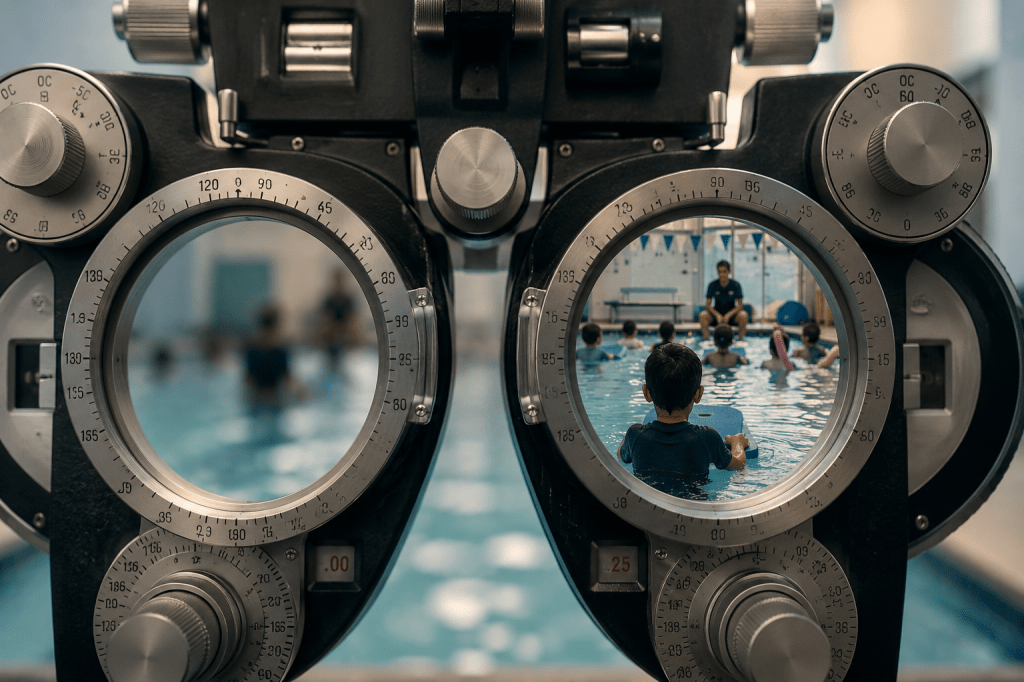
Images created by AI
My dad is a retired optometrist, and I remember him using a machine on people that helped sharpen their vision. It was a cumbersome thing, two huge steel circles side by side, akin to the eyeballs of some otherworldly praying mantis. He’d put it up to your face, as close as you could stand, and while you were wearing these colossal frames, he’d switch the lenses for each eye until you had perfect vision between them.
Always in his calm, soothing voice: “Is it clearer here?” Flip lens. “Or here? How about now, better here?” Flip. “Or here?”
Through this process, you could suddenly see things with more sharpness and acuity, noticing details like shading and definition that were so subtle, you were unaware you were even missing them.
I noticed a few of those details today.
Since my own neurodivergent diagnosis, each day seems to hold some sort of new awakening, an awareness of just how hostile the world around us can be to people who don’t experience things the same way. I was watching my daughter during her swimming lessons and marveling at how well she was doing. In my head, I was, once again, coming to the realization of just how differently she sees, and more importantly FEELS, the world around her. And how much confusion, overstimulation, and even pain all of those sensory inputs can cause her.
As I was (yet again) reminding myself of her tenacity and bravery, my attention shifted to the other end of the pool.
The Kid Who Couldn’t Sit Still
There was a young lifeguard, maybe 16–17ish, give or take (at my age, they all look so young!), teaching a group of seemingly five-to-eight-year-olds. They were backed against the pool’s edge in the shallow end, holding their flutterboards in front of them while he gave instructions.
What caught and held my attention was the instructor shouting, “Jordan, listen to me. Stop messing around or you won’t get to go.”
The kiddo in question was obviously fidgeting, dunking under the water, and having trouble sitting still long enough to listen. As I watched, I saw the instructor demonstrate that he wanted the kids to push the flutterboard in front of them with straight arms and practice their scissor kicks behind them. Of course, he was about 10–15 feet away from the kids, and with all the sights, sounds, and sensations they were experiencing in the pool, it was likely difficult for some of them to pay attention.
But that wasn’t what caused my ears to perk up with a “Wuh-ohhh,” à la Scooby-Doo.
He then proceeded to tell them he wanted them to practice the technique and swim to him, one at a time. Given that each child took several minutes to swim to the instructor and back to the wall, the result was that the children at the end of the line were standing still, doing nothing, in the hot sun, for many minutes at a time.
But what really creamed my corn and baked my cheese (it’s lunchtime and I’m getting hungry) was that instead of letting Jordan go first, because this was the child who was obviously having the hardest time standing still and seemed to require movement to attend, he rewarded the kids who had been standing quietly and listening.
And this broke my heart.
First, as a figure skating coach of nearly 30 years, who is NCCP Level 3 certified and Level 4/5 trained, and who spent the better part of my career not only learning best practices for coaching but teaching them to others, no child should be standing around waiting their turn for that long. There were a million ways this young instructor could have engaged all the students at once.
He could have had them perform the skill together without venturing into the deep end, so they could simply touch down in the shallow end. He could have given the waiting kids a skill or fun game to practice in the water, perhaps holding onto the side of the pool and practicing their kicks 20 times, then grabbing their board, swimming out to him and back, where he could give feedback as they went.
This is a fairly standard coaching faux pas. But it’s made worse when you consider that out of those five kiddos, statistically there’s a decent chance at least one of them was neurodivergent.
Take one guess which kiddo had caught everyone’s attention.
And suddenly, all my daughter’s dance practices came flashing back to me. The ones where the kids who could sit still and take instruction were rewarded, and the ones who couldn’t were punished. Kids with invisible conditions like ADHD, ASD, AuDHD, and a myriad of others can struggle with these skills through no fault of their own.
You wouldn’t ask a hard-of-hearing child to just listen more carefully. You wouldn’t expect a child with a physical disability to simply try harder to make their body do something it cannot do. So why do we get upset and attribute a child’s struggle to follow directions, sit still, regulate their body, or pay attention to a behavioural problem when their brain may literally process those demands differently?
Yet as coaches, instructors, teachers, and parents, we do it all the time.
I know I did it before I became the mom of a neurodivergent child and then was diagnosed myself, at 57, with ADHD and ASD. And I STILL do it in moments of frustration and exhaustion. When it’s the end of a very long day, I sometimes have to consciously remind myself of that familiar phrase: she’s not giving me a hard time. She’s having a hard time.
And suddenly my entire history came rushing back. Being a figure skater in group lessons. The instruction I received in my coaching courses that failed to prepare me for virtually ANY type of neurodivergence. And, more heartbreakingly, all the coaches and instructors who have worked with my daughter who, however well-meaning, and however well they THOUGHT they understood neurodivergence…did not.
My daughter quit dance because of this. Something she was good at, something she loved, and something that was soooo good for her on so many levels. She got tired of watching neurotypical kids who could attend, focus, and progress more quickly receive more attention. And, of course, more attention fostered faster progression, which meant kids like my daughter never had an even playing field.
So, as I mentally prepared the blog I was going to write in my head after this realization, my daughter finished swimming and we came home (after our McDonald’s run, obviously).
As soon as I walked into the house, the smell of burnt plastic assailed my daughter and me. It was so strong when we walked into our mudroom that we almost choked. My kiddo immediately went downstairs to her room, but I, of course, went into threat-response mode. As you do.
I went into the kitchen, where my mom was heating a huge pot of water on the stove. My mom dismissed my sense of smell, telling me nothing smelled and she was just boiling water. The smell wasn’t as bad in the kitchen, but when I went back into the mudroom, there it was again: a melting, burning, plastic smell that made me wary.
Of course, I did a circuit of the house, all the while my mother telling me nothing smelled. But it wasn’t just what she was saying. It was the way she was saying it. As if I was crazy. As if there was nothing to be worried about. As if, yet again, I was making too much out of nothing. As if my concern that something might actually be burning was too much and a bother to her.
As if I was a bother.
So I went upstairs to my room and proceeded to put laundry away. In the process, I got distracted and ended up Marie Kondo-ing my closets, which took the better part of an hour.
(And yes, my daughter and I still live with my parents, and I’ve decided I’m going to stop feeling guilty about that. I needed help raising a neurodivergent kiddo on my own, and now I’m helping care for my father, taking on more responsibilities around the house and yard to make sure everything is okay, and giving my mom longer breaks when she needs them. And I’ve always paid our own way and helped with household bills.)
Anyhoo…where was I before I attempted to justify my existence yet again? Hello, ADHD much?
Oh, right.
After my closets were sufficiently bare, I went back downstairs, and there was the smell again. Just as strong and just as worrisome. So I did another inspection, again to just as much judgment and criticism from my mother.
Boom. Second epiphany.
How many times have kids like Jordan, or even people like me when we were younger, been berated or dismissed because of our extraordinary senses? Sensory differences are incredibly common among autistic and otherwise neurodivergent people. Sounds can be louder. Lights can be brighter. Smells can be overwhelming. Textures can hurt. Things other people barely register can hit our nervous systems like a truck.
How many times each day, in schools, sports, workplaces, and homes, were we made to feel like the way we experienced the world was made up? All in our heads? Too much? Attention-seeking? Misbehaviour? Something we were doing to cause problems for other people?
How many times did we receive the message that we were bad?
How many times were we ignored, dismissed, or punished for our inability to fit neatly into a world that can be profoundly hostile to people whose brains and bodies work differently? And is it any wonder that I now sometimes feel crippling levels of loneliness and a sense of being “othered,” even within my own family?
I remember often feeling like I didn’t fit in. I didn’t share similar interests, struggled to relate on a fundamental level, and couldn’t simply shed injustices or slights the way my brothers seemed able to. And because I couldn’t, the message was always that I was too much.
Which brings me back to Jordan. How many kids like him have been punished instead of accommodated?
Maybe Jordan Wasn’t the Problem
I can tell you that in nearly 30 years of coaching with Skate Canada and going through the NCCP system, there was minimal content devoted to invisible disabilities. Sure, there is an entire branch of coaching designed for Special Olympics, but newsflash: kids like my daughter, who don’t have an intellectual disability, do not qualify.
So where do they go? Are they accommodated in our mainstream coaching systems? What about testing and competitive systems? Are accommodations and scaffolding provided for those kids? Because expecting equality without providing equitable support isn’t actually equality.
Are coaches taught how to recognize when a child isn’t refusing to listen, but can’t process the instruction in the environment we’ve created? Are we changing the environment, or are we trying to change the child?
Because if one child can stand quietly against the wall for ten minutes while another needs to move, why is standing quietly the behaviour we’re rewarding? If one child learns by listening to a verbal explanation while another needs to see it, do it, repeat it, move through it, or receive the instruction one-on-one, why have we decided the first child is the “good listener”?
Maybe Jordan wasn’t the problem. Maybe the lesson was.
And as it became ever more obvious to me today, this world, and so many of the activities within it, still aren’t safe or equitable places for kids with invisible disabilities. It’s as if because you can’t see their disability, it doesn’t exist, and therefore accommodating it is optional.
It isn’t.
Maybe that’s what diagnosis has been doing for me. It’s like my dad’s giant optometry contraption has been sitting metaphorically in front of my face, flipping lenses one at a time.
Is it clearer here? Or here?
And every day, something else comes into focus: my daughter, Jordan, my coaching career, my childhood, my family, myself.
Things that were always there, but whose edges I couldn’t quite see. And now that I can see them clearly, I don’t think I can ever unsee them.


Leave a Reply